Custom Steel Structure Fabrication China — Engineered to the Millimeter
Most steel structure factories in China compete on price per ton. We compete on engineering precision per millimeter. This page documents our steel structure manufacturing capabilities — the ten proprietary technologies, the CAD-CAM production system, and the quality control processes behind 200,000 tons of steel structures delivered annually.
200,000 Tons Per Year, Built to Engineering Tolerance
Most Chinese steel structure factories operate on a price-per-ton model. Drawings arrive at the workshop on paper. A foreman interprets them, assigns work to manual cutting stations and hand-welding teams, and dimensional accuracy depends on individual skill. When components reach the construction site, mismatches are resolved with grinders, shims, and field modifications — all billed to the project as "erection tolerance."
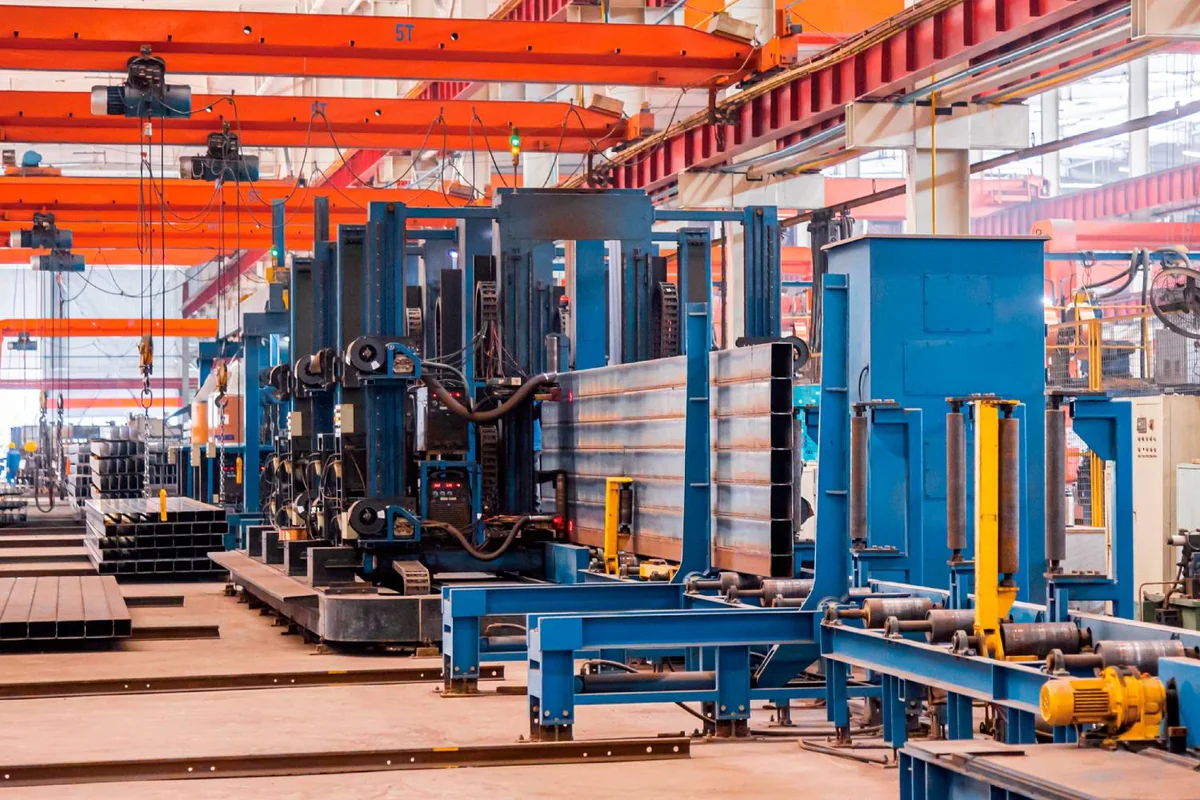
Permanent Steel Structure does not work this way. Our 300-mu manufacturing base operates on CAD-CAM intelligent production lines where design data flows directly from engineering models to CNC equipment. Every component is fabricated to engineering tolerance, not foreman interpretation. Ten proprietary manufacturing technologies — from CNC cutting to 3D spatial grid pre-assembly — ensure that what arrives on site fits what was designed.

Ten Technologies, Each Born from a Real Problem
Most factories list equipment models. We list the engineering problems each technology was deployed to solve — and the project where it proved itself.
Cutting & Drilling
CNC Cutting. The problem: Manual flame cutting produces dimensional drift of 3–5mm, causing mismatched plate connections during field assembly. How it works: Our CNC plasma and oxy-fuel cutting machines receive design data directly from CAD models through the CAM pipeline. Cutting paths are computed to ±0.5mm tolerance, with automatic nesting software that reduces plate waste by 12–18%. Proven on: The 229-meter clear-span coal storage facility — the world's longest single-span coal storage structure — where 4,200 unique plate components were cut to tolerance and assembled without field rework.
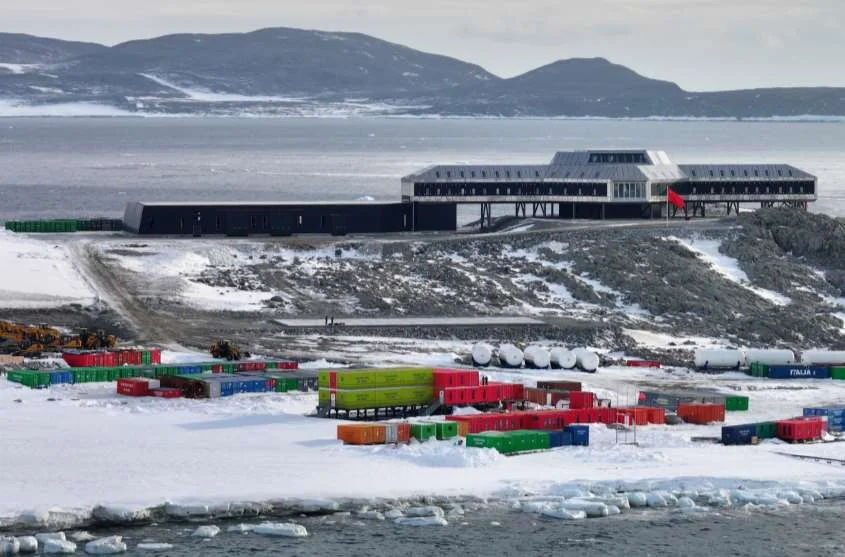
Precision Drilling. The problem: Bolt holes positioned by manual marking shift by 2–3mm, causing bolt-binding and connection failure under seismic load. How it works: CNC drilling centers position bolt holes to ±0.3mm, with CAM-generated drill schedules that match each hole to its counterpart in the mating member. Proven on: The Antarctica Ross Sea New Station, where every bolted connection had to align perfectly in −40°C conditions with zero possibility of field rework.
Welding
Robotic Welding. The problem: Manual welders produce inconsistent penetration, undercut, and slag inclusion — defects that may not surface until years of cyclic loading. How it works: Six-axis robotic welding arms execute programmed weld paths with full parameter control: current, voltage, travel speed, and wire feed rate. Every weld is logged and traceable to its robot program and operator. Proven on: High-rise steel columns for commercial towers in first-tier Chinese cities, where ultrasonic testing pass rates exceed 99.5%.
H-Beam Automatic Welding. The problem: Manual submerged-arc welding of H-beams causes angular distortion from uneven heat input, requiring costly mechanical straightening. How it works: Gantry-mounted automatic submerged-arc welding systems weld both flange-to-web junctions simultaneously, balancing heat input and holding distortion below L/1000. Proven on: Industrial workshop frames across our 3,000,000m² of annual construction, where dimensional consistency directly reduces erection time on site.
Box Column Welding. The problem: Box columns for super-tall buildings contain internal diaphragm plates whose welds are physically inaccessible to manual welders. How it works: Our process combines through-thickness electro-gas welding and multi-pass robotic welding with controlled pre-heat and interpass temperature, achieving full-penetration welds on internal diaphragms without access openings. Proven on: Super-tall building projects where box columns carry axial loads exceeding 8,000 tons per column.
Forming
Corrugated Web Beam Production. The problem: Conventional H-beams at depths over 1,000mm waste significant steel in the web, which carries only shear force. How it works: We cold-form corrugated webs from thin plate (3–6mm) and weld them to thick flanges, achieving equivalent shear capacity at 30–50% less web weight. The corrugated profile also improves buckling resistance without additional stiffeners. Proven on: Long-span roof structures for sports arenas and transit hubs, where reduced self-weight enables longer clear spans.
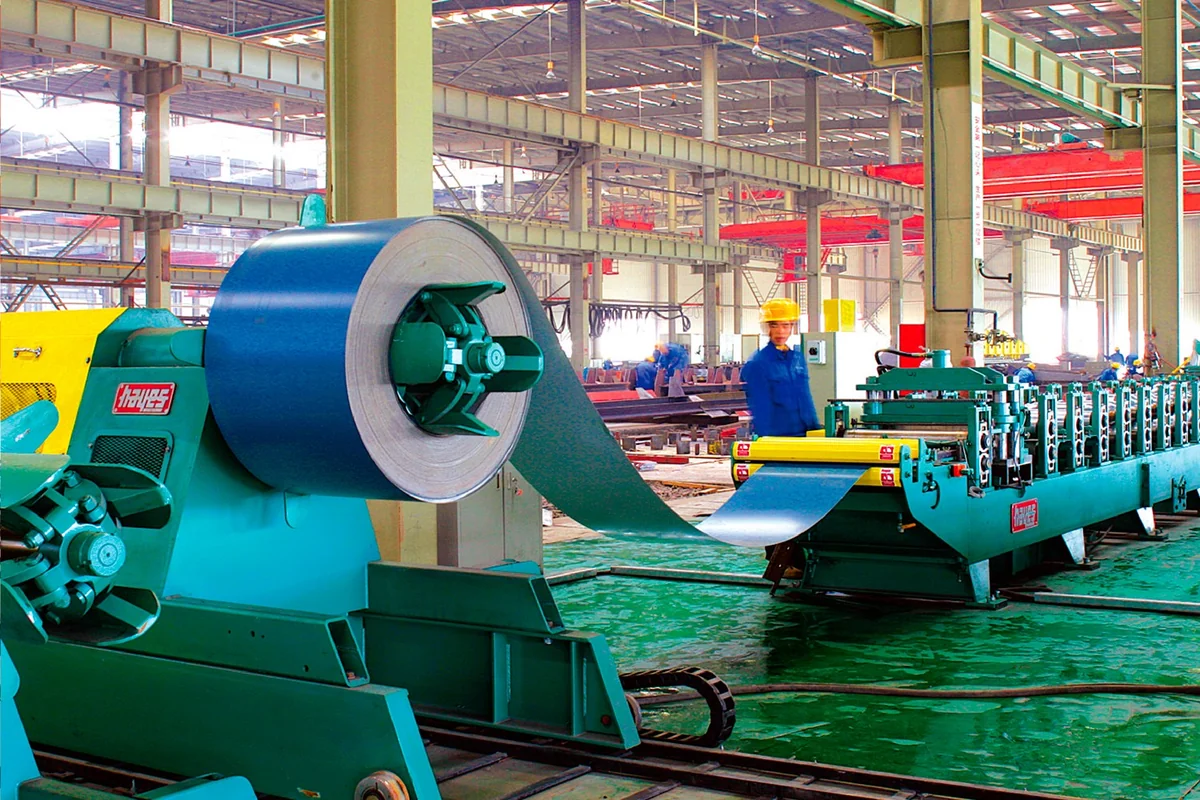
Sandwich Panel Continuous Production. The problem: Batch-produced sandwich panels suffer inconsistent core density, delamination at the skin-core interface, and thickness variation across the panel. How it works: Our continuous production line injects and cures polyurethane or mineral wool core between pre-coated steel facings in a single pass, controlling density, thickness, and bond strength to ISO standards. Proven on: Wall and roof enclosure systems for industrial projects, including export shipments to Pakistan and Indonesia.
Surface Treatment
Shot Blasting & Spray Painting. The problem: Steel structures in coastal, industrial, or extreme environments corrode when surface preparation is inadequate — a failure mode that is invisible at handover but catastrophic within years. How it works: Automated shot blasting to Sa 2.5 cleanliness (near-white metal) removes mill scale and oxidation, followed by multi-layer spray painting (epoxy primer, intermediate coat, and fluorocarbon topcoat) applied in climate-controlled spray booths. Dry film thickness is measured at multiple points per member and recorded against the member's QR code. Proven on: The Antarctica Ross Sea New Station, engineered for C5-M marine atmospheric corrosion, and Pakistan hydropower stations where anti-corrosion standards exceed domestic norms.
Assembly
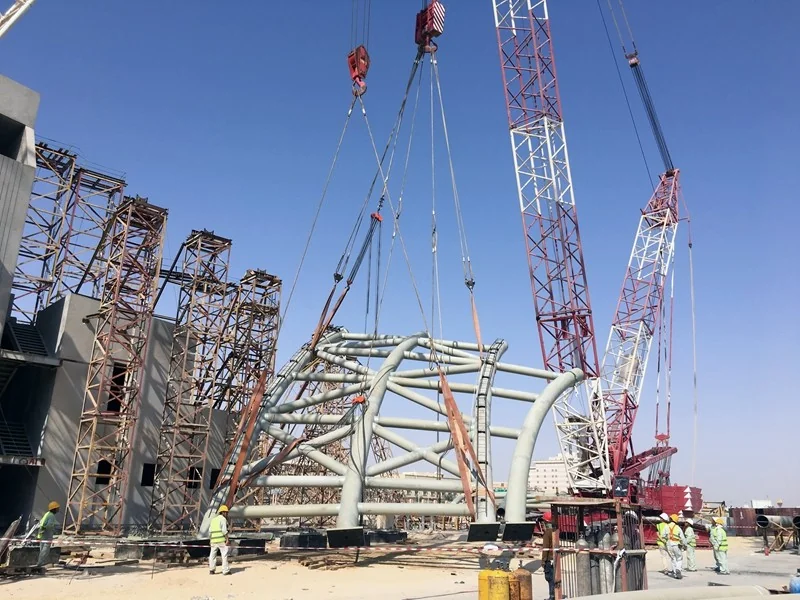
3D Spatial Grid Pre-Assembly. The problem: Three-dimensional grid structures comprise hundreds of intersecting members at compound angles. Field assembly of misfabricated components reveals errors when crane time is most expensive. How it works: Pre-assembly stations with 3D laser scanning verify node coordinates against the BIM model before shipping. Each grid module is trial-assembled, scanned, and corrected in the workshop — not on site. Proven on: Bolted-sphere grid structures for Guangzhou Baiyun Airport Terminal and the 229-meter coal storage span.
CAD-CAM Intelligent Production Lines: Design Data Flows Directly to CNC
In most Chinese steel structure factories, the gap between the design office and the workshop floor is bridged by a foreman with a tape measure. Engineering drawings are printed, interpreted, and translated into manual cutting and welding instructions. Each translation introduces error. By the time a component reaches site, dimensional drift has accumulated across every handoff — and the cost of correcting it is billed to your project.
Our CAD-CAM intelligent production system eliminates this gap. Design data — whether from Tekla, AutoCAD, or our proprietary spatial grid design software — flows directly into CNC equipment without human reinterpretation. A CAD model's geometry becomes a CNC machine's tool path. A bolt hole's coordinate in the design file becomes a drill bit's position on the member. No paper drawings, no interpretation, no drift.
This is why we state that we compete on engineering precision per millimeter, not price per ton. When a China OEM steel structure factory guarantees that every component arrives on site within engineering tolerance, the entire construction sequence accelerates: erection is faster, rework is minimal, and the structure's integrity matches the design intent. That is the difference between fabricating steel and engineering steel.
Three Layers of Verification Before Anything Leaves the Workshop
Quality control at Permanent Steel Structure is not a final inspection checkbox. It is embedded across the production process — material traceability from mill to member, in-process dimensional verification, and non-destructive testing on every structural weld.
Material Traceability
Every steel plate and section arrives with a mill test certificate and heat number. This heat number is tracked through cutting, drilling, welding, and painting, and recorded against the member's QR code. When a client requests documentation for a specific column or beam, we trace its steel from the mill melt to the finished component — not by batch, but by individual member.
Non-Destructive Testing (NDT)
Ultrasonic Testing
Internal weld defects detected by high-frequency sound wave reflection. Applied to all full-penetration welds on primary structural members.
Magnetic Particle Testing
Surface and near-surface cracks detected by magnetic flux leakage. Applied to weld toes and high-stress zones.
Radiographic Testing
Internal weld quality verified by X-ray imaging. Applied to critical joint welds requiring permanent radiographic record.
Dimensional Inspection
Dimensions are verified at three stages: after cutting (plate dimensions and hole positions), after welding (member straightness, cross-section, and length), and before shipping (full-member 3D scan for complex geometries). Tolerance compliance is recorded per member, not per batch.
50+ Engineers, 100+ Patents, Joint Lab with Shanghai Jiao Tong University
R&D Engineers
Patented Technologies
Publications & Standards
Steel structure manufacturing is not a static discipline. Codes evolve, materials advance, and building forms grow more complex. Our R&D investment — 50+ engineers, 100+ patents, and a joint research center with Shanghai Jiao Tong University's School of Naval Architecture, Ocean and Civil Engineering — ensures our engineering does not fall behind the structures our clients ask us to build. We have contributed to 30+ industry publications and co-authored national and industry standards for spatial grid structures, pipe trusses, and steel structure manufacturing.
Recognition includes the Luban Prize (China's highest construction quality award), the Steel Structure Gold Prize, National High-Tech Enterprise certification, and National Specialized "Little Giant" enterprise status — designations that confirm our engineering capability at the national level.
Discuss Your Steel Structure Project with Our Engineering Team
Whether you need custom steel structure fabrication in China or a complete turnkey project, our engineering team responds within 24 hours. Send us your drawings, specifications, or project requirements.
Contact Our Team