Bolted Sphere Grid Structures — Engineered for 100m+ Clear Spans
Most Chinese space frame manufacturers sell grid structures by weight. We hold the Special Grade — the highest national manufacturing qualification for bolted sphere grids — and engineer every node in 3D structural software before a single member is cut.
A Bolted Sphere Grid Is Not Just Steel and Bolts — It Is a Mathematical Structure
Most Chinese space frame manufacturers sell grid structures by the ton. You send a span requirement, they quote a steel weight, and the engineering discussion ends there. The grid is fabricated to generic drawings, welded on site where dimensions drift, and bolted without torque verification. If a member is overstressed, nobody finds out until it fails.
We hold the Special Grade — the highest national manufacturing qualification for bolted sphere grid structures in China, held by only a handful of companies. It means we are authorized to manufacture grids of any span, any complexity, for any structural application.
Our approach is fundamentally different: every node is engineered, every bolt is torqued to specification, and the entire grid is modeled in 3D structural software before a single member is cut. We built the world's longest 229m span beam-string coal shed. When you hold that record, your engineering speaks for itself.
What Is a Bolted Sphere Grid Structure?
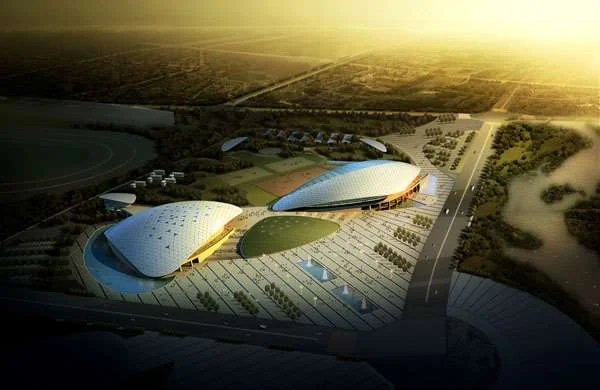
A spatial grid structure distributes loads through a network of steel tubes connected at nodes — not through individual beams carrying weight independently. The bolted sphere system is the most precise iteration of this principle.
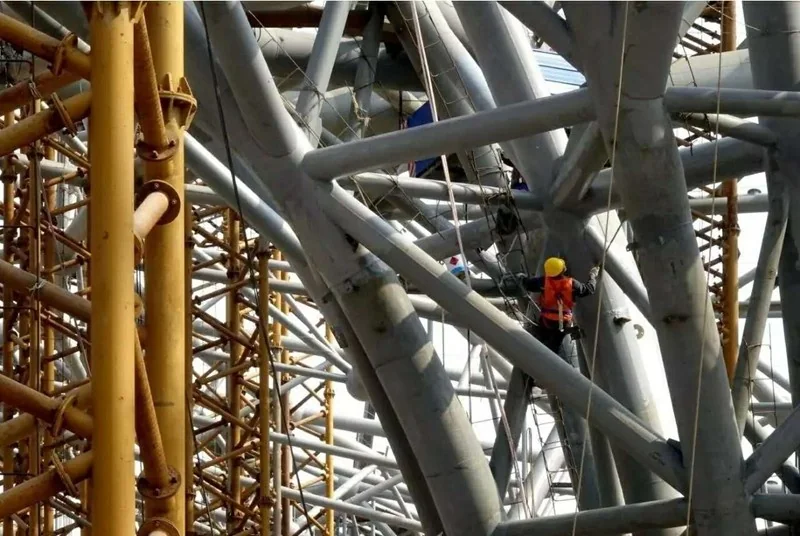
A bolted sphere grid (also called a bolted ball grid or space frame structure) consists of steel tubes connected at nodes via forged steel spheres with threaded bolt connections. Each sphere is drilled with threaded holes at precise angles calculated by structural software. Tubes are cut to exact lengths, fitted with conical sealing plates, and bolted into the sphere to form rigid, triangulated modules.
Unlike welded grid systems, every component is prefabricated off-site with CNC precision and assembled using torque-controlled bolted connections. No field welding. No dimensional drift. The grid goes together exactly as modeled.
Four Grid Types We Engineer
- Double-layer flat grid — the workhorse for rectangular roof spans, typically 30m to 90m
- Double-layer curved grid — cylindrical, spherical, or freeform curvature for domes and canopies
- Triple-layer grid — for spans exceeding 100m where depth-to-span ratios demand three chord layers
- Composite grid — grid combined with beam-string or cable-strut elements for record-breaking spans

Material Specification
- Steel tubes: Q355B / Q345B, precision-cut to design length
- Sphere nodes: 40Cr forged steel, CNC-drilled at engineered angles
- Bolts: 10.9S high-strength, torque-specified per node load
- Design codes: GB 50017, JGJ 7, AISC 360
Why a Bolted Sphere Grid Outperforms Conventional Steel Framing
The advantages are consequences of the structural geometry — consequences that hold true whether your span is 30 meters or 229.
Lightweight per Square Meter
A bolted sphere grid typically consumes 15–30 kg/m² of steel for a 50m clear span. A conventional steel beam roof of the same span would require 60–90 kg/m². The triangulated geometry distributes load across hundreds of short, slender members rather than a few heavy beams — reducing steel weight, foundation load, and transport cost simultaneously.
Structural Redundancy
A grid is statically indeterminate. If a single member fails — due to impact, corrosion, or defect — the load redistributes through adjacent members along multiple load paths. This is how spatial grids survive seismic events and extreme loading that would collapse a determinate truss.
Rapid Bolted Assembly
Every connection is bolted, not welded. Components arrive prefabricated to millimeter tolerance, labeled by node ID, and assembled like a three-dimensional kit. No field welding means no inspection delays, no weather-dependent curing, and no heat-affected zones. A 5,000m² grid roof can be erected in weeks, not months.
Architectural Flexibility
The node-and-tube system is geometry-agnostic. Flat grids, curved barrel vaults, full domes, freeform surfaces, skylight cutouts, cantilevered edges — the structural logic does not change. If your architect can model it, our engineers can analyze it and our CNC equipment can fabricate the spheres at the exact angles the geometry demands.
Where Bolted Sphere Grids Solve Real Engineering Problems
Each application is not just a use case — it is a set of structural challenges that bolted sphere grids are specifically engineered to address.
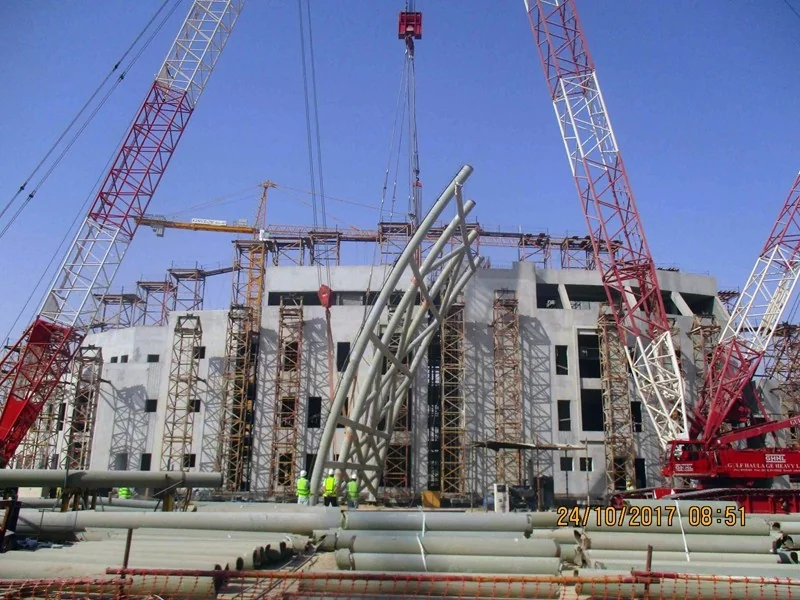
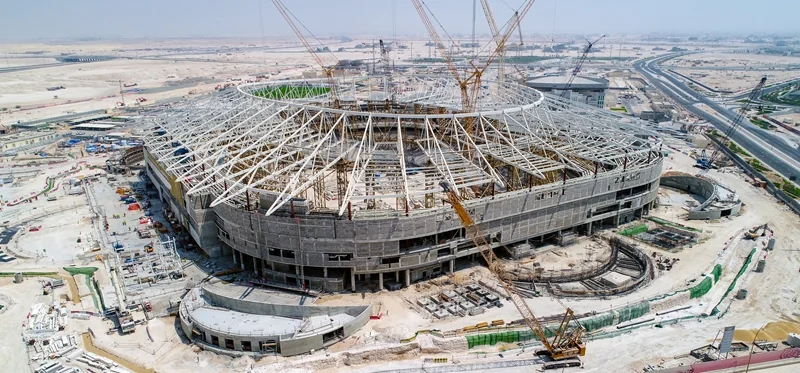
 Stadiums
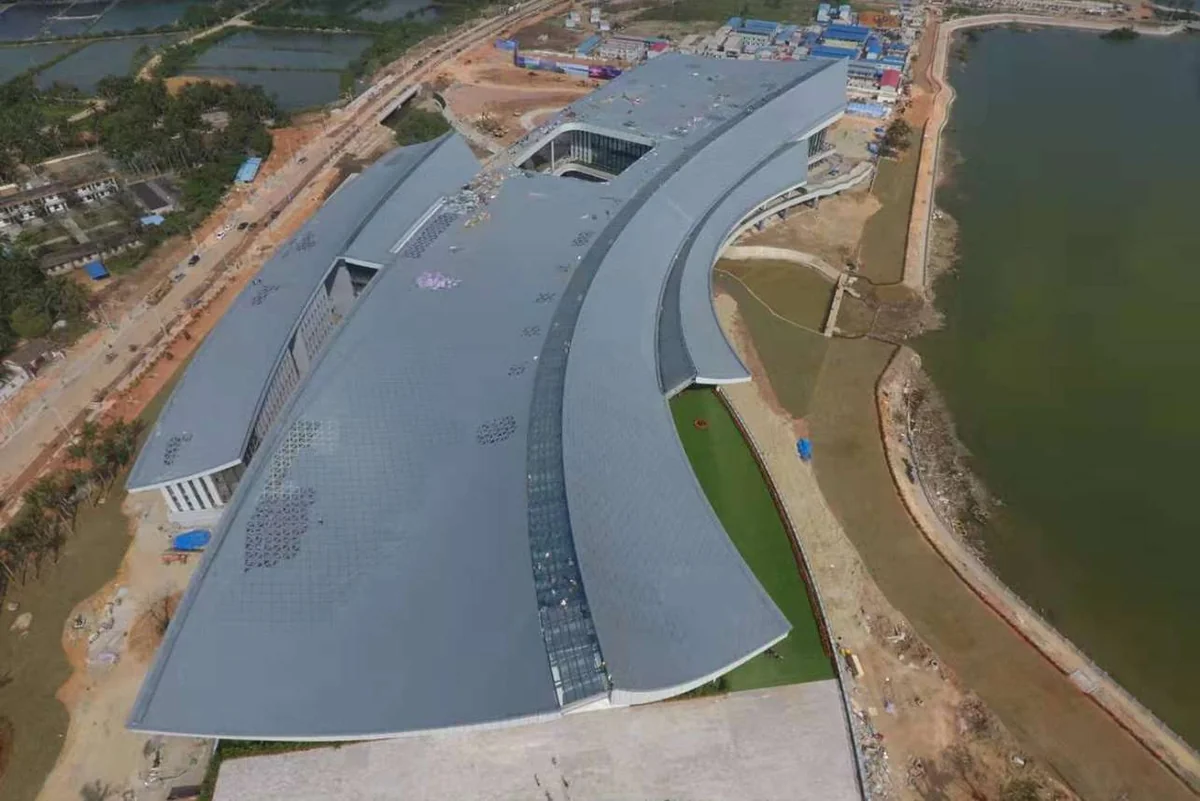
Stadium Roofs
Challenge: Column-free spans of 80–150m for unobstructed sightlines, seismic performance in active zones, and acoustic design that prevents roof drumming under wind gusts.
Solution: Double-layer and triple-layer grids provide the span depth-to-weight ratio that single-layer trusses cannot achieve. The inherent damping of a multi-member grid reduces dynamic response to wind and seismic loads. Skylight modules and acoustic panel hangers integrate directly into node positions without secondary framing.
 Coal Sheds
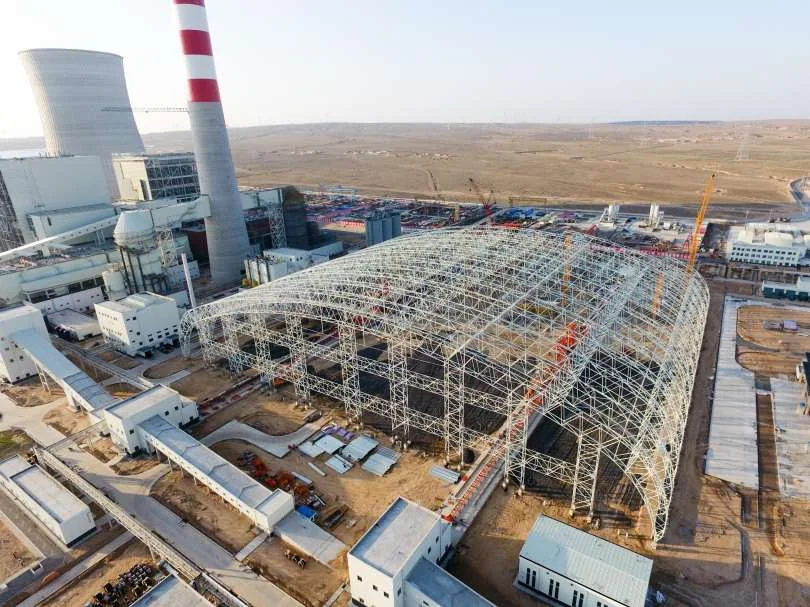
Coal Storage Sheds
Challenge: Spans exceeding 100m to eliminate interior columns that interfere with stacker-reclaimer machinery. The environment is corrosive — coal dust, sulfur compounds, and moisture attack unprotected steel.
Solution: Our world-record 229m span beam-string coal shed eliminated all interior columns. Bolted sphere connections are sealed with conical sealing plates and specified with heavy-duty anti-corrosion coating systems rated for C4-C5 environments. The bolted assembly allows periodic disassembly for inspection and recoating of individual members.
 Airport Terminals
Airport Terminal Canopies
Challenge: Aesthetic curved forms that define the terminal identity, integration of natural light through skylights and glazed seams, and wind load management on large cantilevered surfaces.
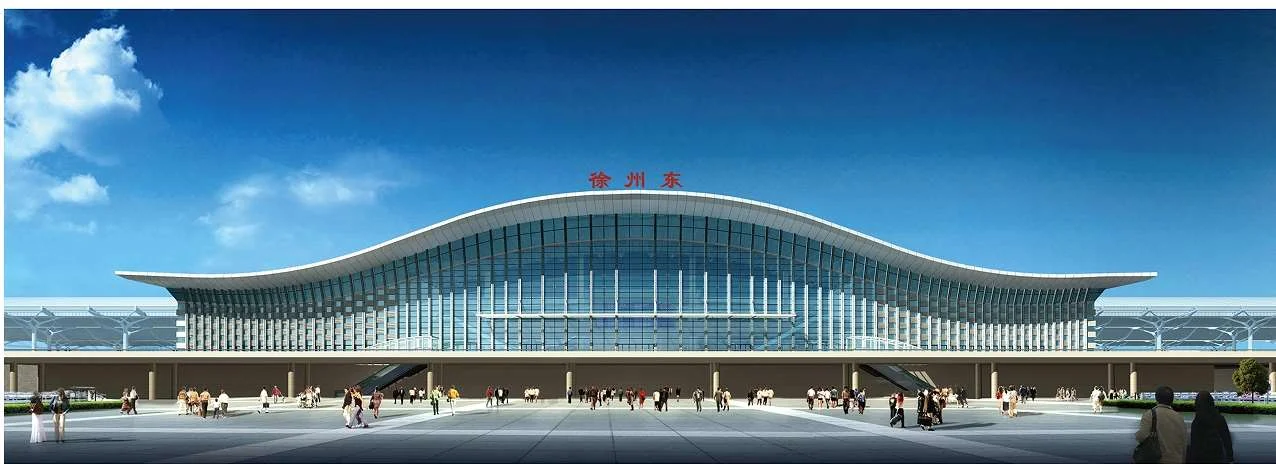
Solution: Double-layer curved grids follow any architect-defined curvature while maintaining uniform structural depth. CNC-drilled sphere angles accommodate freeform geometry precisely. Skylight frames mount directly to grid nodes, eliminating secondary structural members and preserving the architectural vision of lightness and transparency.
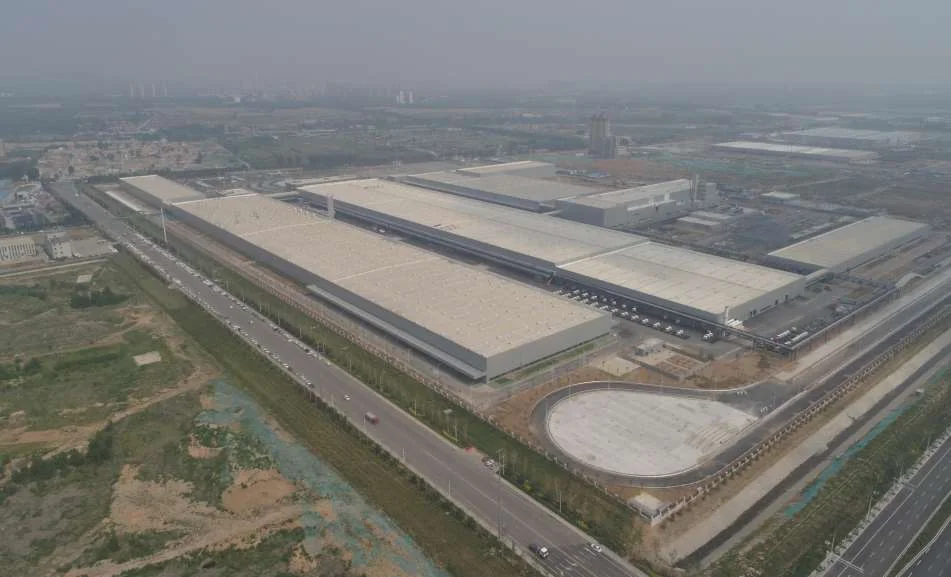
 Exhibition Halls
Challenge: Column-free floor space of 60–120m for maximum exhibition flexibility, integration of overhead rigging for lighting and signage, and skylight systems that balance daylighting with solar heat gain.
Solution: Flat double-layer grids deliver the clear span with bottom-chord nodes positioned for rigging attachment points. The lightweight steel consumption (typically 20–25 kg/m²) keeps the roof structure cost-competitive even at 100m+ spans. Modular grid geometry allows future expansion by extending the bay pattern without structural modification.
The Special Grade Qualification — What It Means for Your Project
In China's steel structure manufacturing system, qualifications are tiered. Special Grade is the highest level. It is not awarded for factory size or annual tonnage. It is awarded for demonstrated engineering capability, audited quality control systems, and a proven track record on complex structural projects.
For bolted sphere grid structures specifically, very few companies in China hold this grade. It certifies that we can manufacture grid structures of any span, any geometry, and any structural classification — without the project-size restrictions that lower-tier manufacturers face.
For your project, this means: no qualification ceilings on your span. No risk of a supplier who is licensed for 60m grids attempting a 120m grid for the first time on your dime. And an audited quality management system that covers every stage from sphere forging to final bolt torque verification.
Our 200,000-ton annual capacity and 3,000,000m² of completed construction per year are backed by a full-industry-chain setup. Scale matters, but the qualification behind it ensures every ton meets specifications.
World-Record Project: 229m Span Beam-String Coal Shed
The longest clear span of any beam-string coal shed structure in the world. Here is the engineering challenge and how we solved it.
The Challenge
The client required a coal storage facility with zero interior columns across a 229m span. Interior columns would block the stacker-reclaimer machinery that needs to traverse the full width of the shed. Conventional bolted sphere grids had been built up to 150m, but at 229m, the self-weight of a pure grid becomes structurally inefficient — the top chord would need to resist enormous compression, and the bottom chord would carry proportionally enormous tension.
Our Solution
We deployed a hybrid beam-string system: a bolted sphere grid for the top chord and upper web, paired with prestressed high-strength steel cables replacing the bottom chord. The cables put the grid into compression and the cables into pure tension — the ideal stress state for each material. Steel consumption dropped by approximately 30% compared to a conventional grid at the same span.
The entire structure was modeled in 3D structural software, load-tested against typhoon wind loads and seismic spectra, and assembled with real-time cable tension monitoring. No interior columns. No structural compromise. A world record that demonstrates what happens when you treat a spatial grid structure as a mathematical problem, not a commodity product.
Design & Manufacturing Process: From 3D Model to Torque Verification
Every bolted sphere grid we manufacture follows the same six-stage process. No stage is skipped. No stage is compressed for schedule.
-
1
3D Structural Modeling
Every node, member, and connection is modeled in spatial structural software. Load cases include dead load, live load, wind, snow, seismic, and temperature differential. Member forces are extracted for connection design. -
2
Structural Analysis & Optimization
Member sizes are optimized for steel consumption while maintaining code-compliant safety factors. Connection forces determine bolt diameter, sphere hole angles, and sealing plate specifications. -
3
CNC Sphere Drilling
40Cr forged steel spheres are CNC-drilled at the exact angles defined by the 3D model. Thread quality is verified per sphere. No two spheres in a curved grid are identical — each is drilled to its unique position in the structure. -
4
Tube Cutting & Sealing Plate Welding
Q355B steel tubes are cut to design length on automated cutting lines. Conical sealing plates are welded to tube ends with certified procedures and non-destructive testing verification. -
5
Bolt Tension Specification
10.9S high-strength bolts are specified with torque values calculated from the connection forces at each node. Every bolt has a documented torque target tied to its position ID in the grid. -
6
Site Assembly with Torque Verification
Components arrive on-site labeled by node ID. Trained crews assemble the grid using calibrated torque wrenches. Random bolt sampling verifies that field torque matches specification. The as-built grid geometry is surveyed against the 3D model before cladding installation.
Have a Large Span Project? Let Us Engineer It.
Send us your span requirement, loading conditions, or architectural concept. Our engineering team will respond within 24 hours with a feasibility assessment, preliminary grid layout, and budget quotation — backed by Special Grade manufacturing qualification and world-record span experience.
Specifying the connection first? See the full bolted & welded sphere node specifications — steel grade, capacities, tolerances (GB 50017 / JGJ 7) →
Email: market@permanentsteelstructure.com | WhatsApp: +86 18621689980 | Phone: +86 516-83269982