Buying Steel Structures From China: A Supplier Screening and Contract Guide
China fabricates more structural steel than any other country, and its export supply chain can deliver exceptional value — but the market is also where the widest quality spread exists. Between a steel structure that arrives pre-assembled, color-coded, and documented with full traceability, and one that arrives with wrong hole spacings and missing bolt sets, the only difference is the discipline of the supplier and the rigor of the buyer. Most procurement failures in this market are not caused by bad steel; they are caused by assumptions that were never written down.
This guide is written from the fabricator's side of the table to help buyers purchase intelligently. It covers the practical steps in order: screening real factories from trading companies, reading quotations clause by clause, running drawing review, setting quality hold points, choosing third-party inspection, negotiating payment milestones, and protecting yourself in the contract. It concludes with a request-for-quotation (RFQ) checklist you can send to any candidate supplier.
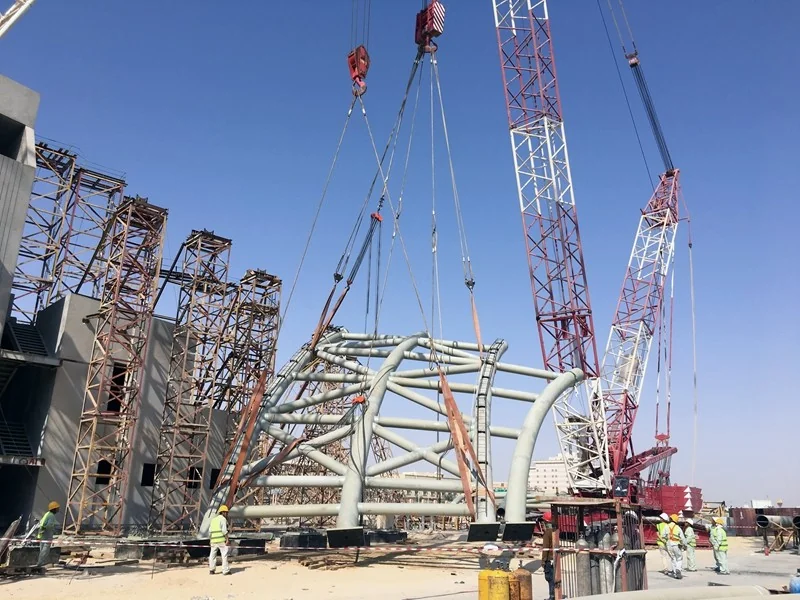
1. Real Factory or Trading Company? How to Verify
A trading company is not automatically a problem — many reliable trading houses manage quality well. The problem is buying at a factory price from an entity that has no factory. Three verification layers, in order of reliability:
- Verify manufacturing qualifications. In China, steel structure manufacturers hold a graded manufacturing qualification recognized under GB/T 50621 inspection practice and administered at provincial or national level. The qualification specifies a maximum tonnage and structural category the factory may manufacture. Ask for a scanned copy and verify the holder's name matches the factory's business license — not the trading company's. If the factory claims EN 1090 or other international certification, verify it with the issuing body's register.
- Visit or video-audit the workshop. A live video walk-through is a reasonable minimum before contracting. Look for: plate cutting and drilling lines, a welding shop with covered or indoor positions, a sandblasting or shot-blasting and coating line, and physical stock of steel rather than an empty yard. A factory's production schedule is visible in its work-in-progress; a trading office is not.
- Ask for welding and inspection evidence. Request welder qualification certificates (per GB/T 15169 or equivalent), NDT personnel certificates, a sample mill test certificate (MTC) set, and photographs of current NDT reports. A fabricator that cannot produce welder and inspector certifications for an export order is not a fabricator.
Cross-check on business-license databases (SAIC), and confirm the entity that invoices you is the entity that signed the contract. Asymmetry between the contract party and the factory owner is the first red flag in this market. For a reference on what manufacturing capability we operate, see our qualifications page.
2. Reading a Quotation: The Clauses That Bite
A Chinese steel structure quotation is a contract offer, and its wording decides who absorbs cost when assumptions fail. The clauses that matter most:
| Quotation clause | What to confirm | Typical risk if left vague | Best practice |
|---|---|---|---|
| Weight basis | Theoretical (drawing) vs actual (scale) weight | 5–10% invoice swing on tonnage-priced steel | State "theoretical weight per approved drawings, tolerance ±2%" |
| Currency and exchange | USD vs CNY basis; rebate date | Undefined FX assumption = renegotiation at shipment | Price in one currency; shift risk only by explicit clause |
| Tax treatment | VAT (13% in China) included or excluded; export rebate sharing | Quoted price suddenly "excludes tax" at invoicing | "NET export price including VAT and rebate arrangements" |
| Scope exclusions | Bolts, anchor bolts, touch-up paint, spare parts | Site stalls for missing anchor bolts or touch-up kits | Itemized scope list attached to quotation |
| Price validity | Steel price escalation clause | Quote honoured only if steel market is stable | Fixed price + defined escalation formula, or material-basis clause |
Two further points are specific to China's export market. First, rebates: exports of goods may receive a VAT rebate from Chinese customs, and whether that rebate stays with the seller or is shared with the buyer is a negotiation item — put it in writing. Second, "factory price" means ex-works: verify whether loading, packing per shipping standard, and port delivery are included, because these are frequently excluded by default.
3. Drawing Review: The Stage Where Projects Are Won or Lost
Drawing review is not the supplier's internal task; it is a contractual milestone the buyer must formally close. The process that protects both sides:
- Stage 1 — structural design basis: confirm the governing code (Eurocode, GB, or local), load cases (snow, wind, seismic, crane), and material grades (Q235/Q355 versus S235/S355 equivalence) before any shop drawing work.
- Stage 2 — shop drawings: the supplier issues fabrication and erection drawings. Review connection details (moment vs simple), splice locations (which affect transport and container loading), and hole patterns against the erection sequence.
- Stage 3 — material substitution approvals: suppliers may propose equivalent grades or section sizes. Any substitution needs the buyer's named engineer's written approval before fabrication starts — post-fabrication approvals are where quality disputes begin.
Time-box the review in the contract (a typical window is 14–21 days per stage) and state that exceeding it shifts the schedule. An un-reviewed shop drawing set is a license for the supplier to interpret, and the interpretation will favor fabrication speed over your site conditions.
4. Quality Hold Points During Fabrication
Inspection should be staged, not final. The four hold points that catch real defects, in production order:
- Raw material re-verification. Mills certificates (MTCs) must be matched to the physical plates and sections in stock (heat numbers traceable), with positive material identification (PMI) sampling for high-strength or low-temperature grades. This is the only point where a wrong steel grade can still be corrected cheaply.
- Welding process control. Verify the approved WPS is the one being used, welders hold current certifications for the position and process, and preheat/temperature records exist for cold-weather or thick-section work. Spot-check weld appearance against the acceptance standard (GB 50661 or AWS D1.1).
- NDT results. Full-penetration welds on primary members are subject to ultrasonic (UT) or radiographic (RT) testing per the spec; fillet welds to magnetic particle (MT) sampling. Require copies of signed NDT reports with defect locations marked on drawings before shipment.
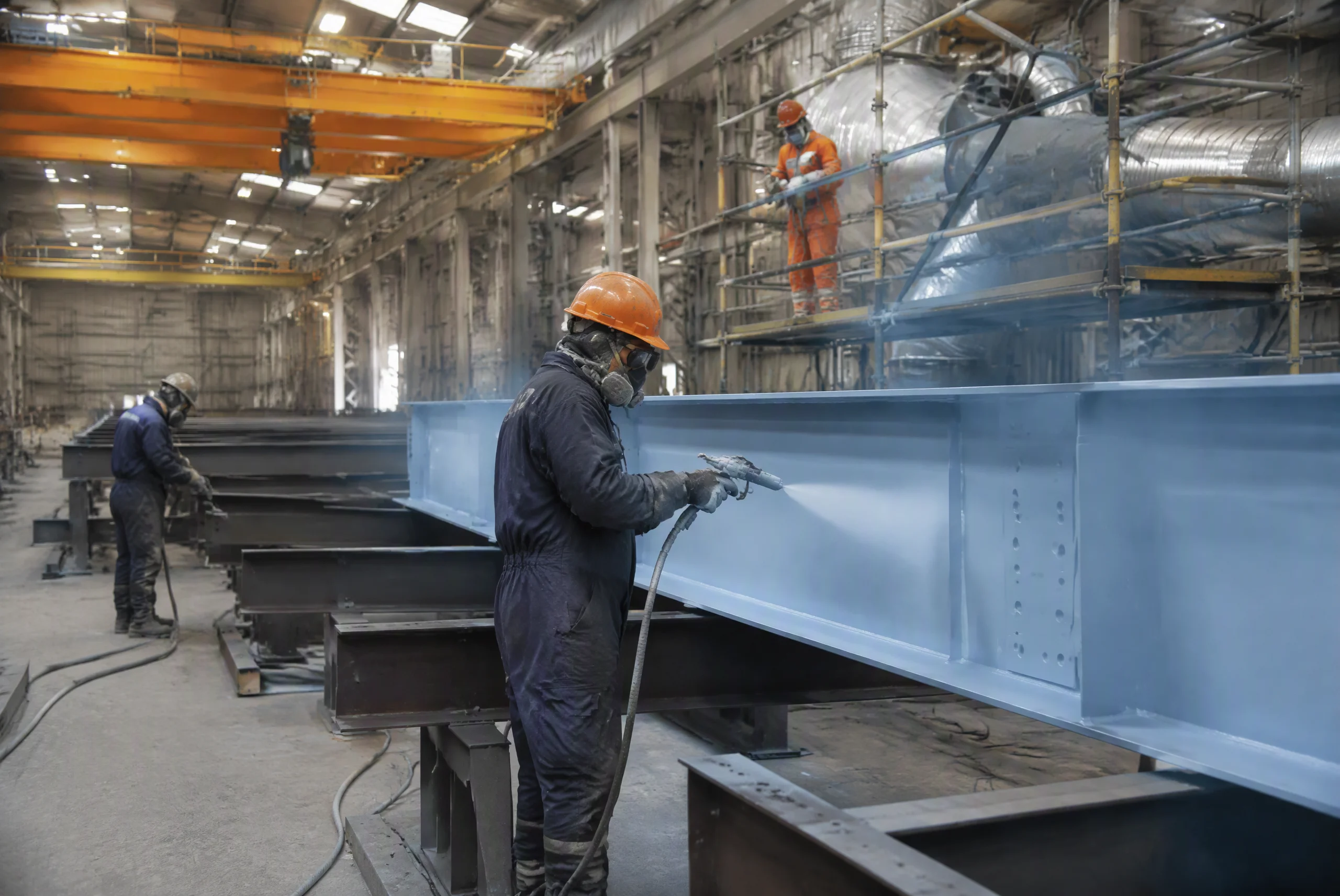
- Pre-assembly and coating. Require trial assembly (pre-assembly) of at least one representative bay or unit, with photos and dimensions recorded. Coating is verified by DFT measurement per ISO 12944 and adhesion tests; touch-up and damage repair is documented before packing.
Each hold point requires a formal release — a signed inspection report or gate approval — before production may proceed to the next stage. Without gated hold points, the "final inspection" that finds a defect is really a cost negotiation about rework, and the buyer always loses the schedule.
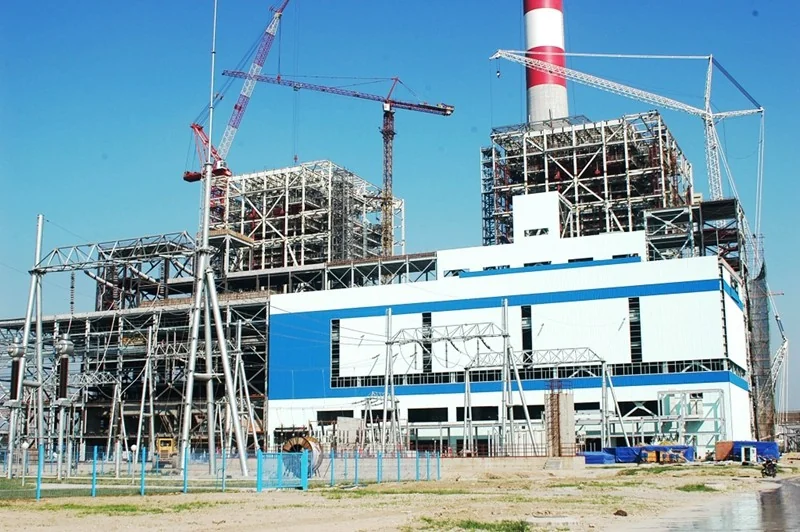
5. Third-Party Inspection: What It Does and Does Not Do
International inspection houses — SGS, Bureau Veritas, TÜV, Intertek, and others — offer factory inspection services in China, and a buyer's inspection clause is standard on export contracts. Know its limits:
- It verifies the sample and the documented evidence — dimensions against shop drawings, weld appearance on sampled joints, coating thickness on sampled areas, and packaging. It does not re-engineer your structure or guarantee fit on site.
- It only checks what the checklist asks it to check. The inspection scope should be written by you or your engineer, referencing the contract's code, NDT requirements, and tolerances — not left to the inspection company's generic template.
- Timing is everything. A single pre-shipment inspection is the weakest arrangement: defects found then are too late to fix without schedule loss. Staged inspections tied to the hold points above are worth the extra fee.
For many buyers, an independent engineer's office or the buyer's own project engineer performing staged inspections is more effective than a generic pre-shipment survey — it knows the design intent. Combine both if budget allows: your engineer defines the criteria; the inspection house executes the checklist.
6. Payment Terms and Contract Protection
Payment structure is where trust is formalized. The two standard patterns in the Chinese export steel market:
- Milestone TT: 30% advance (material procurement) → 30% on fabrication completion against signed inspection reports → 30% against shipping documents (B/L) → 10% on arrival or erection completion. Variants like 30/40/20/10 exist; the pattern matters more than the split — no single payment should exceed work actually done.
- LC-based: 30% TT advance + 70% irrevocable LC at sight against shipping documents. This is the standard for larger contracts and for buyers requiring document security; the LC terms must match the packing list, invoice, and B/L exactly.
Contract protections that are cheap to add and expensive to lack:
- Specification and drawings attached as annexes — the defined "as-built" basis, so any deviation is contractually identifiable.
- Liquidated damages for delay — a fixed rate per week (commonly 0.1–0.5% of contract value, capped at 5–10%) or the schedule claim is unprovable after the fact.
- Quality guarantee clause — typically 12–24 months from arrival or handover, with responsibilities for shipping damage clearly split at the Incoterms delivery point.
- Dispute resolution — arbitration under a named institution (e.g., CIETAC for Chinese suppliers), with the seat and language stated; court litigation across borders is rarely worth pursuing for mid-size disputes.
- Milestone-gated payments — tying each payment release to a signed inspection report rather than a calendar date.
7. Request-for-Quotation (RFQ) Checklist
Send the following to every candidate supplier. The quality of the response is itself the first screen — a supplier that answers every line supplies the same rigor to your structure.
| RFQ item | What to provide / ask | Why it matters | Red-flag response |
|---|---|---|---|
| 1. Building data | Drawings or dimensions, span, eave height, loads, site wind/snow | Defines the design basis for every quote line | "Send us your drawings and we will price" with no questions |
| 2. Code and certification | Governing code, required certs (EN 1090, ISO 9001), welder/NDT evidence | Determines design, inspection, and approval path | "We can do any code" without citing qualifications |
| 3. Price structure | Itemized: steel, fabrication, coating, bolts, packing, freight, Incoterms | Enables line-by-line comparison across suppliers | Single lump-sum "package price" only |
| 4. Weight and measurement | Theoretical vs actual weight basis; tolerance | Prevents 5–10% invoice drift on tonnage pricing | "We will invoice by actual weight" with no formula |
| 5. Schedule and milestones | Drawing review dates, fabrication start/end, inspection, shipment dates | Turns vague promises into contractual gates | "Delivery in 45 days" with no production plan |
| 6. Inspection regime | Proposed hold points, NDT levels, third-party access | Shows whether the factory is used to external scrutiny | "Inspection not necessary, our QC is enough" |
Key Takeaways
- Screen the factory, not the brochure. Manufacturing qualifications, a live workshop audit, and welder/NDT evidence separate fabricators from trading offices.
- A quotation is a contract offer. Weight basis, currency, tax, scope exclusions, and price validity must be written clauses, not assumptions.
- Drawing review is a contractual milestone — code, connections, and material substitutions all get written approval before steel is cut.
- Gate production with four hold points — material re-verification, welding process, NDT results, pre-assembly and coating — with signed releases at each.
- Payment mirrors work performed. 30% advance plus milestone-gated releases (or an LC at sight for the balance) protects both sides; add delay damages and named arbitration to the contract.
Buying steel structures from China is a solvable engineering and contract problem. If you would like a second set of eyes on a quotation, drawings, or an inspection plan, our export engineering team can review your documents and give you a structured assessment. Contact our export sales team or see why buyers work directly with our factory.
Buy Direct From a Factory That Understands Export Procurement
We quote with itemized scopes, milestone-based payments, gate inspections, and document sets designed for international projects. Send your drawings or an RFQ for a structured response within 24 hours.
Send Us Your RFQ