H-Shaped Trusses with Complex Joints — Where Two Structural Systems Meet
When a pipe truss must connect to a heavy structural steel frame — at the junction of two different structural systems — the connection joint becomes the most critical, most heavily loaded, and most fabricationally complex component in the entire structure. This complex joint fabrication is one of our 10 core manufacturing technologies.
Why H-Shaped Truss Joints Are the Hardest Fabrication Challenge
In a building that uses both pipe trusses (for long-span roofs) and heavy structural steel framing (for crane support, equipment mounting, or seismic resistance), the two systems must connect. That connection — where round pipe truss members meet rectangular steel frame members — is the H-shaped truss joint.
This joint is called "H-shaped" because in cross-section it resembles the letter H: two parallel pipe trusses (the vertical legs) connected by a horizontal structural steel beam (the crossbar), with the connection gusset plate or thickened chord wall forming the joint body. The forces converging at this joint are the heaviest in the structure: vertical loads from the truss, horizontal loads from the frame, and seismic forces from both directions simultaneously.
The fabrication challenge has three dimensions:
- Geometry: Round pipe meets rectangular plate at compound angles, requiring intersecting curve (contour) cutting that is unique for every joint
- Welding: Thick-plate joints (20–50mm) require multi-pass welding with preheat, interpass temperature control, and post-weld heat treatment for critical applications
- Inspection: 100% ultrasonic and radiographic testing of heavy-wall welds, with acceptance criteria that exceed standard structural welding requirements
This is why complex joint fabrication is one of our 10 core manufacturing technologies — it is the capability that determines whether a combined pipe-truss-plus-structural-steel project can be built at all.
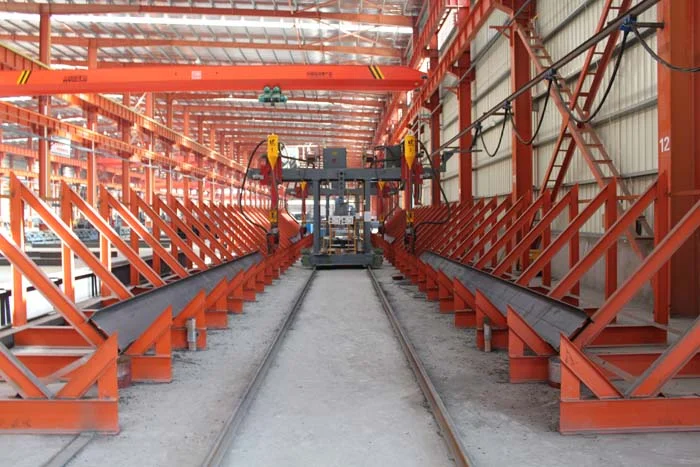
Complex Joint Types: K, TT, and Cross Joints
Each joint type is defined by the geometry of the web members meeting the chord at a single node. The geometry determines the force paths, the weld preparation, and the inspection requirements.
K-Joint
The K-joint is the most common joint in pipe trusses. Two web members approach the chord from the same side, forming a "K" shape. The gap (or overlap) between the two web member footprints on the chord surface is a critical design parameter — a gap joint distributes force through the chord wall, while an overlap joint transfers force directly between web members through the overlap weld.
For heavy-load K-joints in H-shaped trusses, the chord wall at the joint is often thickened by welding a reinforced gusset plate to the chord face before the web members are attached. This distributes the concentrated force from the two web members over a larger area of the chord, preventing local yielding of the chord wall.
TT-Joint
The TT-joint (also called a DT-joint) has two web members approaching the chord from opposite sides, forming a "T" on each side. This configuration is used when the truss requires web members on both sides of the chord — typically in space trusses or double-layer grids where the chord carries both tension and compression web forces.
The TT-joint's challenge is that the two web members pull or push the chord from opposite sides simultaneously. The chord wall must resist punching shear from both sides, and the welds on both sides must be full-penetration to transfer the balanced forces without chord wall failure.
Cross-Joint
The cross-joint has four web members meeting the chord: two from one side and two from the other, forming a cross pattern. This is the most complex joint geometry, used in space trusses with members converging from multiple directions, and in H-shaped trusses where the horizontal structural beam connects to the pipe truss chord at the same node as vertical web members.
Cross-joints require the most extensive intersecting curve cutting — up to four pipe-to-plate connections at different angles on a single chord surface. The weld preparation must accommodate all four connections without interference, and the welding sequence must be carefully planned to manage distortion and residual stress.
Gusset Plate Reinforcement
For joints where the concentrated force exceeds the chord wall capacity, we design and fabricate gusset plate reinforcement — thick steel plates welded to the chord surface at the joint location, extending beyond the web member footprints to distribute force. The gusset plate is full-penetration welded to the chord, and the web members are welded to the gusset plate rather than directly to the chord.
For the heaviest joints (power plant structures, hydropower stations), gusset plates may be 30–50mm thick, requiring submerged arc welding (SAW) with preheat temperatures of 100–150°C and controlled interpass temperatures. Post-weld heat treatment (PWHT) may be specified for joints in seismic-critical applications to relieve residual stresses.
Intersecting Curve CNC Cutting & Thick-Plate Welding
Intersecting Curve CNC Cutting
When a round pipe meets a flat plate (or another round pipe) at an angle, the intersection line is a complex 3D curve — the "intersecting curve" or "contour" that must be cut into the end of the pipe so it fits flush against the plate or pipe surface. This curve is different for every angle, every pipe diameter, and every wall thickness.
We cut intersecting curves on CNC plasma/pipe cutting machines that rotate the pipe while moving the cutting torch in a calculated path defined by the joint geometry. The machine software takes the joint angle, pipe diameter, and wall thickness as inputs and generates the cutting path automatically. Key parameters include:
- Bevel angle preparation (single-V, double-V, or compound bevel for full-penetration)
- Root face dimension (controls weld fit-up gap)
- Cutting tolerance (±0.5mm on contour profile)
- Multi-axis simultaneous motion (pipe rotation + torch X-Y-Z movement)
For cross-joints with four connections, the pipe must be cut at four different curves along its circumference — each curve defined by a different web member's angle. This requires a CNC machine capable of cutting in any rotational position, with software that manages all four curves in a single setup.
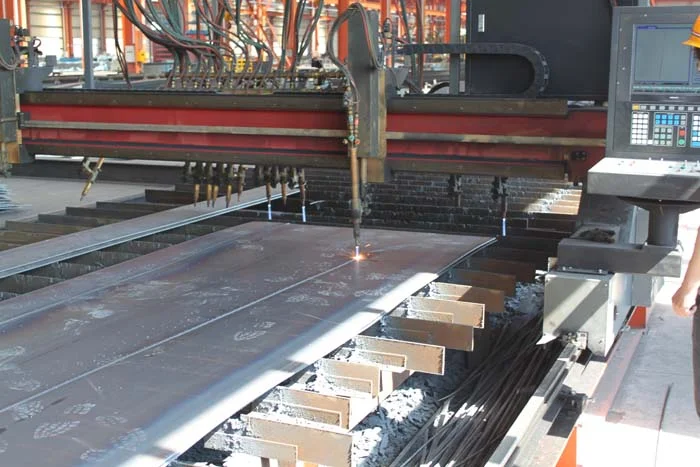
Thick-Plate Welding
Joint gusset plates in heavy-load H-shaped trusses are typically 20–50mm thick. Welding steel at this thickness requires:
- Preheat: 100–150°C for plates ≥ 25mm to prevent hydrogen-induced cracking
- Multi-pass welding: SAW or FCAW-G with 5–20 passes depending on thickness
- Interpass temperature control: Maintained at preheat temperature – 50°C throughout welding
- Welding sequence: Balanced deposition to control distortion — alternating sides and layers
- Post-weld heat treatment: Stress relief at 580–620°C for critical seismic joints (per project specification)
100% NDT: Ultrasonic & Radiographic Testing of Every Joint
In heavy-load H-shaped truss joints, a single weld defect can compromise the structural integrity of the entire connection. We do not sample-test these joints — we test 100%.
Ultrasonic Testing (UT)
Every full-penetration weld in H-shaped truss joints is 100% ultrasonic tested per GB/T 11345 (or AWS D1.1 on request). UT uses high-frequency sound waves to detect internal defects — porosity, slag inclusions, lack of fusion, and incomplete penetration — without destroying the weld.
For thick-plate joints (25mm+), we use phased array ultrasonic testing (PAUT) — an advanced UT technique that uses multiple angled beams to create a cross-sectional image of the weld, providing better defect characterization and sizing than conventional UT. PAUT is specified for seismic-critical joints where defect acceptance criteria are most stringent.
Acceptance criteria: Grade II per GB/T 11345 for standard structural joints; Grade I (stricter) for seismic-critical connections in zones with seismic intensity ≥ 8.
Radiographic Testing (RT)
For the most critical joints — typically those in power plant structures, hydropower stations, and seismic-critical connections — we supplement UT with radiographic testing (RT) per GB/T 3323. RT uses X-rays or gamma rays to create a permanent image of the weld's internal condition, providing a documented record that UT cannot.
RT is specified for:
- Joints in structures with seismic design intensity ≥ 8
- Butt welds in main chord members
- Gusset plate-to-chord welds in heavy-load connections
- Any joint where UT indicates a defect requiring further evaluation
Every NDT report is archived with the project quality records. Welds that fail NDT are ground out to sound metal, re-welded with qualified WPS, and re-tested until acceptance. No joint enters service without documented NDT clearance.
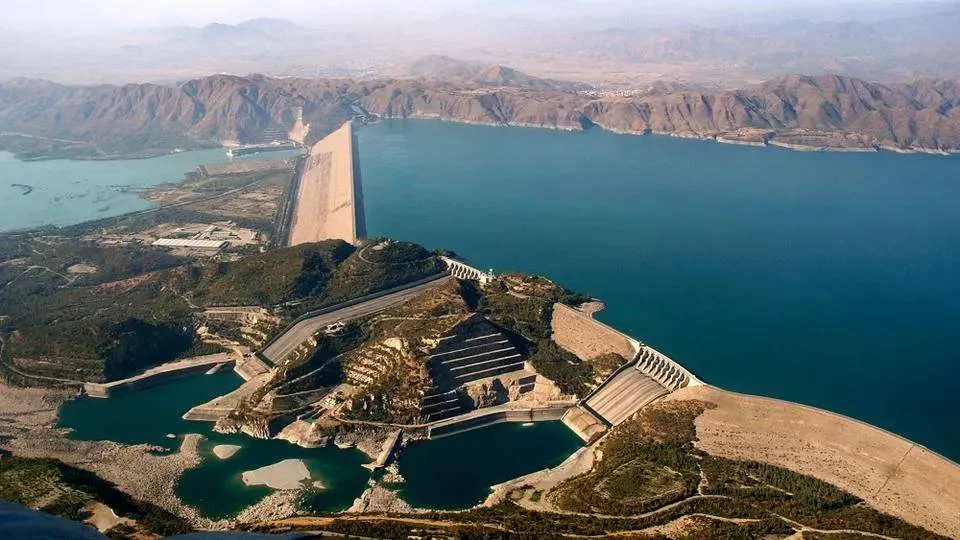
Pakistan Tarbela Hydropower Station
International hydropower infrastructure — demonstrating our complex joint fabrication capability on the global stage.
Project Overview
The Tarbela Dam on the Indus River in Pakistan is one of the world's largest earth-fill dams, and its hydropower station is a critical component of Pakistan's national power grid. Our involvement in the steel structure supply for the Tarbela Hydropower Station demonstrates that our complex joint fabrication technology meets international engineering standards — not just Chinese national standards.
Structural Requirements
Hydropower station steel structures must withstand:
- Dynamic loading from turbine operation and water flow pulsation
- Seismic loading (the dam is in a seismically active region)
- Corrosive environment (high humidity, water exposure)
- Stringent international quality and inspection standards
Our Fabrication
The H-shaped truss joints for this project required thick-plate gusset reinforcement, full-penetration SAW welding with preheat and interpass control, and 100% UT + RT inspection per international standards. Every joint was documented with welding procedure records (WPR), NDT reports, and material certificates — meeting the documentation requirements of international infrastructure projects.
Where H-Shaped Trusses with Complex Joints Are Required
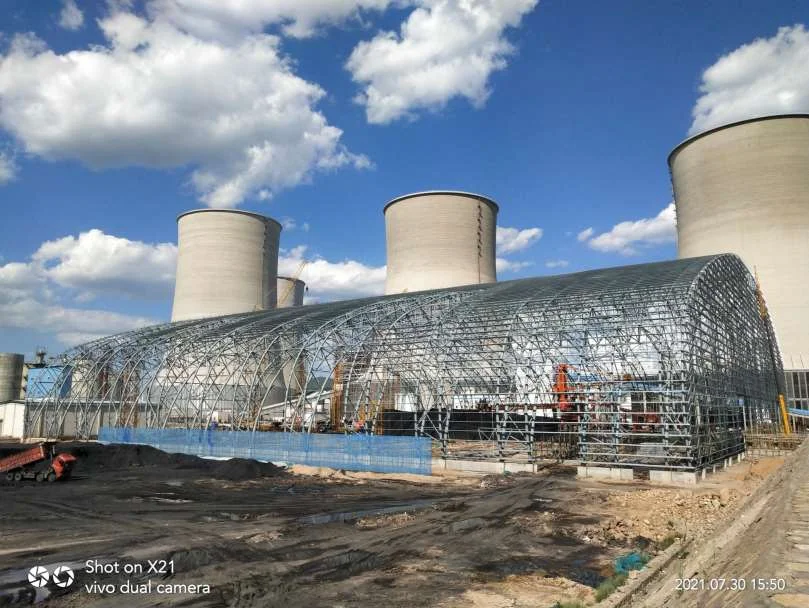 Power Plants
Power Plant Structures
Thermal power plants require steel structures that support heavy equipment (boilers, turbines, precipitators) while providing long-span roof coverage. The junction between equipment-support framing and roof trusses is the classic H-shaped truss joint application — heavy loads, dynamic forces, and zero tolerance for joint failure.
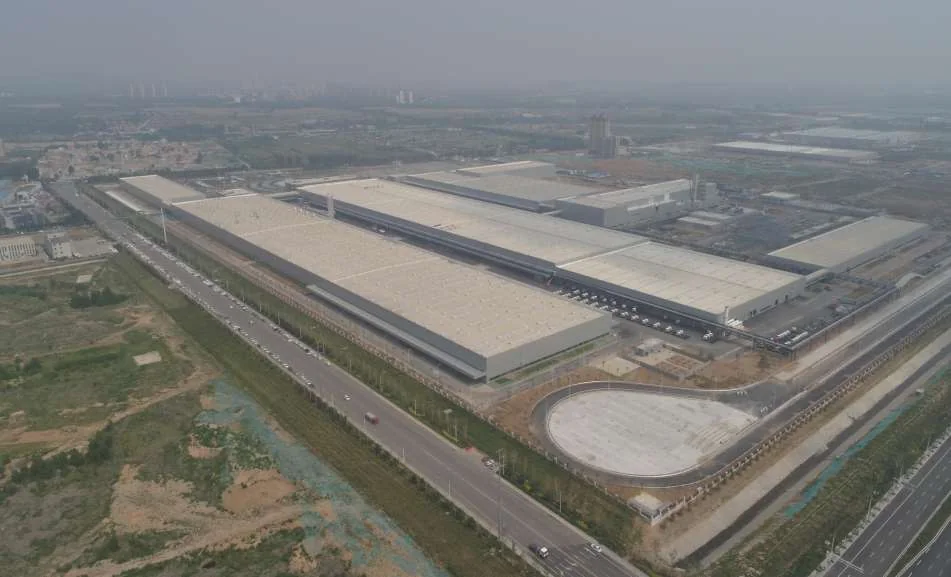 Heavy Industrial
 Buildings
Steel mills, cement plants, and heavy machinery assembly workshops use overhead cranes that impose concentrated moving loads on the building frame. The connection between the crane-runway beam and the roof truss is an H-shaped joint — designed for fatigue under cyclic crane loading, not just static strength.
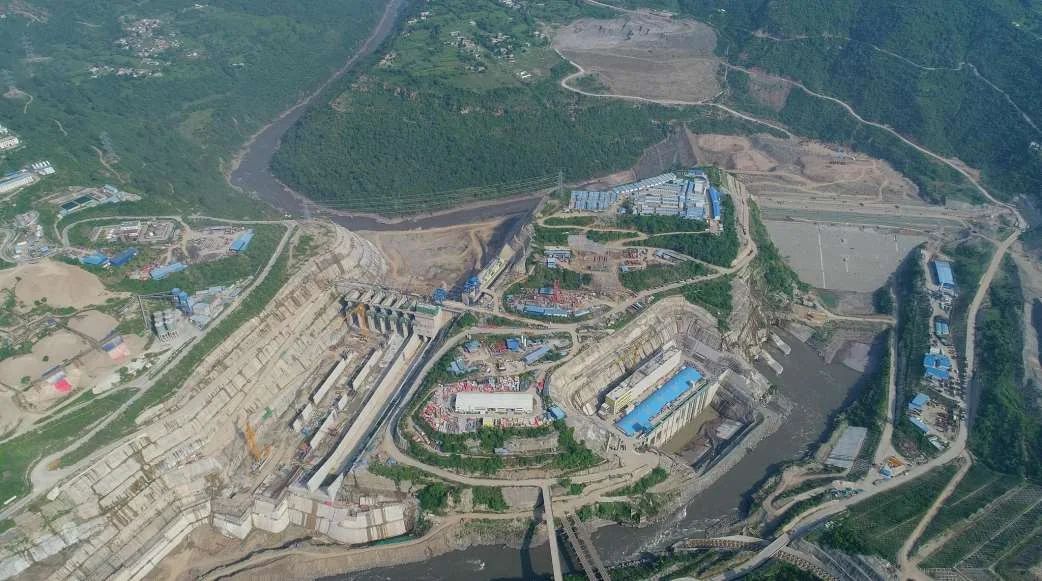 Hydropower
 & Infrastructure
Hydropower stations, pump stations, and water treatment plants require steel structures that resist dynamic loading from water flow and equipment vibration, in corrosive environments, to international quality standards. Our Tarbela project demonstrates our capability to deliver complex joint fabrication for international infrastructure clients.
H-Shaped Truss System Specifications
| Parameter | Light Industrial | Power Plant | Hydropower |
|---|---|---|---|
| Chord pipe | Φ114–180mm | Φ180–325mm | Φ219–402mm |
| Wall thickness | 4–8mm | 8–16mm | 12–25mm |
| Gusset plate | 12–20mm | 20–35mm | 30–50mm |
| Steel grade | Q235B/Q355B | Q355B | Q355B/Q390B |
| Joint type | K, T | K, TT, Cross | K, TT, Cross + gusset |
| Welding process | GMAW | GMAW/SAW | SAW + PAUT |
| Preheat | None (<25mm) | 100–120°C | 120–150°C |
| NDT | UT 100% Gr.II | UT 100% Gr.II + RT 10% | UT 100% Gr.I + RT 20% |
Design Standards, Codes & Quality Control
Design Standards
H-shaped trusses with complex joints are designed to the following Chinese national standards and industry codes:
- GB 50017 — Standard for design of steel structures (member design, stability, joint design)
- GB 50205 — Standard for acceptance of construction quality of steel structures (fabrication tolerance, NDT acceptance)
- GB 50661 — Code for welding of steel structures (WPS qualification, welder certification, preheat requirements)
- GB/T 11345 — Non-destructive testing of welded joints — Ultrasonic testing (acceptance criteria and procedures)
- GB/T 3323 — Non-destructive testing — Radiographic testing of welded joints (for critical joints)
- GB 50011 — Code for seismic design of buildings (seismic detailing for complex joints)
- GB/T 1591 — Low-alloy high-strength structural steels (Q355B/Q390B material specification)
- GB/T 8162 — Seamless steel tubes for structural purposes (chord and web member material)
- GB 50661 Annex A — Welding procedure qualification (WPQR) requirements for thick-plate joints
For international projects (such as the Pakistan Tarbela Hydropower Station), we also comply with ANSI/AWS D1.1 (Structural Welding Code — Steel) and EN 1090 (Execution of steel structures) as specified by the client's design code.
Quality Control System
Every H-shaped truss with complex joints is manufactured under our ISO 9001 quality management system, with the following control points:
- Material certification: Every steel pipe and plate arrives with mill test certificates (yield, tensile, elongation, chemical composition); certificates are cross-referenced to heat numbers on material
- Joint geometry verification: Intersecting curve cut profile checked against design model using template gauge; angle accuracy within ±0.5°; root gap 3–5mm verified at four positions around the joint
- WPS compliance: Each joint welded per its qualified Welding Procedure Specification; preheat temperature verified with contact pyrometer before first pass; interpass temperature maintained per WPS
- Welder qualification: Every welder holds GB 50661 certification for the position, process, and thickness range being welded; certification records archived per project
- NDT execution: UT performed by Level II+ technicians per GB/T 11345; RT (where specified) performed by certified radiographic inspectors; NDT reports archived with weld maps
- Defect management: Welds failing NDT are marked, ground to sound metal, re-welded with WPS, and re-tested; no joint enters service without documented NDT clearance
- Final inspection: Overall truss geometry verified against design (length, camber, squareness); surface preparation and coating inspected; lifting points verified
- Traceability: Every joint marked with a unique ID linking to its WPS, welder, NDT report, and material certificate — full quality record retrievable by QR code
Why Permanent Steel for Complex Joint Fabrication
Complex joint fabrication is one of our 10 core manufacturing technologies. The Pakistan Tarbela Hydropower Station project demonstrated that our complex joint capability meets international engineering standards — not just Chinese national standards. Every joint was documented with welding procedure records, NDT reports, and material certificates meeting the documentation requirements of international infrastructure clients.
Our 50+ R&D engineers perform joint design per GB 50017 and GB 50661, including FEM analysis of stress concentration at complex intersections, weld sizing for combined axial, shear, and moment loads, and fatigue assessment for dynamically loaded joints (crane structures, turbine support frames).
Integrated NDT Capability
- 100% UT on every full-penetration joint weld per GB/T 11345
- PAUT (phased array ultrasonic) for thick-plate joints in seismic-critical structures
- RT (radiographic) for power plant, hydropower, and seismic-critical connections
- In-house NDT team — Level II+ certified technicians, not subcontracted
- Full traceability — every joint has a QR code linking to WPS, welder, NDT report, and material certificate
- 6 top-level qualifications covering steel structure design, manufacturing, and construction supervision
- 100+ patents in complex joint design, welding processes, and advanced fabrication technology
- 200,000 tons annual capacity with dedicated thick-plate welding stations and heavy-lift capability
- International delivery with full documentation: WPS, PQR, WPQR, NDT reports, and mill certificates per project
With 6 top-level qualifications, 200,000 tons of annual capacity, and proven international project delivery, Permanent Steel is the fabricator that makes combined pipe-truss-plus-structural-steel projects buildable. Contact our engineering team today to discuss your project specifications and complex joint fabrication requirements.
Have a Project with Complex Structural Joints?
If your project involves the intersection of pipe truss and structural steel framing — power plants, hydropower stations, heavy industrial buildings — our complex joint fabrication technology is the capability that makes it buildable. Send us your structural drawings for a fabrication feasibility assessment and quotation.
Email: market@permanentsteelstructure.com | WhatsApp: +86 18621689980 | Phone: +86 516-83269982