Steel Structure Projects in Europe — Eurocode Rigour, Delivered From China
Europe is the world's most demanding steel structure market — not because its spans are the longest, but because its rules are the strictest. EN 1090-2 execution classes, Eurocode 3 design and fatigue checks, CE marking of structural products under the Construction Products Regulation, and a supply chain that tests every claim against a designer's specification. Our European delivery — including the Frankfurt Air-Rail Center project — is the blueprint for how a Chinese fabricator earns a place in this market: design to the European codes, fabricate to the execution class, document everything, and never ask the client to lower a standard.
Five Rules That Govern Steel Delivered to Europe
1. EN 1090-2 is a manufacturing law, not a suggestion. Every structural member delivered to Europe carries an execution class (EXC2-EXC4) set by the designer, and that class drives weld quality levels, tolerances, inspection frequencies and the competence of personnel. EXC3 and EXC4 demand qualified welding procedures and welders (ISO 9606 / ISO 15614), a defined inspection plan, and traceability from mill certificate to final inspection. Our shop is set up to fabricate to EXC3 as standard and EXC4 on members where the fatigue or consequence class requires it — the same member, the same line, simply with the higher inspection regime applied.
2. Fatigue is a design requirement wherever trains, cranes or dynamic loads meet steel. European infrastructure — rail concourses, station canopies, airport piers, crane runways — is analysed for fatigue under EN 1993-1-9, with detail categories selected from the catalogue and damage accumulated over the design life. This changes fabrication: weld details are ground or dressed to reach the required detail category, bolt holes are drilled or reamed rather than punched where fatigue governs, and load-bearing splices are located outside the highest stress zones. The Frankfurt Air-Rail project demonstrates this discipline — a structure shared by high-speed rail and aviation traffic, where every detail category and every weld line was engineered for millions of load cycles.
3. CE marking makes the product, not just the building, accountable. Under the Construction Products Regulation, structural steel components supplied to the EU carry CE marking to the harmonised standard EN 1090-1, with the factory production control (FPC) assessed by a notified body. For non-EU fabricators this means an equivalent FPC assessment and a declaration of performance that a European client can verify. Our quality system is structured around this requirement from the outset — test certificates, weld records and mill certificates are not retro-filed, they are produced as the member is manufactured.
4. The specification is the contract. European designers write detailed specifications — steel grades (S235-S460), material toughness at design temperature, execution class, corrosion protection to EN ISO 12944, tolerances to EN 1090-2. Our engineering review reads the specification as a contractual document, flags any ambiguity before fabrication, and delivers the member exactly to the sheet. Where a minor deviation is genuinely unavoidable, the client is consulted in writing — never surprised at site handover.
5. Documentation is a deliverable, weighted alongside the steel. A European project's documentation set — design calculations, fabrication drawings, weld maps, NDT reports, coating thickness records, inspection certificates — is checked by the designer, the client and often a third-party inspector. We ship the documentation as a complete, numbered package that mirrors the sequence of manufacture, so a client's inspector can audit any member from drawing to mill certificate in minutes. It is this auditability, as much as the welding, that lets a Chinese fabricator repeat business in Europe.
Europe is not a market you enter with price alone. It is a market you enter with the EN 1090-2 certificate, the ISO 3834 weld qualifications, the fatigue calculations and the discipline to deliver exactly what the specification says.
European Projects & Deliveries
 Transportation
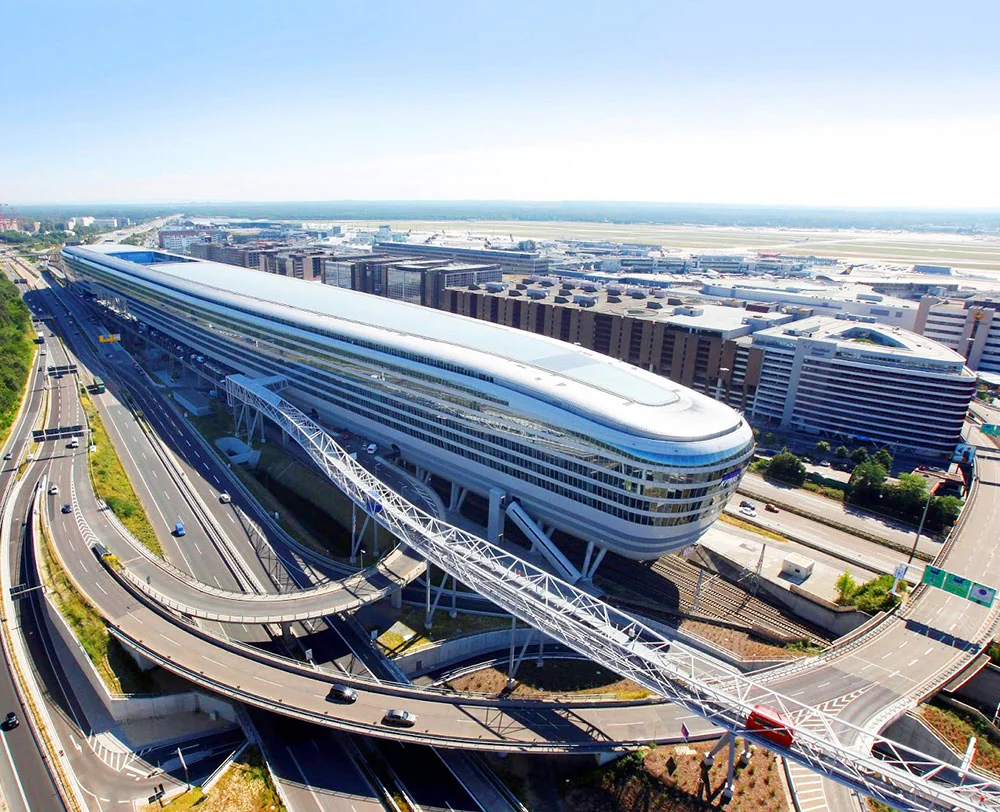
Frankfurt Air-Rail Center
Type: Air-rail interchange structural steel | Standard: EN 1090-2, Eurocode fatigue
An interchange facility where aviation and high-speed rail share one structure — a case study in European execution standards. Every member was fabricated to the execution class of the design, with weld details engineered for the fatigue demand of rail traffic beneath the airfield. The project stands as our reference for Eurocode-based design, EN 1090-2 fabrication discipline and the documentation standard Europe's inspectors expect.
What a European Client Receives From Us
The European client's question is rarely "can you fabricate steel." It is "can you fabricate to my execution class, prove it, and fit my programme." Our answer is the export package built for the European market:
- Execution-class manufacturing: EN 1090-2 EXC3 standard, EXC4 where the design requires, with the FPC regime of EN 1090-1 adhered to in spirit and in records.
- Eurocode engineering: design and detailing to EN 1993-1-1 / 1-8 / 1-9 (fatigue included), with the designer's calculation or our own as the project requires.
- Fatigue-aware detailing: detail categories selected and weld dressing planned in the shop so the member arrives at the site already able to meet its fatigue class.
- CE-aligned quality system: ISO 3834-2 welding, ISO 9606/ISO 15614-qualified welders and procedures, ISO 17640 UT, full traceability from mill certificate to member.
- Complete documentation package: numbered, sequence-matched documentation that mirrors manufacture — audit-ready from the first meeting.
Send us the designer's specification and execution class, and we respond with a fabrication proposal the specification can be checked against — not around.
Planning Steel Structures in Europe?
Send the designer's specification, execution class and programme. We respond with a fabrication proposal, an EN 1090-2 compliance statement and the audit-ready documentation this market requires.
Email: market@permanentsteelstructure.com | WhatsApp: +86 18621689980 | Phone: +86 516-83269982