
Steel Bridges & Infrastructure — Long-Span Structures Over Water, Roads & Rail
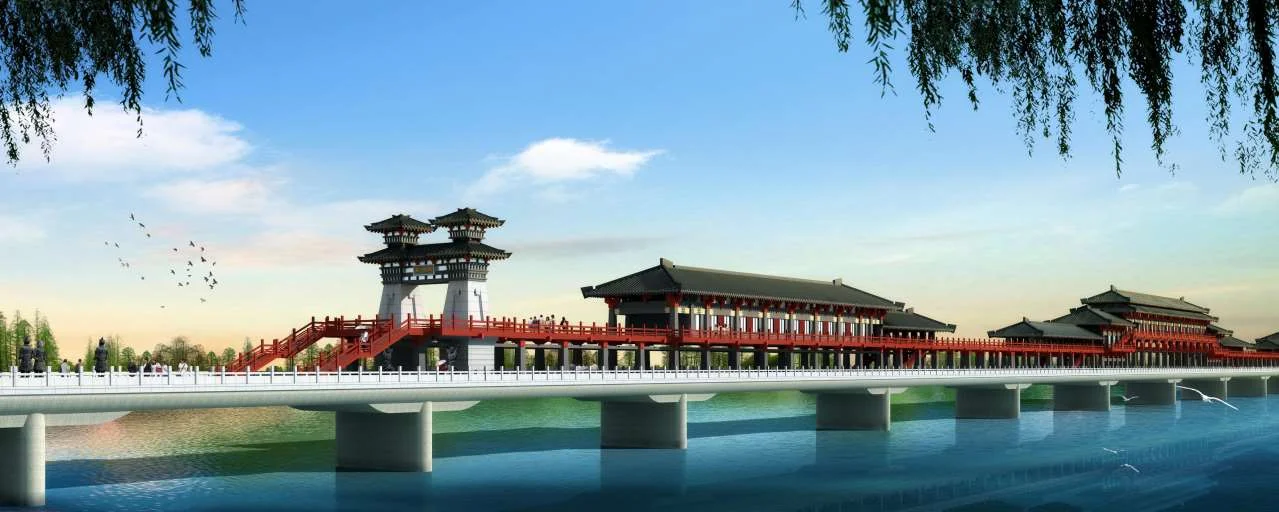
A bridge is the one steel structure the public photographs, the one whose failure is unacceptable, and the one that must carry live loads larger than any building floor. It is also the structure where fabrication precision meets its most public test: a 748 m covered bridge spans a city river with members that were cut and welded hundreds of kilometres away, then erected to a closure measured in millimetres. That is the discipline of steel bridge engineering — and it is our Australian, Middle Eastern and African clients' reason for trusting us with their crossings.
What Bridges Demand Beyond Building Engineering
The design loads, the fatigue, the fabrication tolerances, and the erection sequence of a bridge are a separate discipline — with numbers of a different order of magnitude.
Live loads rule bridge design. A road bridge carries traffic live loads of 0.6-1.8 kN/m² per lane (GB 50917-2014 standard vehicle, EN 1991-2 Load Model 1, or AASHTO HL-93), but the governing case is the notional 300-600 kN vehicle or the 25-40 tonne axle that produces concentrated effects. A rail bridge adds a 22.5 tonne axle at 1.5 m spacing (GB standard) or 25 tonne (UIC 71), multiplied by a dynamic amplification of 1.1-1.5 depending on speed. These loads sit on a deck whose own weight is 10-30% of the total — so the steel is tuned to be light where the operator wants speed of erection, and robust where the lower chord crosses a highway.
Fatigue is the bridge engineer's constant. While buildings are checked for 2 million wind cycles, a road bridge's welded details are verified for 10-20 million cycles of traffic amplitude (EN 1993-2 with detail categories 36-112 MPa at 2 million cycles), and rail bridges for 50-100 million cycles. The result changes the details: full-penetration welds instead of fillets at splice plates, no sharp cut-outs in gussets, and a relentless minimum-detail-category floor that excludes the cheap tricks used in buildings.
Tolerances of ±2 mm, not ±20 mm. A building frame closes at ±20 mm; a bridge deck that spans a highway closes at ±2-5 mm, because the deck joint, the bearing and the expansion joint must all work at that precision or they wear out — or fail. Our fabrication line for bridges holds member-to-member tolerances of ±1 mm at the bolted splices and ±2 mm overall section depth, with full-size lofts and trial assemblies for every pier segment before shipment.
Erection without falsework over live rivers and roads. A bridge is usually installed without temporary supports beneath it — over a navigable river, a live highway or a rail line. The erection sequence (cantilever, cable-stayed segmental, incremental launching, or full-span lift) is designed so the structure is self-supporting at every intermediate stage, with the erection stresses verified in the design office against the same codes as the final bridge. Our portfolio's 748 m covered bridge was closed with a 24-hour cantilever sequence over the Wei River at Xianyang; every stage was modelled before a single member left the factory.
Corrosion is a life-cycle decision. Bridge steel lives in the atmosphere that attacks it: de-icing salts on the deck, salt spray over tidal waters, industrial SO₂ near plants. The protection system (ISO 12944 C5-M or C5-I, duplex galvanizing + paint, or weathering steel in appropriate climates) is selected for the 100-120 year design life, with the maintenance program (inspection intervals of 1-6 years, repainting at 15-35 years) costed into the client's decision. Repair and replacement access — the walkways, gantries and anchors under the deck — are designed in, not added later.
The bridge is, finally, the proof of a fabricator's claim. Every building we deliver is judged by its owner; every bridge is judged by the public, by the inspectorate and by history. We build bridges the way our name suggests: to the permanent standard, with the numbers that move traffic — and the tolerances that close a 748 m crossing to the millimetre.
Six Bridge Configurations We Deliver
Through- & Deck-Type Truss Bridges
Classic steel truss bridges of 50-200 m spans, through-type for navigable rivers (headroom below the deck) and deck-type for highway crossings. Warrentig and Pratt layouts with bolted or welded field splices.
- Span: 50-200 m, depth-to-span 1/6 to 1/12
- Load: GB standard vehicle, EN LM1 or AASHTO HL-93
- Field splice: bolted at 12-18 m, ±2 mm tolerance
- Erection: cantilever or launching, no falsework
Steel Arch & Tied-Arch Bridges
Tied-arch (bowstring) bridges of 60-300 m spans for rivers and highways, with the deck tied to the arch to eliminate horizontal thrust on the abutments. Tension members are parallel-wire or locked-coil cables.
- Span: 60-300 m, rise-to-span 1/5 to 1/7
- Tie: 50-100 t ultimate cables, anchorages spliced i.e.
- Deck: composite steel-concrete, 200-300 mm slab
- Closure: arch rib closure ±5 mm with jacking at tie
Covered & Landscape Bridges
Covered pedestrian, cycle and scenic bridges with architectural roofs over steel trusses — our specialty since the 748 m Xianyang Covered Bridge, China's first Qin-style two-level steel pedestrian landscape bridge.
- Span: 60-748 m, individual arch or truss units
- Roof: glulam or steel-clad, self-supported on trusses
- Pedestrian load: 5.0 kN/m², crowd-checked
- Vibration: natural frequency > 1.5 Hz (group excitation)
Composite Girder & Multi-Girder Bridges
Cost-efficient composite I-girder bridges of 20-80 m spans for highways: steel plate girders with concrete slab acting compositely through shear studs, fabricated in 6-18 m transportable segments.
- Span: 20-80 m regular, 5-7 girders per cross-section
- Girder: welded plate I-section, 1.5-3.0 m deep
- Studs: φ19-25 mm Nelson studs at 125-200 mm spacing
- Erection: segmental shored or full-span single lift
Cable-Stayed & Suspension Bridges
For the longest crossings — 200-1000+ m spans — where the deck is supported by stay cables from a pylon or main-cable hangers. Fatigue-critical stay anchorages detailed to EN 1993-1-11.
- Span: 200-1000+ m, pylons 100-300 m
- Stays: 7-139 wire strands, 100-1500 t ultimate
- Deck: orthotropic or composite, 2-3 m deep
- Aero: flutter & vortex checks at 1.2× design wind
Railway Bridges & Viaducts
Steel bridges carrying rail traffic with the highest fatigue and deflection limits: 22.5-25 t axle loads at 120-350 km/h, track alignment deflections limited to L/1200-1/2000, and 50-100 million cycle fatigue details.
- Span: 30-300 m, speed 120-350 km/h
- Axle: 22.5-25 t at 1.5 m spacing (GB/UIC 71)
- Deflection: L/1200 for ballasted, L/2000 for slab track
- Fatigue: 50-100 million cycles to EN 1993-1-9
Six Engineered Details of a Steel Bridge
±2 mm Fabrication Tolerance
Members cut, welded and drilled to ±1 mm at splice holes (drilled full-size after trial assembly), ±2 mm overall depth, and verified by full loft layout before shipment. Field splices are bolted, never adjusted on site.
100% UT on Full-Penetration Welds
All full-penetration butt and T-joints on flanges, webs and node plates are 100% ultrasonically tested to ISO 17640 Level B, with 10-20% radiography on critical butt splices — the same acceptance standard as fatigue-critical EN 1090-2 EXC4 details.
Fatigue-Verified Details to 100M Cycles
Every connection detail is classified to EN 1993-1-9 (detail categories 36-112 MPa at 2 million cycles, reduced for 100 million), with the plate edge distances, weld shapes and hole patterns engineered for the specific traffic spectrum.
ISO 12944 C5 Corrosion Protection
Zinc-rich primer + epoxy intermediate + polyurethane topcoat (ISO 12944 C5-I/C5-M, 120-year design life) or duplex galvanizing + paint for tidal exposure, with a documented maintenance program of 15-35 year repaint cycles.
Self-Supporting Erection Stages
Erection by cantilever, launching or full-span lift — never falsework in the water or across a highway — with every intermediate erection stage verified in the design model against the same GB/EN/AASHTO load factors as the final structure.
Aerodynamic Stability Verification
Long-span bridges are flutter-checked at 1.2× the design wind speed and vortex-shedding amplitude verified to ISO 10137 comfort limits — tested by CFD and, for signature spans, by section-model wind tunnel.
Codes Applied to Bridge Design & Fabrication
Design
GB 50917-2014 (steel bridge design) with the GB standard vehicles and dynamic factors; EN 1991-2 + EN 1993-2 for European projects (Load Model 1, fatigue load model 3); AASHTO LRFD for North American projects (HL-93). Special structures follow EN 1993-1-11 (tension components and cables), with aerodynamic verification per EN 1991-1-4 Annex E for long spans.
Fabrication
EN 1090-2 (EXC3 standard, EXC4 for fatigue-critical members), ISO 3834-2 welding, steel to EN 10025 S355J2+N or S460M, UT per ISO 17640 Level B, radiographic sampling per ISO 17636-1, and full-size trial assembly for every bridge's pier segments.
Protection
ISO 12944-2 C5 classification, corrosion allowance or duplex systems for the 120-year design life, fire protection of support structures over highways per the local code, and marine-exposure detailing for tidal and splash zones.
Steel Bridges We Have Fabricated & Erected
The bridge that defines our capability is the Xianyang Covered Bridge over the Wei River — at 748 m, China's first Qin-style two-level steel pedestrian landscape bridge. It is not one span but a sequence of arch-truss units closed by cantilever over the river, with the pedestrian deck, the covered roof and the historically-inspired envelope all integrated into the steel structure. The same bridge line produces interchange and viaduct steelwork for Chinese motorway projects, steel truss bridges for rail corridors, and export bridge steelwork documented to EN 1090-2 EXC3/EXC4 for European instructing engineers.
For infrastructure clients, what matters is the fabrication record: 200,000 tonnes of annual capacity, full-penetration welds 100% UT-tested, ±2 mm member tolerances, and a trial-assembly hall where every pier segment is closed before it ships. When your project document says "NB 25 m clear span deck-type truss, HL-93, EN 1090-2 EXC3, ISO 12944 C5-M," the answer is not whether we can build it — it is which of our 748 m bridge's quality records we will file first.
Planning a Steel Bridge or Infrastructure Crossing?
Send us the crossing (span, width, load class, speed for rail), the site constraints (navigable water, live highway, rail possession), the preferred structural form, and the governing code (GB, EN, AASHTO). We return a scheme with member schedule, fabrication tolerance plan, erection sequence, protective coating spec and a budget estimate.
Email: market@permanentsteelstructure.com | WhatsApp: +86 18621689980 | Phone: +86 516-83269982