Cylindrical Shell Grid Structures — The Arch That Earns Its Steel
A flat grid covers a rectangle. A cylindrical shell grid covers a volume. The arch geometry inherently sheds gravity loads through compression, provides maximum enclosed storage volume per ton of steel, and creates the natural barrel-vault form that defines the world's most efficient bulk-material enclosures — from 1,000m-long coal yards to aircraft hangars.
Why a Cylinder Is Not Just a Bent Flat Grid
A flat double-layer grid distributes loads through triangulated members in a horizontal plane. It works. But when the application is bulk-material storage — coal, mineral ore, grain, cement clinker — the enclosure must maximize enclosed volume per ton of steel, shed environmental loads naturally, and resist the asymmetric pressures that arise when material is stacked against one wall.
A cylindrical shell grid solves all three problems through geometry. The arch shape converts vertical gravity loads primarily into compression along the arch axis — the stress state steel handles most efficiently. Wind loads flow around the curved surface rather than slamming into a flat wall. And the barrel-vault cross section provides the maximum enclosed cross-sectional area for a given span and steel weight.
The numbers are decisive. For a 100m-span coal storage enclosure, a cylindrical shell grid typically requires 20–30% less steel than a flat grid of the same span — because the arch geometry carries load through arch action rather than through bending resistance of the grid depth. Less steel means lower material cost, lower foundation load, and lower transport cost simultaneously.
This is why every major enclosed coal yard in China built in the last decade uses a cylindrical shell grid, not a flat grid. The form follows the function.

Three-Center Arch Geometry: The Mathematics of the Shell
The cylindrical shell grid is not a simple semicircle. It is engineered using three-center arch geometry — a compound curve that optimizes the structural form for the specific loading and clearance requirements of each project.
The Three-Center Arch
A three-center arch (also called a three-hinged arch or compound arch) is constructed from three circular arcs with different radii and centers. The geometry is chosen to:
- Maximize headroom at the center where stacker-reclaimer machinery operates, using a large-radius arc at the crown
- Reduce lateral thrust at the supports by steepening the curve near the base, using smaller-radius arcs at the haunches
- Optimize the rise-to-span ratio — typically 1/4 to 1/6 for coal storage — balancing steel weight against internal clearance and foundation thrust
The result is a shape that looks like a silkworm cocoon when viewed in cross-section — wider at the shoulders, flattened at the top, and curved smoothly to the ground. This form is now the standard geometry for large enclosed coal yards in China's power sector.
Grid Topology on the Shell
The grid members are laid out on the cylindrical surface in a pattern that maintains the structural logic of the spatial grid while conforming to the curvature. Two topologies are common:
- Orthogonal grid on cylinder — members run in the longitudinal (length) and circumferential (arc) directions, forming rectangular modules on the curved surface
- Diagonal grid on cylinder — members run at ±45° to the longitudinal axis, forming triangular modules that provide superior torsional rigidity and buckling resistance
Load Transfer Mechanism
The cylindrical shell grid transfers loads through two simultaneous mechanisms:
1. Arch action (in-plane): Vertical loads travel along the circumferential arch members toward the supports. Because the arch is curved, gravity creates primarily compression in the arch ribs — the stress state where steel is most efficient. The horizontal thrust at the base is resisted by tied-foot connections, ground anchors, or the foundation structure itself.
2. Shell action (out-of-plane): Wind loads, snow loads, and internal pressure loads act perpendicular to the shell surface. The grid's double-layer depth provides bending resistance, while the curvature itself distributes out-of-plane loads across the shell surface rather than concentrating them at individual members.
The combination of arch action and shell action is what gives cylindrical shell grids their extraordinary span-to-weight efficiency. A flat grid must resist all vertical load through bending of the grid depth. A cylindrical shell grid resists a large portion of the same load through pure compression in the arch geometry — a fundamentally more efficient load path.
Stability Considerations
The primary stability concern in cylindrical shell grids is overall buckling — the tendency of the arch to snap through (invert) under asymmetric loading. This is controlled by:
- Sufficient rise-to-span ratio (typically ≥ 1/6)
- Adequate grid depth (double-layer minimum for spans > 60m)
- Longitudinal bracing connecting adjacent arch ribs to distribute asymmetric loads
- Foundation tie systems to resist arch thrust
Flat Grid vs Cylindrical Shell Grid: When the Arch Wins
| Parameter | Flat Double-Layer Grid | Cylindrical Shell Grid |
|---|---|---|
| Load transfer mechanism | Grid bending (truss action) | Arch compression + shell action |
| Steel per unit area (100m span) | 25–35 kg/m² | 18–25 kg/m² (20–30% less) |
| Enclosed volume efficiency | Rectangular section (wasted headroom) | Barrel-vault section (max volume per ton) |
| Wind load response | Full frontal pressure on vertical surfaces | Streamlined flow around curved surface |
| Foundation thrust | Vertical only | Vertical + horizontal (arch thrust) |
| Ideal application | Stadiums, exhibition halls, terminal roofs | Coal yards, bulk storage, hangars |
| Max practical span | ~150m (with beam-string hybrid) | ~150m (pure grid); 229m (beam-string hybrid) |
For projects requiring maximum enclosed volume, the cylindrical shell grid is structurally superior. For projects requiring a flat ceiling plane (stadiums with rigging, exhibition halls with display walls), the flat grid remains appropriate. Our engineers analyze both options when evaluating project requirements. See our flat grid capabilities →
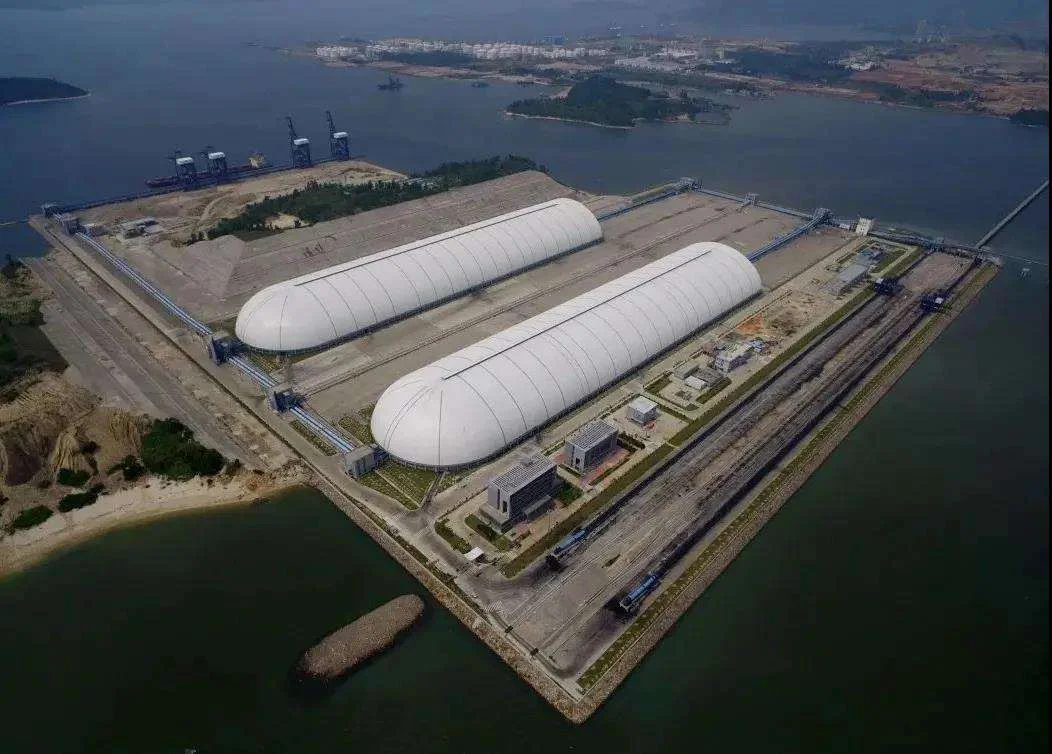
Huizhou Port Quanwan Terminal Enclosed Coal Yard
1,000 meters long. 118 meters span. 7,000 tons of steel. One of the largest enclosed coal yard structures in southern China.
Project Overview
The Guangdong Huizhou Port Quanwan Terminal required an enclosed coal storage facility capable of housing bulk coal handling operations while meeting stringent environmental dust-control regulations. The enclosure needed to span the full width of the coal stacking area — 118 meters — with zero interior columns that would interfere with stacker-reclaimer machinery, and extend for 1,000 meters along the berth.
Structural Solution
We designed a cylindrical shell grid structure with three-center arch geometry. The barrel-vault form provided:
- 118m clear span — eliminating all interior columns for full machinery access
- Maximum stacking height — the arch geometry provided 35m+ clearance at the crown, matching the stacker-reclaimer boom reach
- 7,000 tons of steel — optimized through three-center arch geometry and double-layer grid topology with diagonal member arrangement
- Environmental enclosure — the curved surface supported continuous cladding without geometric discontinuities that create dust leakage points
Engineering Challenges
At 1,000m length, thermal expansion is a critical design consideration. The structure was designed with expansion joints at approximately 60m intervals, with the grid segments separated by sliding bearing connections that allow longitudinal movement while maintaining structural continuity in the circumferential direction.
Wind loading on a 1,000m × 118m curved surface required extensive wind tunnel analysis. The three-center arch geometry was tuned to minimize the wind pressure coefficient at the haunches, where the curve transitions from steep to shallow, creating the highest local suction forces.
Fabricating Curved Grid Members: Precision on a Cylinder
Every member in a cylindrical shell grid is cut to a different length and meets its nodes at a different angle — because no two positions on a curved surface are geometrically identical.
The manufacturing challenge of cylindrical shell grids is fundamentally different from flat grids. In a flat grid, a square-on-square topology has repeating member lengths and identical node angles within each bay. In a cylindrical shell grid, the curvature means that:
- Circumferential members are curved (or faceted approximations of a curve), with each facet length depending on the local curvature radius
- Longitudinal members are straight but meet the curved circumferential members at continuously varying angles
- Node sphere hole angles (for bolted systems) or weld bevel angles (for welded systems) are unique for every position on the shell
- Member lengths vary continuously along the arc, not in discrete steps
This means every member must be individually cut, every node individually prepared, and the entire grid must be digitally pre-assembled to verify geometric fit before physical fabrication.
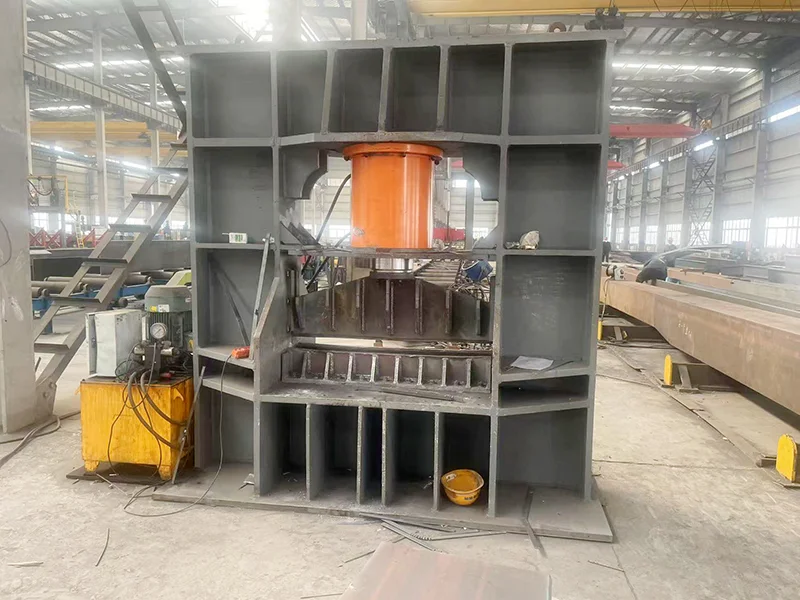
Our Fabrication Capability
- CNC tube cutting: Automated band saw lines with CNC angle control for member-to-node fit
- Curved member forming: Self-developed hydraulic bending machines for pipe curvature
- Digital pre-assembly: 3D modeling software verifies every member-to-node connection before cutting
- Sphere drilling: CNC sphere drilling at project-specific angles for bolted systems
- Welding & NDT: Full-penetration welding for welded systems, 100% UT per GB/T 11345
Where Cylindrical Shell Grids Are the Structural Answer
Coal Yards
Enclosed Coal Storage
Challenge: Environmental regulations require full enclosure of coal storage at ports and power plants. The enclosure must span 100m+ to accommodate stacker-reclaimers, resist corrosive coal dust, and maximize storage volume.
Solution: Cylindrical shell grids are the dominant structure type for this application in China. The barrel-vault form maximizes stacking height at the center while minimizing steel. The Huizhou project (118m × 1,000m, 7,000t) demonstrates our capability at scale.
 Hangars
Aircraft Hangars
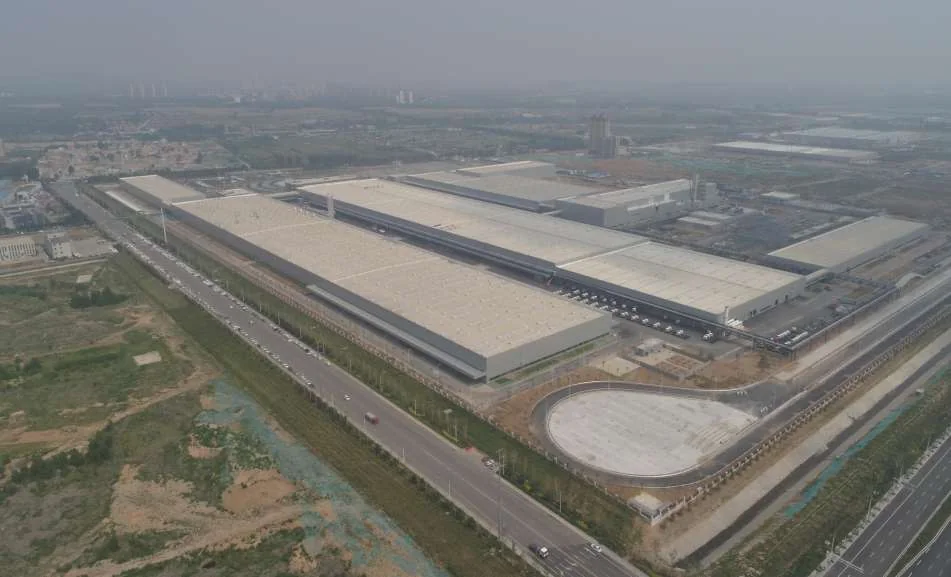
Challenge: Hangar doors require a clear rectangular opening of 80–150m, but the roof behind the door can be arched. The structure must support crane rails, lighting systems, and ventilation equipment.
Solution: A cylindrical shell grid with a flat front face (for the door opening) and an arched rear section combines clear access with efficient roofing. The arch geometry reduces steel weight while providing the headroom needed for tail-height clearance.
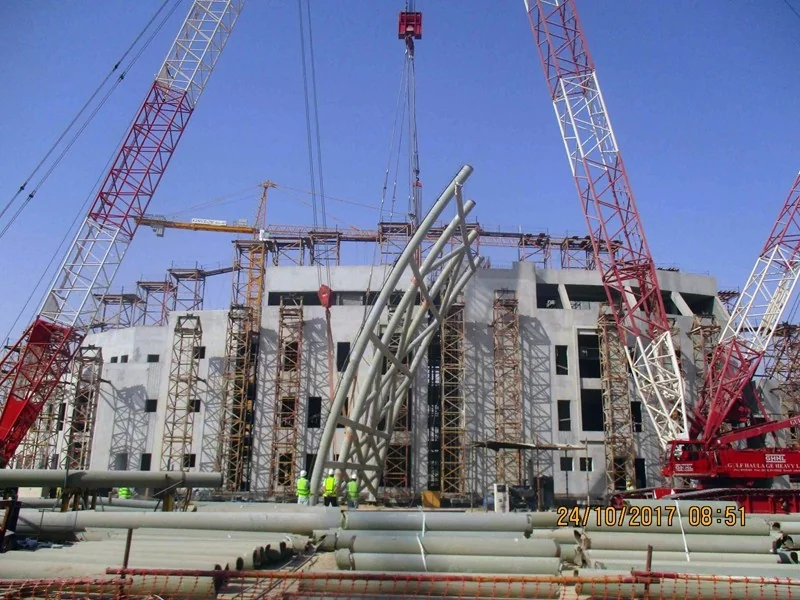 Sports Venues
Sports Halls & Arenas
Challenge: Indoor sports venues need column-free space with high clearances for spectator sightlines and lighting rigging. The roof form often defines the architectural identity of the venue.
Solution: The barrel-vault form provides natural column-free spans of 60–120m with a soaring interior volume that enhances the venue's architectural character. The curved underside improves acoustics by dispersing sound reflections.
Cylindrical Shell Grid Design Parameters
| Arch geometry | Three-center arch (compound curve, silkworm-cocoon shape) |
| Rise-to-span ratio | 1/4 to 1/6 (optimized per project loading and clearance) |
| Typical span range | 60–150m (pure grid); up to 229m (beam-string hybrid) |
| Max demonstrated length | 1,000m (Huizhou coal yard, with expansion joints) |
| Grid topology | Double-layer, orthogonal or diagonal on cylindrical surface |
| Node type | Bolted sphere or welded sphere (selected per project requirements) |
| Steel consumption | 18–25 kg/m² (100m span); 25–35 kg/m² (150m span) |
| Expansion joint spacing | ~60m (for long structures with thermal movement) |
| Cladding system | Profiled steel sheeting or sandwich panels, curved to shell geometry |
| Design codes | GB 50017, JGJ 7, GB 50009 (loads), GB 50011 (seismic) |
Cylindrical Shell Grid Design Parameters
| Parameter | Coal Yard | Hangar | Sports Venue |
|---|---|---|---|
| Span | 80–150m | 60–100m | 50–90m |
| Length | 200–1,000m | 100–300m | 100–250m |
| Rise/span ratio | 1/5–1/4 | 1/6–1/5 | 1/8–1/5 |
| Grid depth | 3.0–5.0m | 2.5–4.0m | 2.0–4.0m |
| Member type | Welded sphere + tube | Bolted sphere + tube | Bolted sphere + tube |
| Steel grade | Q355B | Q235B/Q355B | Q235B/Q355B |
| Wind load | 0.50–0.70 kN/m² | 0.40–0.55 kN/m² | 0.35–0.50 kN/m² |
| Steel usage | 35–55 kg/m² | 25–40 kg/m² | 20–35 kg/m² |
Curved Member Manufacturing & Geometry Verification
Curved Member Fabrication
Cylindrical shell grid members must follow the arch curvature. Unlike a flat grid where all members are straight, the chords of a cylindrical shell grid are curved tubes, bent to the design radius before connection to spheres.
Our manufacturing process for curved grid members:
- Tube bending: Steel tubes are bent to the arch radius using CNC rotary draw machines, with spring-back compensation; bend radius tolerance ±3mm
- Member cutting: CNC plasma cutting of tube ends for sphere connection, with bevel preparation for full-penetration welding
- Sphere preparation: Welded or bolted spheres prepared with connection holes or weld bevels matching the member geometry
- Assembly: Curved members assembled with spheres on a precision jig matching the arch geometry; temporary bracing maintains curvature during welding
- NDT: All sphere-to-tube welds 100% UT tested per GB/T 11345 Grade II
Design Standards
- JGJ 7 — Technical specification for space frame structures (cylindrical shell grid geometry, load combinations, stability analysis)
- GB 50017 — Standard for design of steel structures (member design, stability)
- GB 50205 — Acceptance of construction quality of steel structures (tolerance, NDT)
- GB 50661 — Code for welding of steel structures (WPS, welder qualification)
- GB/T 11345 — Ultrasonic testing of welded joints
- GB 50009 — Load code for the design of building structures (wind, snow, thermal loads on shells)
- GB 50011 — Code for seismic design of buildings
- GB 50191 — Code for seismic design of special structures (large-span spatial structures)
Erection Tolerance
- Arch span: ±L/2000, max ±30mm
- Rise (crown height): ±15mm
- Member curvature: ±3mm per 500mm arc length
- Node position: ±5mm in all axes
Why Permanent Steel for Cylindrical Shell Grids
Our experience with cylindrical shell grid structures is anchored by the Huizhou Port Quanwan Terminal Enclosed Coal Yard — a 1,000-meter long, 118-meter span, 7,000-ton steel cylindrical shell grid that is among the largest enclosed coal storage facilities in southern China. This project demonstrated our capability to manufacture curved members at scale, manage the geometry of a shell that is longer than most airport runways, and install it using accumulative sliding construction methods.
For long cylindrical shells (200m+), the construction method is as important as the design. We use accumulative sliding installation — assembling grid sections on the ground or at one end of the structure, then sliding them along temporary tracks to their final position. This avoids the need for extensive scaffolding across the entire length of the shell and allows continuous assembly while previous sections are already in service. For the Huizhou project, this method reduced installation time by an estimated 40% compared to full-height scaffolding assembly.
Design & Analysis Capability
- Finite element analysis: Full 3D FEA of shell geometry, including arch stability, wind load distribution on the curved surface, and thermal expansion analysis for long shells
- Wind tunnel testing: For shells in typhoon-prone regions, wind tunnel testing of the curved surface profile to verify design wind pressure coefficients
- Seismic design: GB 50191 seismic analysis for large-span spatial structures, including vertical seismic action on the shell
- Special-Class qualification: Our top-level qualification for spatial grid structure design and manufacturing covers cylindrical shell grids
- Track record: Coal yards, bulk storage, hangars, and sports venues delivered to specification
With 50+ R&D engineers, 100+ patents, and 6 top-level qualifications, Permanent Steel is one of the few Chinese manufacturers with the design depth, manufacturing scale, and installation experience to deliver cylindrical shell grid structures at the 100m+ span and 500m+ length scale.
Have a Curved Roof or Enclosure Project?
Whether you need a 118m-span coal yard, a 90m hangar, or a sports venue with architectural curvature, our engineering team can design and manufacture a cylindrical shell grid optimized for your loading, clearance, and budget requirements. Send us your project parameters for a feasibility assessment within 24 hours.
Email: market@permanentsteelstructure.com | WhatsApp: +86 18621689980 | Phone: +86 516-83269982