Cross-to-Box Steel Column — One of Our 10 Core Manufacturing Technologies
High-rise buildings do not tolerate columns that fail on paper. Cross-to-box column fabrication — one of Permanent Steel's ten core manufacturing technologies — closes a cross-shaped built-up section into a box through sequential welding, managing weld residual stress far better than a single-pass box welder ever could. It is the technology behind 180-meter towers with 40 mm+ plate columns.
Why the "Cross-to-Box" Sequence Matters More Than the Box Itself
A box column is, in appearance, the simplest structural member there is: four plates welded into a closed rectangle. Appearance is misleading. When four thick plates fillet-weld into a closed section, each weld pulls on the plates around it, and because the section is already closed, the member cannot relieve the strain — residual stress accumulates, the corners distort, and on heavy plate the as-fabricated column quietly no longer matches the analysis section. The worse the weld sequence, the more hidden stress the erector inherits, and the harder it is to keep the column straight and square through the height of a tower.
The cross-to-box process inverts the problem. The four plates are first assembled as a cross-shaped section — two plates or sub-assemblies crossing at right angles, welded while the section is still open and free to move. Preheating, weld size, and sequence are controlled on an open geometry where distortion can be measured and corrected. Only then are the two remaining corners closed with the final welds, turning the cross into a box. Because half the welding was done on the open section, the residual stress locked into the closed box is a fraction of what a single-pass box build would leave behind.
This is not an exotic process for exotic buildings. It is the disciplined manufacturing route that makes heavy box columns — the kind used in towers and high-rises — straight, square, and predictable, and it is one of the reasons Permanent Steel lists cross-to-box fabrication among its ten core manufacturing technologies, backed by more than 100 patents and the engineering staff to execute it at production scale.
Cross Sections, Box Sections, and the Transition Between Them
Every high-rise column starts with a structural question: which section shape carries the floor loads, resists the wind moment, and connects to the beams at a given height?
Cross-Shaped (Cruciform) Column
A cross or plus-shaped built-up column formed by two plates crossing at right angles. High stiffness about both axes, simple beam connections on four faces, and the standard answer for mid-rise framing where the load is moderate and the connections are frequent.
Box (Rectangular Tubular) Column
Four plates welded into a closed rectangle. Maximum strength and stiffness per unit of steel, torsional rigidity that open sections cannot match, and the clean fireproofing-friendly surface that towers demand. The column of choice when loads and sway control rule the design.
Cross-to-Box Transition
A single column that is cross-shaped in its lower floors and box-shaped above — or vice versa — with a fabricated transition segment redistributing the load path at the change. Architects get the column they want at plaza level; the structure gets the shape it needs higher up.
Welding 40 mm+ Plate: Where Procedure Is Everything
Plate thickness above 40 mm is where welding stops being a craft skill and becomes a scientific process. Every millimetre matters, and the procedure is the product.
Thick plate welding compresses four interacting disciplines into one joint:
1. Joint Preparation and Narrow-Gap Welding
For plate from 40 mm upward, open V or double-V preparations waste filler metal and pour heat into the joint. Our heavy fabrication stations use narrow-gap preparations — a tight, deep groove filled with fewer, larger passes — which reduces heat input, shortens weld time, and cuts the distortion budget in half compared with a conventional open groove. The narrow gap is the reason a 50 mm joint can be welded with a weld volume roughly a third of a standard preparation.
2. Preheat and Interpass Control
Thick plate acts as a heat sink: without preheat the weld metal freezes against cold parent steel and cracks. Preheat temperature (governed by plate thickness, grade, and carbon equivalent), interpass temperature, and cooling rate are specified, measured, and recorded — a heated plate is checked with contact pyrometers before and between passes, because a joint welded at 100°C different from the procedure may as well have been welded by a different welder.
3. Stringent Consumable and WPS Control
Every vertical set uses a written welding procedure specification (WPS) qualified by procedure qualification records (PQR) for the grade and thickness range. Consumables are baked and stored to specification, and wire batches are traceable to the joint. On 40 mm+ joints there is no improvisation; there is only the procedure, performed and documented.
4. Non-Destructive Testing with No Exemptions
Full-penetration thick welds are examined, not eyeballed: ultrasonic testing (UT) per the code's acceptance criteria on the welding, with the required percentages rising with joint category and thickness. Defects found are repaired under a documented re-weld procedure and re-tested. The UT report is part of the column's file — the same file that travels with the member to site and into the building's operations manual.
The Cross-to-Box Manufacturing Sequence
The sequence is the technology. It is the difference between a box that is assembled and a box that is built.
Stage 1 — Open Cross Assembly
The four plates are positioned as a cross: one web plate with its axial partner, flanges set at right angles, all held in CNC alignment fixtures. The section is open — every plate face is accessible, every weld line can be reached, and every dimension can be checked and corrected while the structure is still compliant. Assembly on the open cross is where squareness is born: the tooling, not the welder's patience, sets the geometry.
Stage 2 — Controlled Welding on the Open Section
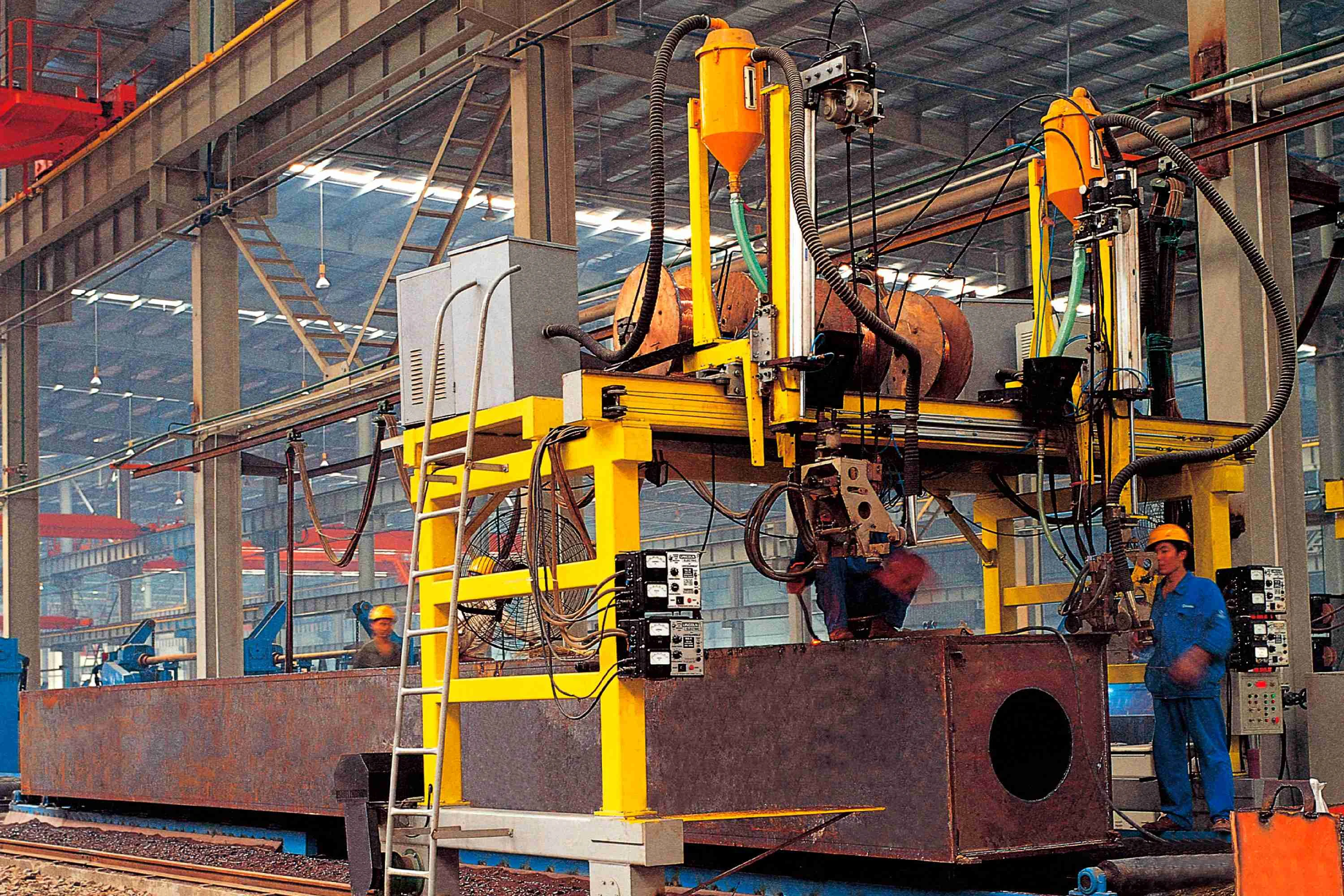
The first four fillet welds — the ones that join the plates into a cross — are deposited with twin-wire submerged arc welding. Because the section is open, welding heat can escape and distortion can be measured; welds are run in a balanced sequence around the cross to keep the member straight. Preheating of the heavier plate is executed and recorded here, at the point where it is still possible to correct drift rather than accept it.
Stage 3 — Closure Welds into the Box
Only after the cross is true are the two remaining corners closed. The closure welds travel down the already-stable section, and the final box geometry is verified against the shop drawing: outer dimensions, corner squareness, section twist, and straightness along the column length. The residual stress that would have accumulated in a from-scratch box build is instead a small, documented remainder — which is precisely the property that keeps a 40 mm+ column straight during erection and stable in service.
Stage 4 — Final Machining and Inspection
End milling or facing prepares the column ends for spliced erection; diaphragm plates inside the box at beam levels are positioned and their welds inspected from access openings before closure; and the completed member passes dimensional audit and NDT before shot blasting and coating.
Closing the Box: Electroslag Welding for Vertical Seams
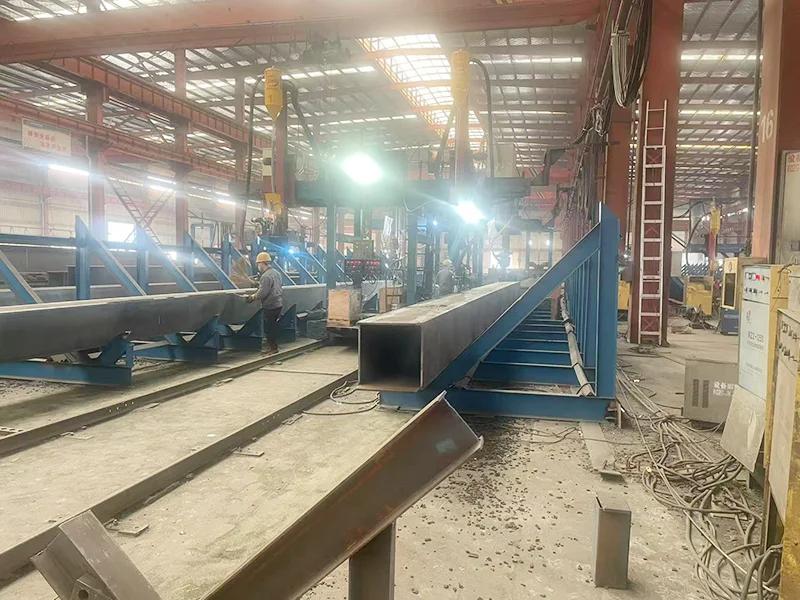
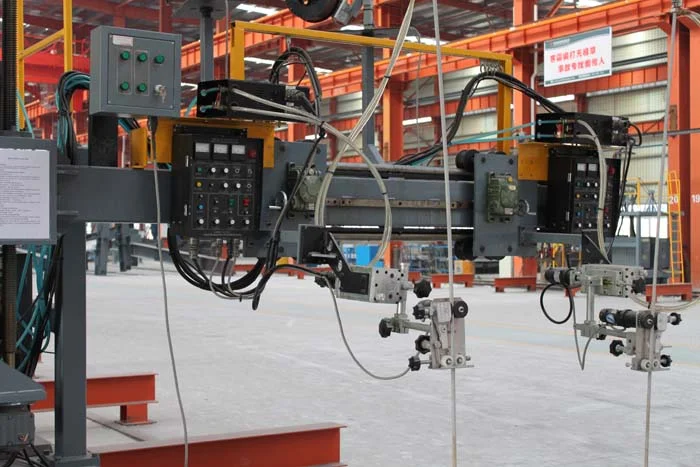
Closing a box section leaves one class of joint that standard welding cannot reach economically from the outside: the hidden vertical seam inside a closed box, and the long vertical butt joints between heavy plates. Permanent Steel's box-column stations use cantilevered electroslag welding for exactly these seams.
Electroslag welding is a vertical process: the joint is enclosed by water-cooled shoes, wire is fed continuously into a molten slag pool, and the resistance of the slag keeps the pool hot enough to fuse the full plate thickness in a single pass. One small package of equipment runs the whole vertical seam — typically a third to a fifth of the time of manual multi-pass welding on the same joint — with full penetration assured by the process physics rather than by access. The cantilevered machine positions the equipment without occupying the box's interior, which is what makes it the standard tool for closing heavy box columns in production.
Electroslag joints receive the same documentation as every other category: procedure qualified on the actual plate thickness, UT examined after welding, and any repairs executed under a re-weld procedure and re-tested. The speed of the process is a production advantage only because its quality is held to the same bar as the rest of the column.
Box Column Welding Technology Comparison
| Joint Type | Our Process | Typical Alternative |
|---|---|---|
| Cross assembly fillets | Twin-wire SAW, balanced sequence | Single-wire manual welding |
| Box closure corners | Sequence-controlled closure on true cross | Direct box assembly, stress unmanaged |
| Hidden vertical seams | Cantilevered electroslag welding | Manual access welding or bolted cover |
| Butt joints, thick plate | Narrow-gap SAW, preheat recorded | Open-groove multi-pass welding |
| Examination | UT per code on full-penetration joints | Visual-only on many shop joints |
Welding is performed to qualified WPS/PQR documentation; NDT scopes are defined in the project quality plan.
180 Metres of Box Columns: The Tianjin R&F Guangdong Tower

The Tianjin R&F Guangdong Tower is a high-rise building whose steel core relies on heavy box columns carrying the vertical and lateral loads of an approximately 180-metre-tall structure. Plate thickness in the column tiers exceeds 40 mm — exactly the regime where box-column fabrication stops being routine and starts being a specialty.
For a column that heavy and that tall, every stage of the cross-to-box discipline earns its keep. The open-cross assembly gave the fabricators a geometry check before the box was sealed. The narrow-gap and electroslag processes kept the weld volumes and the distortion within a budget that a conventional open-groove approach could not hold on 40 mm+ plate. The preheat records and UT documentation gave the design team the confidence that the as-built column was the analysed column — the property that matters most in a tall, slender structure where a straightness error at the base compounds as sway at the top.
Buildings like this are why the cross-to-box process is classified as a core technology rather than a routine bay operation. If your project involves deep box columns, thick plates, or a transition between cross and box sections, this is the manufacturing pedigree you are buying into — not a promise, but a documented process with towers standing on it.
View High-Rise Project PortfolioWhere Cross-to-Box Columns Lead the Structure
High-Rise Buildings
Core and perimeter columns in towers of 20–60+ storeys, where box sections deliver the sway-resisting stiffness and the beam connections the height demands.
Super-Tall & Mixed-Use Towers
Columns in the extreme load regime — 40 mm+ plates, high-strength grades, and transition segments where sections change with the structural system.
Transfer & Mega-Columns
Huge column sections at podium levels that carry the loads of the tower above and spread them to foundations — the heaviest single members in the frame.
Industrial Heavies
Box columns for heavy industrial buildings with high reaction loads and moment frames, using the same thick-plate and closure-weld technology at column scale.
Documentation You Can Build a Tower On
A thick-plate box column is only as good as its file — the record that tells the design engineer, the erector, the inspector, and a future building owner exactly what was done and what it was verified against. For every column we produce, that file contains:
- Material certificates with heat numbers for every plate, traceable from mill to member;
- Qualified WPS/PQR documentation for every joint category and thickness range used;
- Preheat and interpass temperature records on thick-plate joints, the data that proves the procedure was followed;
- Dimensional records at assembly, after welding, and after straightening — the three states that bracket the behavior of the member;
- UT and other NDT reports on full-penetration welds with repair records where applicable;
- As-built marks and member identification tying the column to its erection position.
This documentation standard is not a formality requested by consultants; it is the operational baseline of our fabrication system, applied to every column whether it stands in a 30-storey office or a 60-storey mixed-use tower. When a consultant asks "how do we know this column is as designed?", the answer is not an assurance — it is a file.
The same discipline extends to the interfaces that surround the column. Connection details, splices, base plates, and the interaction with floor framing are all documented to the same standard, so the erector receives a column that connects exactly where the model says it does. In practice this is what makes high-rise erection programmes predictable: the columns arrive with their splices pre-verified, the temporary bracing consideration noted in the erection documentation, and the crane sequence coordinated with the delivery batches. A tower schedule is only as reliable as every member and every document in it, which is why we apply the file standard to the last bolt as well as the first plate.
Cross-to-Box Column Questions from Structural Engineers
Why assemble a box column as a cross first? It seems like extra steps.
Because the extra step buys residual-stress control. Welding the open cross first lets the section relieve distortion while it is still flexible; closing the corners last locks in a small, measured stress state. A box built from scratch accumulates stress with every pass on a section that cannot move, and thick plates magnify the problem. On 40 mm+ columns the sequence is not extra work — it is the work.
What plate thickness can you handle for box columns?
Our box-column stations routinely fabricate plate from 40 mm up into the heavy range, with preheat control, narrow-gap welding, and electroslag closure at production scale. Confirm your maximum thickness with us and we will specify the procedure and capacity for your column schedule.
Do you fabricate the transition between cross and box sections in one column?
Yes. Transition segments are detailed with the load redistribution verified, fabricated with the stiffening the change requires, and documented like every other member. The lower-behaviour and upper-behaviour columns are then spliced and connected per the erection scheme.
What steel grades do you use for high-rise columns?
Q355B, Q390B, and Q420B are our standard structural grades, with higher-performance and improved-toughness variants (C/D/E sub-grades with Charpy testing) specified for seismic and cold-climate projects. Grades are selected with the design team and documented per member.
Can you deliver a complete high-rise steel package, not just columns?
Yes — columns, floor beams, bracing, connections, and erection. We combine the column technology with our H-beam line, connection detailing, and six top-level qualifications into one contract, so the tower steel is one engineered, fabricated, and documented product.
Engineer Your High-Rise Columns with a Core Technology Partner
Send your column schedule, plate thicknesses, and design basis. Our engineers will confirm the fabrication route, procedure qualification, and delivery programme — with documentation standards you can build on.
Request Box Column Fabrication Proposal