
Galvanizing & Coating Specifications — Decide the Corrosion Budget, Not the Corrosion Surprise
The difference between a steel structure that rusts after eight years and one that serves for forty is decided on the surface preparation line and in the coating specification — before the first member is erected. We specify corrosion protection as a designed system: the site's corrosivity class, the design life, the zinc or coating thickness, the edge and weld treatment, and the touch-up and maintenance regime. This page sets out the ISO 1461 and ISO 12944 systems we deliver, with the numbers a specifier needs.
Corrosion Protection Is a Design Decision, Not a Shop Afterthought
Step 1 — classify the site. The ISO 12944 corrosivity class (C2 low → C5 very high) is set from the real environment: rural or clean urban (C2-C3), industrial without aggressive pollutants (C3), coastal salt or heavy industry (C4), and marine coastal or highly polluted industrial (C5). A plant in Xinjiang and a port in southern Brazil face different corrosion budgets; our specification starts with the actual site, not a default.
Step 2 — set the design life. The protection system is selected for a target service life of 15, 25 or 40 years to first major maintenance — the same coating thickness does not serve the same on a 15-year warehouse as on a 40-year bridge. Design life drives zinc thickness class, coating system dry film thickness and the maintenance plan.
Step 3 — choose the system. Three main routes: hot-dip galvanizing (ISO 1461) for economy and durability, especially on members with complex geometry and internal surfaces; paint systems (ISO 12944) where architectural colour, intumescent fire protection or in-service touch-up matters; and the duplex system — paint over galvanizing — where the two protections compound and multiply service life at coastal or industrial sites.
Step 4 — detail for protection. Coating fails first at edges, welds, drainage pockets and contact surfaces. We round or blast edges, treat welds with care before coating, seal internal voids against moisture access, and detail joints so water drains — the corrosion-sensitive details are designed out before the coating specification is applied.
Hot-Dip Galvanizing — ISO 1461 Parameters
| Parameter | Typical Range | Standard / Note |
|---|---|---|
| Surface preparation | Degrease → acid pickle → flux; blast pre-clean where mill scale heavy | Cleanliness per ISO 12944-4 / ISO 8501-1 Sa 2.5 where blasted |
| Zinc thickness (steel ≥ 6 mm) | 85 µm mean, 70 µm minimum local | ISO 1461 Table 2; coastal spec ups to 120-140 µm |
| Zinc thickness (steel < 6 mm) | 55-70 µm mean | Thin sections limit zinc alloy growth |
| Threads & close fits | Masked or re-cut after galvanizing | Bolts: over-tap threads to restore fit; HDG bolts grade-matched |
| Vent/drain holes | Φ≥10 mm holes on hollow members | Prevents internal zinc dross & trapped bath residue |
| Handling & storage | Lift with slings, no chains; stack on dunnage, dry area | Prevents white rust & mechanical damage before erection |
| Verification | Magnetic gauge spot checks per ISO 1461 §7 | Batch certificate with thickness profile issued |
Galvanizing suits structures that will not be re-coated in service (industrial sheds, grid roofs, bridges at height) and gives sacrificial protection even where the coating is mechanically damaged.
Paint Systems — ISO 12944 Parameters by Exposure Class
| Class | Environment | Typical System | DFT (design life 15-25 yr) |
|---|---|---|---|
| C2 | Low pollution rural / dry interior | Alkyd or single-pack polyurethane | 120-160 µm |
| C3 | Urban / mild industrial | Zinc-rich primer + epoxy MIO + polyurethane | 160-200 µm |
| C4 | Coastal / industrial | Zinc-rich epoxy + epoxy + polyurethane | 200-280 µm |
| C5 | Marine coastal / heavy industrial | Duplex: HDG + zinc-rich epoxy + epoxy + PU, or full marine system | 280-360 µm (or duplex) |
| Immersion | Splash zone / permanent immersion | Heavy-duty epoxy + polyurethane, cathodic protection where required | Specialist design per project |
Surface preparation before coating: blast to ISO 8501-1 Sa 2.5 (near-white metal), profile 40-75 µm per ISO 8503, dust-free per ISO 8502-3, soluble salts checked per ISO 8502-6/9 where the environment demands.
How We Prove the Protection
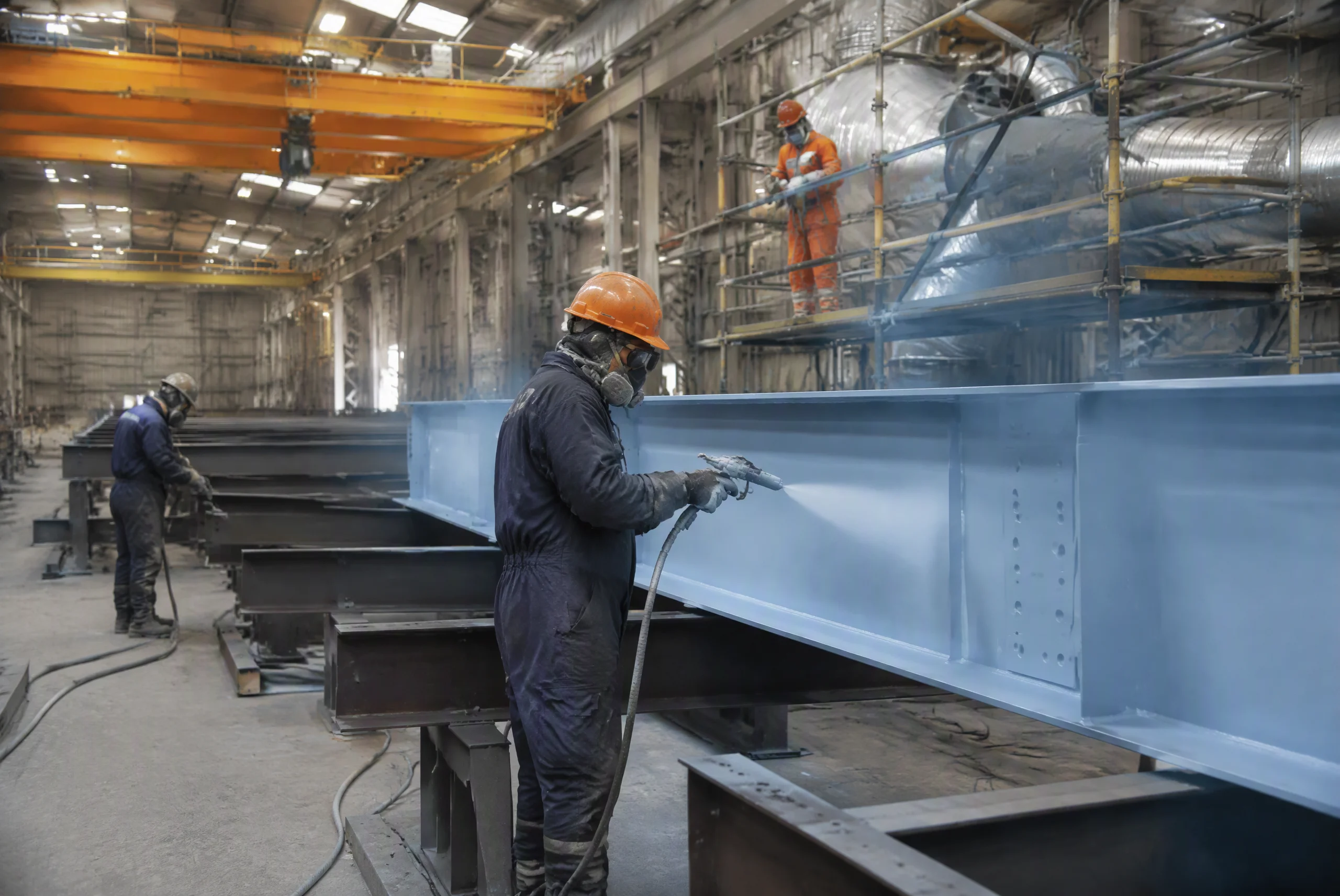
- Controlled environments: blast and coating carried out in enclosed shops with temperature/humidity logging — coating applied only within the product's envelope (typically >5°C and <85% RH, dew-point checked).
- Instrumented verification: DFT measured per ISO 19840 (90/10 or 80/20 rule per spec), adhesion pull-off tests per ISO 4624 on representative panels, and inspection before each coat.
- Edge and weld treatment: edges blasted (radius ≥ 2 mm where feasible) and stripe-coated before the full film — the two failure hot-spots of any coating system.
- Zinc thickness profile: per-member thickness readings issued as a batch certificate with the galvanizing supplier's test record.
- Touch-up and site repair kit: each shipment includes the specified touch-up paint and procedure, so site damage is repaired to system specification, not by guesswork.
- Maintenance schedule: the delivered document includes the recommended inspection interval and recoating trigger for the system's design life.
Specify the Corrosion System With the Data
Tell us the site location, exposure class and required design life — we return the ISO 1461 / ISO 12944 system, DFT schedule, verification plan and maintenance regime for your structure.
Email: market@permanentsteelstructure.com | WhatsApp: +86 18621689980 | Phone: +86 516-83269982