Beam-String Structures — The World's Longest Clear Span
A beam-string is not a truss. It is a self-balancing system where a rigid steel arch carries compression while prestressed cables carry tension, linked by vertical struts. This structural principle achieves spans that no conventional truss can reach — including our world-record 229 meters.
Not a Truss: How a Beam-String Achieves What No Truss Can
A conventional truss carries span loads through top-chord compression and bottom-chord tension, with web members transferring shear between them. As span increases, the top chord must resist ever-greater buckling, the bottom chord must resist ever-greater tension, and the truss depth must grow proportionally. At 150m+, the self-weight of the truss becomes a significant fraction of the total load — the structure is fighting its own mass.
A beam-string structure replaces the rigid bottom chord of a truss with prestressed high-strength cables. The cables are tensioned during construction to put the upper rigid arch into compression and the cables into pure tension — the ideal stress state for each material. Steel excels in compression (when stabilized against buckling by the strut system); cable excels in tension (with no buckling concern whatsoever).
The vertical struts between the arch and the cable are not just connectors — they are the mechanism through which the cable provides elastic support to the arch, breaking the long compression chord into shorter, buckling-resistant segments. The cable acts as a tension tie that simultaneously:
- Resists the horizontal thrust of the arch (self-balancing — no massive thrust blocks)
- Provides intermediate elastic supports to prevent arch chord buckling
- Carries the tension that would otherwise require a massive bottom chord member
The result: a structural system where steel consumption drops by approximately 30% compared to a conventional grid or truss at the same span, and where spans of 200m+ become structurally and economically feasible — not just theoretically possible.

The Three-Component Self-Balancing System
A beam-string structure consists of three structural elements, each serving a distinct role. Understanding how they interact is essential to understanding why this system achieves spans no other can.
Component 1: The Rigid Upper Arch
The upper chord is a rigid steel arch — typically a spatial grid (bolted sphere or welded sphere) or a steel pipe truss. The arch geometry converts vertical gravity loads into axial compression along the arch axis, which is the stress state steel handles most efficiently. The arch is not designed to resist bending — it is designed to carry compression along its curved geometry.
The arch's rise-to-span ratio is typically 1/5 to 1/8, optimized to balance structural efficiency against internal clearance. A higher rise provides better load-shedding but reduces usable internal volume; a lower rise maximizes volume but increases horizontal thrust (which the cable must resist).
For our 229m Ningxia project, the upper arch is a double-layer bolted sphere grid — the grid provides the depth and member triangulation needed to stabilize the arch against buckling between strut support points.
Component 2: The Prestressed Cable
The lower chord is a high-strength prestressed steel cable — typically 7-wire strand or parallel wire bundle with tensile strength of 1,670 MPa or higher. This is 3–4 times the yield strength of structural steel (Q355B at 355 MPa), which means the cable can carry the same tension force as a steel member at a fraction of the cross-sectional area and weight.
The cable is not a passive tension member. It is actively tensioned during construction — jacked to a calculated prestress force that pre-loads the arch into compression before any service load is applied. This prestress is the key to the self-balancing principle: it creates an internal force state where the arch thrust is balanced by the cable tension, and the vertical struts transfer the interaction forces between them.
Component 3: The Vertical Struts
Between the arch and the cable, vertical struts (steel tube members) connect the two systems at regular intervals. The struts serve two critical functions:
- Load transfer: Gravity loads on the arch are transferred through the struts to the cable, which deflects downward and increases tension. The cable then pulls the arch inward at each strut point, creating a distributed elastic support that breaks the long compression span into shorter, buckling-resistant segments.
- Buckling stabilization: Without the struts, the arch chord would need to resist buckling over the full 200m+ span — requiring massive member sizes. With struts providing intermediate lateral support at 10–20m intervals, the effective buckling length of the arch chord drops by an order of magnitude, allowing much lighter members.
The Self-Balancing Principle
The term "self-balancing" means that the horizontal thrust of the arch is entirely resisted by the cable tension. The foundation sees primarily vertical reactions — not the enormous horizontal thrust that a free-standing arch would generate. This eliminates the need for massive thrust blocks, ground anchors, or tension ties at the foundation level, which is a major cost advantage for large-span structures.
In structural mechanics terms, the beam-string is a prestressed composite flexural system: the rigid arch provides bending stiffness and compression capacity; the cable provides tension capacity and pre-compression; the struts provide shear transfer and elastic support points. The system is designed so that under full service load, the cable remains in tension (never going slack) and the arch remains in compression (never going into tension at the crown).
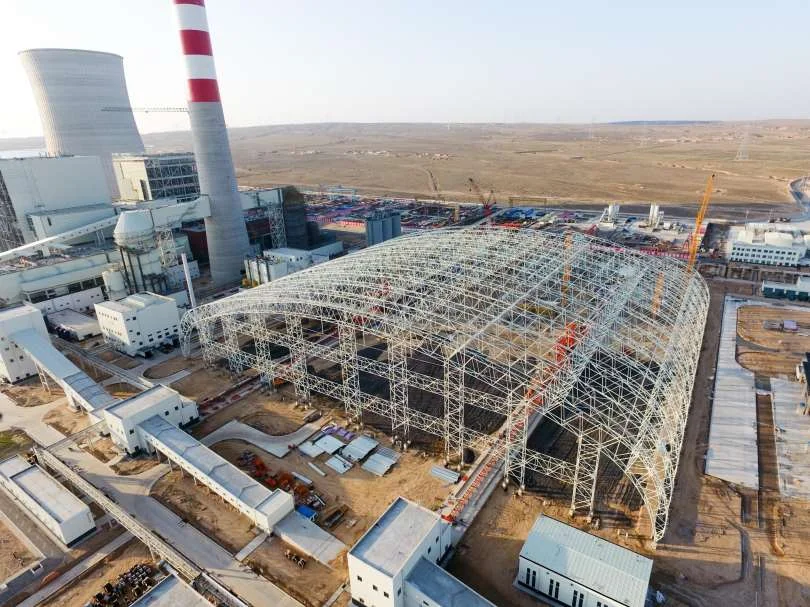
229m Span: Guodian Ningxia Fangjiazhuang Power Plant Coal Shed
The longest clear span of any beam-string coal shed structure in the world. 4,000 tons of steel. Zero interior columns.
Project Context
The Guodian Ningxia Fangjiazhuang Power Plant required a fully enclosed coal storage facility at its Fangjiazhuang site in Ningxia, China. The coal yard needed to span 229 meters — a width dictated by the stacker-reclaimer rail gauge and the stockpile capacity required for the power plant's operational reserves. Any interior column would block machinery movement and reduce effective storage capacity by 15–20%.
At 229m, conventional bolted sphere grids had reached their structural efficiency limit. The self-weight of a pure grid at this span would have required top chord members so large that the grid's own mass would dominate the load case — a self-defeating spiral of increasing weight requiring increasing member sizes requiring increasing weight.
Our Solution
We deployed a beam-string hybrid system: a double-layer bolted sphere grid for the upper chord and web members, paired with prestressed high-strength cables replacing the entire bottom chord. The cables put the grid into compression and themselves into pure tension. The total steel consumption was approximately 4,000 tons — roughly 30% less than a conventional grid would have required at the same span.
The structure was modeled in 3D structural software with load cases including:
- Dead load + live load + snow load (Ningxia: 0.30 kN/m²)
- Wind load (basic wind pressure 0.55 kN/m², with internal pressure coefficients for partially open enclosures)
- Seismic load (intensity 8, per GB 50011)
- Temperature differential (±30°C for enclosed steel structures)
- Cable prestress force + construction sequence loading
Construction Method
The beam-string was constructed using a cumulative sliding/tensioning method:
-
1
Grid Assembly on Ground
The upper grid arch was assembled at ground level in segments, using bolted sphere connections for precision. -
2
Lift & Position Struts
Vertical struts were installed between the arch and the cable anchor points, positioning the cable at the design sag depth. -
3
Cable Installation
High-strength cables were threaded through cast steel anchor sockets at each end of the arch and connected to the strut bases. -
4
Prestress Tensioning
Hydraulic jacks tensioned the cables in a controlled sequence, pulling the cable taut and pre-loading the arch into compression. Cable tension was monitored by load cells at each anchor point. -
5
Verification
The as-built geometry was surveyed against the 3D model. Cable tensions were verified against design values. Only after all checks passed was the structure accepted for service.
220m Span: Shanxi Zhongdian Shentou Power Generation Coal Shed
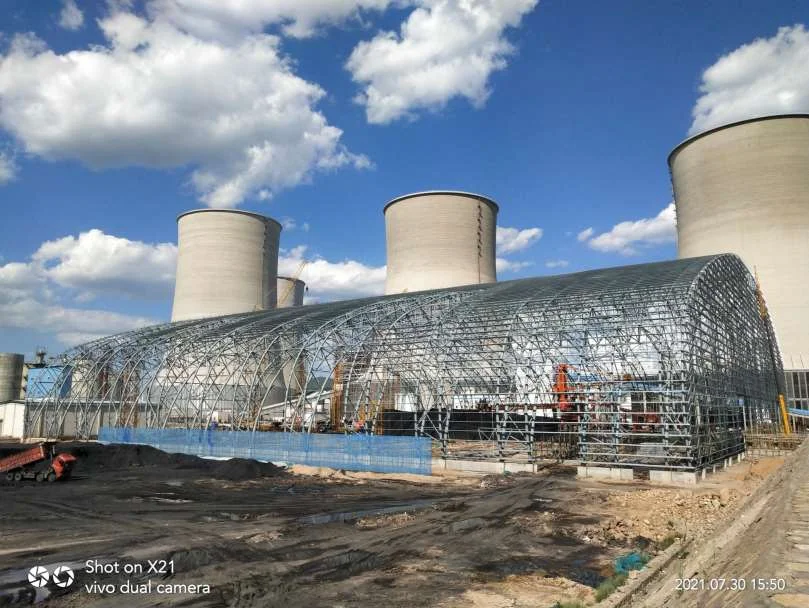
A second beam-string coal shed at 220m clear span — confirming that the 229m record was not a one-time achievement but a repeatable engineering capability.
The Shanxi Zhongdian Shentou Power Generation Unit required an enclosed coal shed with a 220m clear span. While 9 meters shorter than the Ningxia record, this project demonstrated that the beam-string system is a repeatable, scalable technology — not an experimental structure that worked once under unique conditions.
The Shanxi project used the same beam-string principle — rigid steel arch upper chord + prestressed cable lower chord + vertical struts — but with project-specific tuning for the local loading environment. Shanxi's seismic intensity and wind conditions differ from Ningxia's, requiring different cable prestress values, strut arrangements, and arch geometry optimization.
Both projects together establish Permanent Steel as the only manufacturer in China with two completed beam-string coal sheds at 220m+ spans. The engineering knowledge, fabrication procedures, and construction methods developed on these projects are now standard practice in our beam-string manufacturing capability.
Why Beam-String Beats Conventional Truss at 150m+ Spans
Below 150m, a conventional grid or truss is usually the more economical choice. Above 150m, the beam-string becomes structurally and economically superior. Here is why.
| Parameter (at 200m span) | Conventional Grid/Truss | Beam-String |
|---|---|---|
| Bottom chord type | Rigid steel member (Q355B) | Prestressed cable (1,670 MPa) |
| Tension member weight | Heavy (large section for 355 MPa steel) | ~25% of equivalent steel member |
| Arch buckling length | Full span (200m) — requires massive top chord | Strut-to-strut distance (~15m) — light top chord |
| Horizontal thrust at foundation | Significant (requires thrust blocks) | Self-balanced (minimal foundation thrust) |
| Steel consumption (100m span) | 25–35 kg/m² | 20–25 kg/m² |
| Steel consumption (200m span) | 50–70 kg/m² (inefficient) | 30–40 kg/m² (~30% less) |
| Construction complexity | Moderate (standard grid assembly) | High (requires cable tensioning expertise) |
| Practical span ceiling | ~150m (before self-weight dominates) | 250m+ (demonstrated at 229m) |
The crossover point is approximately 150m. Below this span, the added complexity of cable tensioning is not justified by the steel savings. Above 150m, the steel savings of 30% and the structural efficiency of the self-balancing principle make the beam-string the clear choice. For spans approaching 200m, the beam-string is not just more efficient — it may be the only system that is structurally feasible. Compare with our bolted sphere grid capabilities →
Cable Anchoring, Prestressing & the Challenges We Solved
Building a beam-string is not just fabricating steel members. It requires specialized technology for cable anchoring, prestress control, and construction sequencing that conventional grid manufacturers do not possess.
Cast Steel Cable Anchors
The cable anchor is the single most critical component in a beam-string structure. It is the point where the 1,670 MPa cable meets the 355 MPa structural steel arch — a force concentration that demands a purpose-engineered transition element.
We use cast steel anchor sockets (typically ZG 270-500 or ZG 340-550 cast steel, or higher-grade alloys for extreme-load anchors) that are designed to distribute the cable force into the arch structure through a gradually widening load path. The anchor socket geometry is analyzed by finite element method (FEM) to verify stress distribution and eliminate stress concentrations that could initiate fatigue cracking.
Every cast anchor is ultrasonic-tested for internal defects and proof-loaded to 1.2× design tension before installation. No anchor enters a project without documented material certification, NDT clearance, and proof test records.
Prestress Sequence Control
The cable cannot be tensioned in a single step. Tensioning one cable changes the geometry of the arch, which changes the force distribution in adjacent cables. The tensioning sequence is calculated by structural analysis software to ensure that at every step of the process, no member is overstressed and the geometry remains within tolerance.
Our procedure specifies:
- Tensioning order (which cables to jack and in what sequence)
- Incremental force steps (typically 25%, 50%, 75%, 100% of design prestress)
- Inter-step geometry survey (verify arch shape at each load increment)
- Force verification via load cells and strand elongation measurement
- Final lock-off and anchor nut seating verification
Welded Grid for Upper Chord
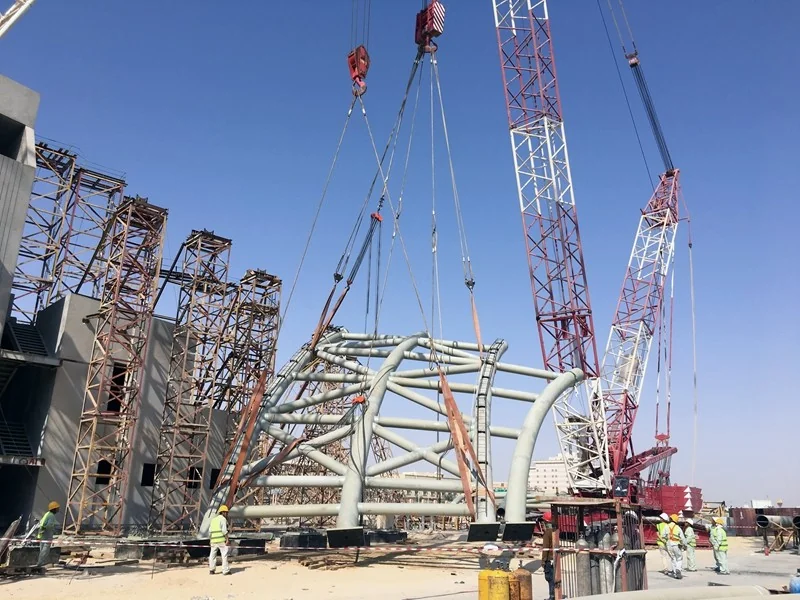
The upper chord arch in our beam-string systems uses either bolted or welded sphere grid topology, depending on the loading and environmental requirements. For coal sheds in corrosive environments with vibration from machinery, welded grid is preferred for the same reasons documented on our welded sphere grid page — monolithic nodes with no bolt maintenance.
Cable Protection
The cables are protected against corrosion by galvanized wire + grease-filled HDPE sheath (triple protection system). Anchor sockets receive additional epoxy coating. In environments rated C4–C5 (per ISO 12944), the cable system is specified with stainless steel outer wires or additional sacrificial anode protection.
Real-Time Monitoring
Our beam-string projects include permanent cable tension monitoring systems — load cells or vibrating wire strain gauges installed at anchor points that transmit tension data to the facility's structural health monitoring system. This allows the owner to verify that cable tensions remain within design range throughout the structure's service life, providing long-term assurance that the self-balancing principle is functioning as designed.
Beam-String Structure Technical Specifications
| Structural system | Rigid steel arch (upper) + prestressed cable (lower) + vertical struts |
| Upper chord material | Q355B / Q390B steel tubes, bolted or welded sphere grid topology |
| Cable type | 7-wire prestressed strand or parallel wire bundle, 1,670 MPa tensile strength |
| Cable protection | Galvanized wire + grease-filled HDPE sheath (triple protection) |
| Anchor type | Cast steel socket anchors, FEM-analyzed, proof-tested at 1.2× design load |
| Strut material | Q355B steel tubes, designed for compression + shear transfer |
| Rise-to-span ratio | 1/5 to 1/8 (optimized per project) |
| Strut spacing | 10–20m (optimized for arch buckling control) |
| Demonstrated spans | 229m (Ningxia, world record); 220m (Shanxi) |
| Steel savings vs grid | ~30% at 200m+ spans |
| Design codes | GB 50017, JGJ 7, GB 50009, GB 50011, JGJ 257 (cable structures) |
Beam-String Structure System Specifications
| Parameter | Standard BSS | Record BSS |
|---|---|---|
| Span range | 80–150m | 150–229m |
| Upper chord | Steel box truss arch | Steel box truss arch (deeper) |
| Lower chord | 1–3 cables, Φ55–85mm | 3–5 cables, Φ85–121mm |
| Cable strength | 1,670–1,770 MPa | 1,770–1,860 MPa |
| Strut type | Steel pipe, welded | Steel pipe, cast steel joints |
| Prestress force | 500–1,500 kN per cable | 1,500–4,000 kN per cable |
| Steel grade | Q355B | Q355B/Q390B |
| Steel usage | 30–50 kg/m² | 40–70 kg/m² |
Why Permanent Steel Holds the World Record
Permanent Steel's 229m beam-string span at the Guodian Ningxia Fangjiazhuang Power Plant is not just a project — it is a world record, recognized in Chinese engineering journals as the longest single-span beam-string structure ever built. The Shanxi 220m span project further confirms our capability at the extreme end of the span range. These projects required innovations in cast steel anchoring, multi-stage prestressing sequences, real-time tensioning monitoring, and construction-stage structural analysis that only a fabricator with 50+ R&D engineers and 100+ patents could develop. For projects requiring 150m+ spans where conventional trusses become economically and structurally unviable, Permanent Steel's beam-string technology is not an option — it is the proven, delivered solution.
Have an Ultra-Long-Span Project?
If your project requires a clear span above 150m — whether for a coal shed, aircraft hangar, or industrial enclosure — the beam-string system may be the only structurally and economically viable solution. Our engineering team holds the world record at 229m. Send us your span, loading, and site conditions for a feasibility assessment within 24 hours.
Email: market@permanentsteelstructure.com | WhatsApp: +86 18621689980 | Phone: +86 516-83269982