Hot-Dip Galvanizing vs Paint Coating: Corrosion Protection Compared
Of all the decisions on a steel structure project, the corrosion protection specification has the longest financial tail. The initial coating cost is typically 3-6% of the structural steel budget, but the maintenance cost over a 50-year design life can exceed the initial coating investment several times over — and it is paid in the least convenient currency: access scaffolding, production shutdowns and tenants displaced by blasting. The choice between hot-dip galvanizing and a paint system is therefore not a painting decision; it is a life-cycle engineering decision driven by environment, member geometry, connection design and access realities.
This article compares the two mainstream protection families — hot-dip galvanizing to ISO 1461 and paint systems to ISO 12944 — across zinc thickness and corrosion rates, system life in each corrosivity category, duplex (galvanized-plus-paint) combinations, field repair, cost curves and the specific cases where painting is the only technically valid route. It is written for project owners and engineers who must write the specification rather than argue about it later.
1. How Hot-Dip Galvanizing Works
Hot-dip galvanizing immerses prepared steel in molten zinc at roughly 450°C. The reaction forms a metallurgically bonded zinc-iron alloy layer plus an outer pure-zinc layer — a coating that is physically part of the steel, not adhered to it. That is the defining difference from paint: a galvanized coating is bonded, continuous and self-healing at scratches through cathodic protection, because zinc corrodes preferentially where the steel is exposed.
ISO 1461 sets the minimum coating thickness by steel section thickness. For structural steel above 6 mm the requirement is an average of 85 μm with no local value below 70 μm (members 3-6 mm: average 70 μm; 1.5-3 mm: average 55 μm). In practice Chinese galvanizing plants regularly achieve 85-120 μm on structural sections, and specifying "average 85 μm minimum per ISO 1461" is the standard baseline for permanent structures. Thicker coatings (140 μm and above) are achievable for aggressive environments, subject to bath and handling constraints.
Bath size is the hard geometry constraint: typical Chinese hot-dip tanks run 12.5-13.5 m long by 1.5-2.2 m wide by 2.5-3.0 m deep. Members up to those lengths dip straight; longer members must be double-dipped (which leaves a visible lapping seam) or sent to special bath capacity. Hollow sections require vent and drain holes at defined locations — per good practice in ISO 14713-2 — so trapped air and water escape during immersion; these holes must be provided for at detailing stage, because drilling them after galvanizing destroys the coating at the worst possible location.
2. Zinc Thickness, Corrosion Rate and Service Life
Zinc corrodes at a rate set by the atmospheric corrosivity category (ISO 9223). First-year corrosion rates for zinc are approximately: C2 (rural, low) 0.1-0.7 μm/year; C3 (urban, moderate) 0.4-2.0; C4 (industrial/coastal, high) 1.5-6.0; C5 (very high industrial/marine) 3.0-12.0. Long-term rates published in ISO 9224 are typically 60-90% of first-year values as the corrosion product layer stabilises. Applying those rates to a common 85 μm coating:
- C2 (rural): 50+ years — bare galvanizing outlives the structure for most purposes.
- C3 (urban): roughly 25-50 years depending on the actual rate within the band.
- C4 (industrial or coastal): roughly 15-30 years — serviceable, but the "30-40 years" commonly quoted for coastal and industrial zones is only reliably achieved with thicker coatings (140 μm+) or a duplex system.
- C5 (heavy marine/industrial): bare 85 μm zinc is marginal (10-20 years); duplex or a thermal-sprayed zinc/aluminium system is the defensible choice for a 30+ year design life.
The engineering message is simple: galvanizing’s life-to-thickness relationship is the most predictable corrosion number in the industry — no adhesion loss at coating holidays, no under-film creep, no chalked topcoat to recoat. What it cannot do is change the zinc consumption rate, and specifiers who quote a fixed 30-40 years in a C5 atmosphere without reading the ISO 9224 rates are setting up an expectation the coating will not meet.
Verifying Coating Thickness and Soundness
Acceptance measurement follows ISO 1461: thickness is read with a calibrated magnetic gauge on cleaned surfaces, distributed over the member at defined sampling positions (typically one measurement area per product unit, spread across flat faces, edges and surfaces affected by draining), and both the average and the minimum local values are assessed against the 85/70 μm limits. Visual inspection verifies complete coverage — no uncoated patches, no heavy ash or flux residues, no sharp edges that could damage handling crews — and on hollow sections the vent and drain holes provided at detailing are checked for unobstructed drainage: trapped acid or water inside a closed member corrodes it from within regardless of the exterior coating, a failure mode that is invisible in the final inspection and only surfaces years later.
Adhesion is verified in the shop by the standard hammer-and-knife test — a sound zinc coating resists the knife tip and does not flake from the zinc-iron alloy layer — and, where the project specifies it, by a quantitative pull-off test per ISO 4624. Freshly galvanized members are also given a curing period before site handling: the zinc-iron intermetallic layers reach their final hardness over 2-7 days, and rough early handling can peel the softer outer zinc layer at edges and corners.
3. Paint Systems: Flexibility and the Maintenance Clock
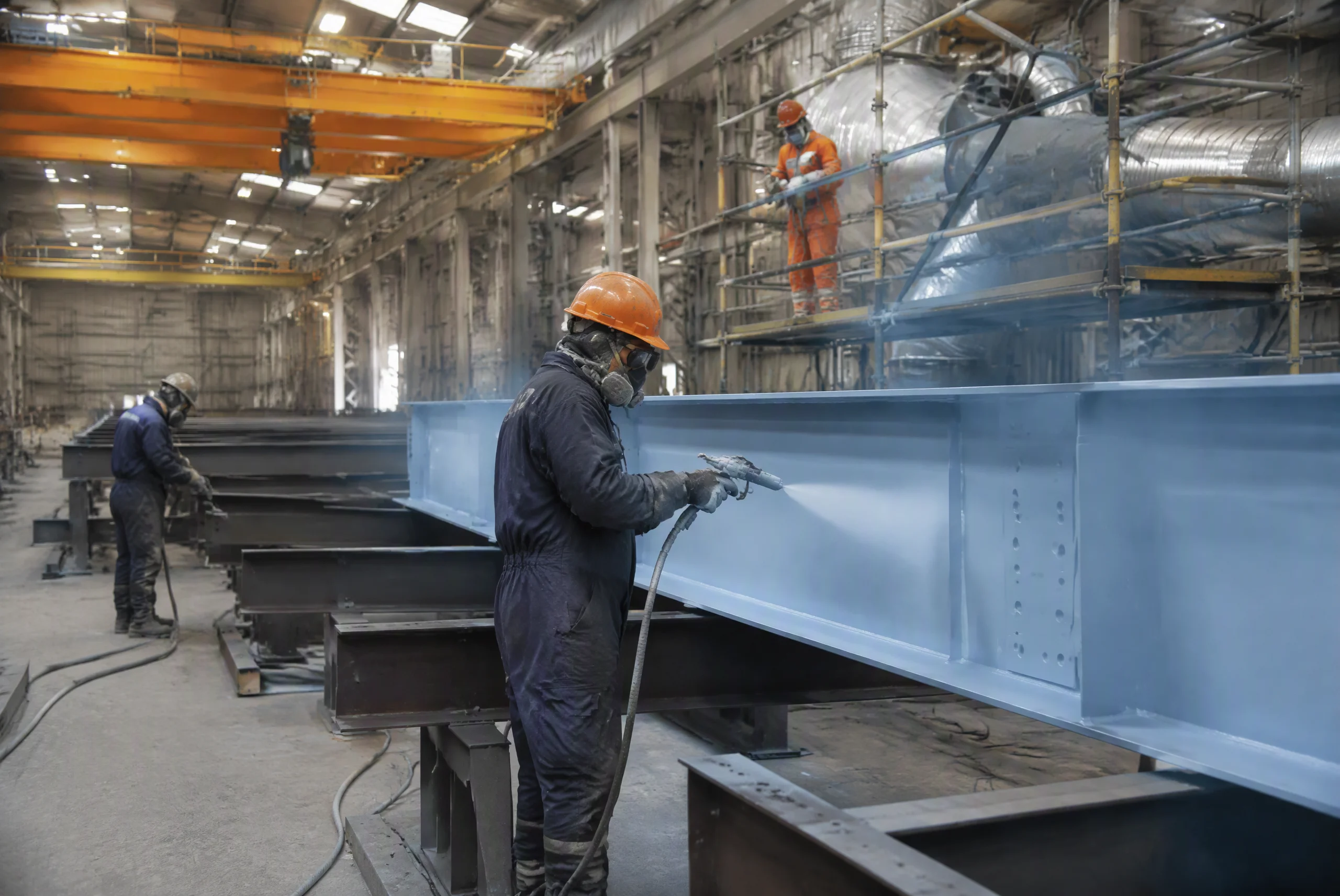
Paint systems per ISO 12944 offer an almost unlimited design space — colour, gloss, fire-performance interface, and coating build tuned exactly to the environment. A robust C4 system (industrial/coastal) is typically three coats: inorganic zinc-rich primer at 70-80 μm, epoxy intermediate at 120-160 μm, and polyurethane topcoat at 50-60 μm, for 260-300 μm total DFT, applied over Sa2.5 blast-cleaned surfaces with a 40-70 μm roughness profile.
Paint’s weaknesses are known and quantifiable. Every paint system has a maintenance interval: in C3-C4 a well-applied ISO 12944 system typically needs first maintenance at 8-15 years (spot repair and full topcoat), and a full recoat cycle at 15-25 years, depending on film thickness and colour. Each cycle costs 25-60% of the initial application (access, masking, surface prep and disposal dominate), and each cycle re-exposes the structure to corrosion on the edges and welds that the painter could not reach correctly the first time. Edges, welds and fastener heads are where painted systems fail first — which is why stripe coats at welds and edges are mandatory, not optional, in any competent specification.
4. Duplex Systems: Galvanizing Plus Paint
The duplex system — hot-dip galvanizing prime coat with a paint layer over it — combines the two mechanisms: zinc provides cathodic protection and barrier defence; paint provides aesthetics, UV protection and further barrier. ISO 12944-5 documents the synergy: the duplex life is typically 1.5-2.3 times the arithmetic sum of the individual lives. A galvanized 85 μm layer plus an 80-120 μm paint system in C4/C5 can deliver 30-50+ years with only cosmetic maintenance — this is the technical basis of the long-lived coastal and industrial structures in service today.
The discipline is in the interface: paint is applied over the galvanized surface after the zinc has stabilised (at least 24-48 h after dipping, or after sweep-blasting fresh zinc with fine abrasive to a 40-70 μm profile), using compatible chemistries — epoxy, polyurethane and water-borne systems generally over zinc, with surface preparation per the paint manufacturer’s data sheet. Standard alkyd paints over fresh galvanizing are the classic mistake; the fatty acids saponify the zinc and the film delaminates within a year.
5. Cost Comparison: The 25-30 Year Crossover
| System | Typical build | Maintenance cycle (C4) | 30-year life-cycle view |
|---|---|---|---|
| Hot-dip galvanized (bare) | 85-120 μm zinc (ISO 1461) | None expected to 25-30 yr; cosmetic repair only where damaged | Initial cost higher than paint; near-zero maintenance; lowest cumulative cost at 30 yr |
| Duplex (galvanized + paint) | 85 μm zinc + 80-120 μm paint | Cosmetic topcoat at 15-20 yr; system life 40-50+ yr | Highest initial cost; lowest life-cycle cost for aggressive environments and long design lives |
| Paint, ISO 12944 C4 | 260-300 μm DFT zinc-rich + epoxy + PU | First maintenance at 8-15 yr; full recoat at 15-25 yr | Lowest initial cost; 2-3 maintenance cycles by year 30 push cumulative cost above galvanizing |
The crossover is a real number, not a slogan. As a rule of thumb on structural steel, hot-dip galvanizing costs roughly 1.5-2.5 times the applied cost of a standard 240-300 μm paint system at the factory (zinc price dependent), but painted steel in C4 attracts two to three maintenance interventions in 25-30 years against galvanizing’s zero to one repair. Beyond approximately 25-30 years of required service life, or in C4+ environments with access problems (roofs, tall columns, enclosed spaces), galvanized and duplex systems win the life-cycle comparison decisively. Below that horizon, or where the client demands colour and flexibility, paint remains the rational choice.
6. Field Repair and Touch-Up
No coating survives site handling, bolting and welding untouched, and the specification must define repair before damage happens. For galvanized steel, damaged areas are cleaned to St3 (power tool cleaning, ISO 8501-1) or Sa2.5, then repaired with two-pack zinc-rich paint containing at least 90% zinc dust in the dry film (per ISO 3549), applied at 80-120 μm DFT. Welded areas on galvanized members — field welds burn the zinc — receive the same zinc-rich repair plus the system topcoat. For painted systems, the repair is a defined sequence of spot blast, primer, intermediate and topcoat, feather-edged to the original film.
Two practical notes. First, repair zinc-rich paints are not a substitute for hot-dip zinc in thickness or bond — the repair is a controlled compromise, and the area is logged in the maintenance file. Second, where galvanized members are welded at site, fire or gouging near the zinc generates zinc oxide fume; the specification should require local extraction and respiratory protection in enclosed work, matching the reality that most "galvanizing failures" in service are actually un-repaired site damage.
7. Where Painting Is the Only Valid Option
There are cases where galvanizing is technically wrong, and painting is not a fallback but the engineering choice:
- Slip-critical bolted friction surfaces. A galvanized surface changes the slip factor of high-strength bolt assemblies. Friction surfaces are masked before dipping or blast-cleaned after, so the slip-performance class (e.g. EN 1090-2 Annex G classes A/B with nominal slip factors 0.30-0.50) is met and demonstrated by slip tests — paint systems over blasted steel are the standard route for these connections.
- Member geometry beyond bath capacity. Members longer or bulkier than the galvanizing bath (and the transport envelope) cannot be hot-dipped; a heavy plate-girder box of 25 m in a 13.5 m bath is a paint, or duplex-in-shop, member.
- Machined and precision surfaces. Threaded studs, machined base plates and sliding surfaces must be masked from the zinc bath; on complex fabrications the masking cost erases galvanizing’s cost advantage and painting with masked areas is simpler.
- Aesthetic and architectural requirements. Galvanizing is monochrome grey and its surface roughness and spangle do not meet architectural finishes; painted RAL systems are the only route for exposed architecture. (Duplex with a full paint layer also works where the zinc beneath buys life.)
- Thin-walled precision members. The 450°C immersion distorts thin plates and closed sections; members with tight dimensional tolerances (machined connections, sliding joints) are painted instead.
- Fire protection interface. Intumescent coatings for fire-rated steel require a specified primer/overcoating system; the galvanized surface needs confirmation of compatibility with the intumescent primer, often driving the selection to paint.

Key Takeaways
- ISO 1461 sets 85 μm average zinc as the baseline for structural steel above 6 mm; corrosion life follows ISO 9223/9224 zinc rates — roughly 25-50 years in C3, 15-30 in C4, and marginal in C5 for bare 85 μm.
- The "30-40 years in coastal/industrial zones" claim only holds with numbers: thicker zinc (140 μm+) or a duplex system is what actually delivers it in C4/C5 atmospheres.
- Duplex (zinc + paint) multiplies life by 1.5-2.3× the arithmetic sum per ISO 12944-5 — the defensible solution for aggressive environments and 40-50 year design lives.
- Galvanizing wins life-cycle cost beyond 25-30 years because paint attracts 2-3 maintenance cycles in that window; paint wins where colour, flexibility, geometry beyond bath size or precision surfaces dominate.
- Friction surfaces, machined areas, oversized members and fire-protection interfaces are paint-only or masked territory — recognise these before the coating specification is frozen.
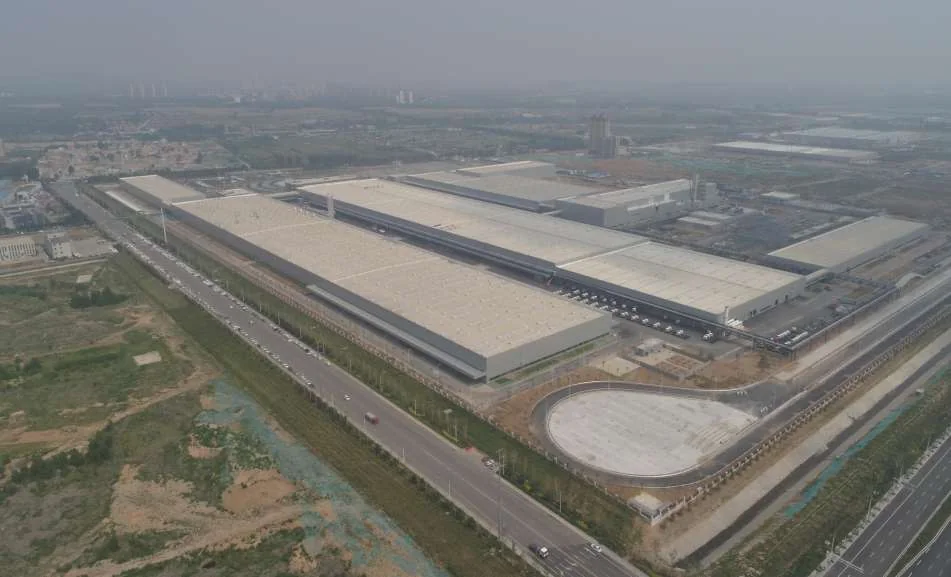
We specify and apply both families — ISO 1461 galvanizing subcontracted to audited bath plants, ISO 12944 paint systems in our own coating halls, and duplex systems on export structures — with DFT control, friction-surface masking and site touch-up kits as standard. For a reference in a demanding environment, see our Daqing West Railway Station project case. If you are writing a corrosion specification or comparing options for a specific site, contact our engineering team with the environment category, design life and member sizes — we will return a coating recommendation with thickness, life and cost figures within 24 hours.
Unsure Which Corrosion System Fits Your Project?
Tell us the location, design life and member geometry. Our coating engineers will compare galvanizing, paint and duplex options with thickness and life-cycle cost projections — within 24 hours.
Request a Coating Study