
Steel Structure Sustainability: Recyclability, Low Carbon and Green Verification
In 2026 the question is no longer whether a steel structure is sustainable, but how its sustainability is measured and documented. Clients on international projects — particularly EU financiers, US developers with ESG reporting and multinational occupiers — increasingly ask for three things: the embodied carbon of the structure, the recycled content of its steel, and the certification evidence a green building scheme will accept. None of those questions can be answered from a brochure; they are answered with EPDs, mill certificates and construction waste records.
Steel has structural advantages in this conversation that are not marketing: it is the world’s most recycled structural material, it is fabricated off-site to millimetre precision, and its demolition waste has a market value that guarantees recovery. But those advantages are conditional. They depend on production route (blast furnace vs electric arc), on where the structure is fabricated, on how well the sections are optimised, and on whether the designer planned for deconstruction at all. This article sets out the numbers that matter — recycling rates, recycled content, embodied carbon boundaries, and the LEED/BREEAM credit structure — and closes with the production practices and project evidence behind the environmental claims made on our own projects.
1. Recycling: Rates, Routes and Recycled Content
The worldsteel figures used in every credible analysis: roughly 85-90% of steel is recycled at end of life globally, and construction steel specifically achieves recovery rates above 90% in mature markets (worldsteel, 2022-2023 reporting). The distinction that causes the most confusion is between recycled content (the fraction of scrap in the production feedstock) and the recovery rate (the fraction captured at end of life). A structure built of BOF steel may have only 15-25% recycled content while still being 90%+ recoverable at demolition; an EAF product can carry 90-100% recycled content. Both are true statements, and both are confidently confusable in tenders — which is why green schemes ask for the production-route-specific number, not a single feel-good percentage.
Globally, electric arc furnace (EAF) production is roughly 28-30% of crude steel, effectively 100% scrap-based; the blast furnace-basic oxygen furnace (BF-BOF) route, dominant in China, uses internal and purchased scrap at 10-25%. The practical implication for a project: if the buyer specifies "minimum 30% recycled content", steel from Chinese BF-BOF mills will typically claim 20-28% and may need careful substantiation, while EAF-sourced sections from, say, an EU mill can document 90%+ without debate. The specification should name the floor, the basis (physical input vs allocation) and the certificate required — for example, an EN 15804-compliant EPD with a stated recycled content value.
2. Embodied Carbon: Measurement Boundaries First
Embodied carbon figures are meaningless without a boundary. The standard framework is EN 15978 / ISO 14067, with EPDs developed per EN 15804. For building structures the communication boundary is almost always A1-A3 (cradle-to-gate): A1 raw material extraction, A2 transport to the mill, A3 manufacturing. The full life-cycle statement also covers A4 transport to site, A5 construction, B1-B7 use (including maintenance and repainting, which is why corrosion protection choice enters sustainability), C1-C4 end of life and D net benefits beyond the boundary — recycling credits sit in D, not in A.
Within A1-A3, published values are (rounded, from worldsteel and national EPD platforms, 2022-2025):
- Global average crude steel: roughly 1.9 t CO2e per tonne (BF-BOF route 2.0-2.4; EAF scrap route 0.4-0.8). Structural steel products — sections, plate — sit close to these values plus finishing.
- Cement: roughly 0.6-0.9 t CO2e per tonne of cement (clinker calcination alone releases about 0.5 t per tonne of clinker); typical C30 ready-mix concrete lands at 300-450 kg CO2e per m³ including aggregates and site batching.
- Structural steelwork fabricated (Chinese practice): add cutting, welding, blasting and coating energy — typically +5-15% on the steel product value depending on member complexity and coating system.
Two implications. First, judge structures, not materials: compare kg CO2e per m² of building, per kN of capacity or per kN·m of moment, never "steel vs concrete" per tonne — a steel frame uses 3-5 times less material mass than a reinforced concrete frame carrying the same load. Second, demand an EPD (EN 15804) from the supplier; a generic number from a website is weaker evidence than a manufacturer-declared EPD covering exactly the product and route being purchased.
3. Steel, Concrete and the Per-Square-Metre Comparison
Structural system comparison at the building level (indicative ranges from published building LCA studies; actual values depend on loading, spans, fire protection and foundation interaction):
| Structural system | Typical material quantity (per m²) | Embodied carbon A1-A3 (kg CO2e / m²) | Recycled content & end-of-life |
|---|---|---|---|
| Steel frame (columns, beams, bracing, secondary) | 50-90 kg steel | 120-200 (plus fire protection where required) | 20-100% recycled content by route; >90% recovery; demolition value positive |
| Precast concrete frame | 300-450 kg concrete + 25-45 kg rebar | 200-320 | Rebar ∼90% recovery; concrete crushing/aggregate reuse partial |
| In-situ reinforced concrete frame | 350-550 kg concrete + 40-80 kg rebar | 300-450 | Rebar as above; formwork waste; demolition crushing dominant |
The table is a range, not a verdict: a steel frame with heavy fire protection and a long transport chain can emit as much as a well-optimised precast system, and the foundation needs differ per site. But on equal terms the steel frame’s carbon advantage is the mass difference — roughly half the embodied carbon per m² of structure — and its end-of-life advantage is absolute: steel scrap is worth money, so recovery is guaranteed by economics, not by regulation.
4. LEED and BREEAM: The Credits Steel Can Earn
Green building certification turns the numbers above into points. The relevant credit families are stable across recent versions:
- LEED v4/v4.1 — Materials and Resources: Building Product Disclosure and Optimization — Environmental Product Declarations (credit for verified EPDs, including manufacturer-specific EPDs and industry-wide EPDs for steel), Sourcing of Raw Materials (recycled content valued at 20% recycled of total material cost in the v4.1 option framework; steel’s recycled content and responsible-sourcing certificates apply), and Construction and Demolition Waste Management (divert 50-75% of waste; steel fabrication offcuts scrap revenue stream makes diversion targets realistic).
- BREEAM — Materials (Mat): Mat 01 Life Cycle Impacts rewards EPDs and whole-life assessments; Mat 03 Responsible Sourcing (BES 6001 or equivalent certification, ISO 14001), and Wst 01 Construction Waste Management rewards measured diversion. Steel fabricators with documented sourcing, recycling and waste figures can directly evidence all three.
- Whole-life carbon beyond credits: several jurisdictions now require embodied carbon reporting at planning (e.g. Dutch MPG, French RE2020, UK parts of Part Z proposals); a steel structure with EPD-backed A1-A3 figures and a defined deconstruction strategy is substantially easier to report than a mixed concrete structure.
The documentation ask is concrete: EPDs for the steel products and coating systems, mill certificates stating the production route, scrap-recycling records from the fabrication plant, construction waste diversion logs, and in some schemes an LCA conducted by an accredited assessor. A fabricator that cannot produce its recycling and waste records will cost the project points at the certification stage — which is a procurement issue, not a design issue.
5. Design and Fabrication Levers That Move the Numbers
Beyond the material declaration, real reductions come from engineering decisions made before steel is ordered:
- Section optimisation: model-based design and shop sequencing reduce steel tonnage; on our long-span work, optimisation of truss layouts and member sizes typically cuts 5-10% of tonnage against a first-pass design — every tonne saved is ~1.9-2.3 t CO2e avoided at the gate, plus transport and erection savings.
- Factory prefabrication: moving welding, cutting and coating indoors removes site energy, scaffolding, weather-related rework and temporary heating; factory processes recycle 100% of cutting skeletons and offcuts back to mills. This is the single biggest operational sustainability lever in steel construction.
- Coating selection: corrosion design life and maintenance frequency (B2 use-stage) are part of the LCA; a duplex or long-life system that eliminates one repaint cycle is a measurable carbon saving at 25-50 years.
- Design for deconstruction: bolted connections, standardised member grids and marked components allow future re-use of steel sections — the highest-value circularity outcome — rather than recycling to scrap. Reuse avoids nearly all A1-A3 emissions of the replacement steel.
6. Our Practice: Verified Measures on Reference Projects
Environmental claims are only as good as their evidence, so the practices below are stated as practices, and the documentation behind them (NDT/QC records, material certificates, scrap-recycling contracts) is made available to clients on request:
- Plant-level measures (Xuzhou fabrication facilities): CNC nesting software raises plate utilisation from a typical 75-80% to 85-90% on complex projects, and all cutting skeletons, plate offcuts and grinding dust are segregated and returned to steel mills for recycling — the shop’s offcut stream itself is a monthly recycled-tonnage record that supports LEED/BREEAM waste credits. Coatings are applied with airless spray at transfer efficiencies above 65%, and shot-blasting media is recycled in closed loops with magnetic separation.
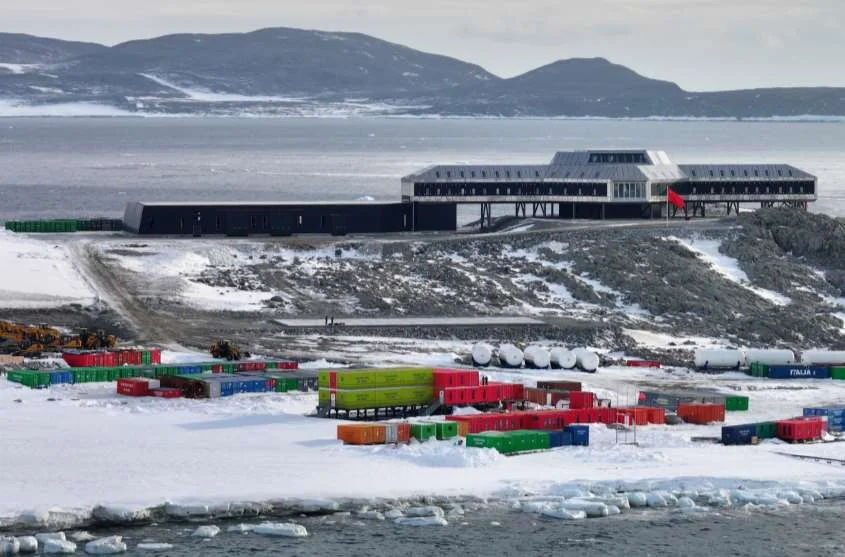
- Antarctic Ross Sea New Station: the entire primary structure was designed as prefabricated bolted modules — all welding, cutting and coating completed in-factory, with only bolted assembly on site. This converted the A5 construction-stage emissions from an open-air, heated, weather-dependent operation to a near-zero-energy site assembly, and reduced transport mass through optimised Q355D section design. The project is documented in our Antarctic case study.
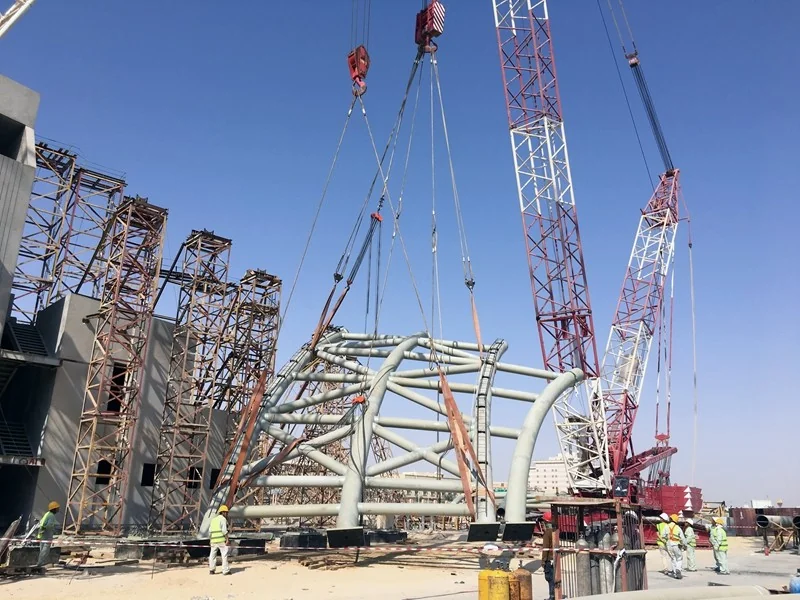
- Guangzhou Baiyun International Airport Phase III Expansion: large-span roof steelwork executed with full factory pre-fabrication and trial assembly — trial bays verified geometry and bolt fit before shipping, eliminating site rework, its embedded energy and its waste; material certificates and NDT records accompanied every delivery. See the project portfolio for the reference list.

Key Takeaways
- Know the two recycling numbers: recovery rate (>90% for construction steel) and recycled content (20-30% BOF route, 90-100% EAF). Certificates must state which one — and on what basis.
- Boundaries first, numbers second: embodied carbon is compared on A1-A3 (cradle-to-gate) per EN 15978/EN 15804; global average steel is ~1.9 t CO2e/t vs 300-450 kg CO2e/m³ for C30 concrete, but only structure-level comparison per m² is meaningful.
- Steel earns LEED/BREEAM credits with documentation: EPDs, recycled-content declarations, responsible-sourcing certification and waste-diversion records — procurement must secure these, not hope for them.
- Real reductions come from design and fabrication: section optimisation (5-10% tonnage), factory prefabrication (site emissions to near zero), long-life coatings (fewer maintenance cycles) and design for deconstruction (reuse beats recycling).
- Claims must be traceable. On our Antarctic and Baiyun projects the sustainability measures are documented practices — factory-only welding, trial assembly, scrap segregation — backed by the same certificate and QC files sold with the steel.
If your project requires embodied carbon figures, recycled-content declarations or LEED/BREEAM documentation for its steelwork, contact our engineering team. We will assemble the A1-A3 calculations, EPDs, material certificates and waste-recycling records for your specific structure — and show you where optimisation can still reduce the number before you order.
Need Low-Carbon Documentation for Your Steel Structure?
Send us your design and certification targets. Our team will prepare the embodied carbon analysis, EPD-based declarations and recycling/waste records your LEED or BREEAM assessment needs — within 24 hours.
Request a Carbon Documentation Pack