Antarctic Ross Sea Research Station
China's first year-round Antarctic research station of the new era — and the first Chinese station facing the Pacific Ocean sector. Built with extreme-environment steel structure engineering that had to survive temperatures below −80°C, hurricane-force winds exceeding 100 m/s, and corrosive salt-laden polar air. This is the project that redefined what our steel structures can endure.
| Project Type | Year-round modular Antarctic research station |
|---|---|
| Location | Inexpressible Island, Terra Nova Bay, Ross Sea, Antarctica |
| Structural System | Modular steel frame with low-temperature welding and corrosion-protection detailing |
| Key Design Conditions | Design temperature context below −80°C with wind chill; design gusts approaching 100 m/s; salt-laden polar air and permafrost conditions |
| Steel Quantity | Available on request from project records |
| Supply Scope | Modular steel fabrication, low-temperature welding controls, protective coating, export packing and assembly support |
| Design Basis | Low-temperature toughness, wind uplift, corrosion resistance, snow drift and foundation thermal isolation |
| Installation / Logistics | Short polar construction window, containerized modules, local crew supervision and sequence-based assembly; detailed logistics available on request |
| Client / Completion Year | Available on request; public project identity shown without unsupported client claims |
Need exact tonnage, installation schedule, crane plan or container count for a comparable project? Request a technical quote and send your drawings or sketch.
Engineering for the Harshest Continent on Earth
The Antarctic Ross Sea station represents a national-level scientific infrastructure project that placed extraordinary demands on every aspect of steel structure engineering — from material selection to welding, from modular prefabrication to on-site assembly in a window measured in weeks.
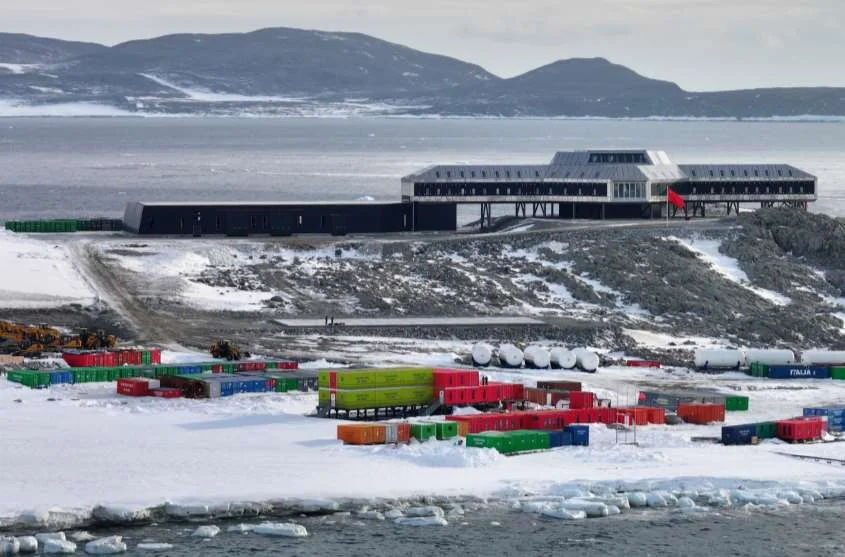
The Chinese Antarctic Ross Sea station, situated on Inexpressible Island in Terra Nova Bay along the Ross Sea coast, is the fifth research station established by China in Antarctica and the first new year-round station of the modern era. It is also the first Chinese station oriented toward the Pacific Ocean sector, filling a critical gap in China's circumpolar observation network. For Jiangsu Permanent Steel Structure Co., Ltd. ("Permanent Steel"), this project was not just another building — it was a validation of our entire manufacturing system under conditions that no laboratory can fully replicate.
The station's geographic position at approximately 74°55′S latitude places it firmly within the Antarctic Circle, where the sun does not rise for months at a time during the austral winter. The site experiences katabatic winds — dense, gravity-driven air flows that descend from the polar plateau and can reach sustained speeds exceeding 60 m/s with gusts approaching 100 m/s. Ambient temperatures at the site have been recorded below −60°C, and with wind chill factors the effective temperature drops well past −80°C. The surrounding environment is not merely cold; it is actively corrosive. Salt-laden air from the adjacent Southern Ocean, combined with freeze-thaw cycling and abrasive wind-blown ice crystals, creates a degradation environment that standard structural steel cannot survive.
Permanent Steel was selected for this project because of our proven capability in prefabricated modular building systems and our proprietary ultra-low-temperature service structural steel welding technology — identified as core manufacturing technology No. 9 in our nine-technology capability framework. No other steel structure manufacturer in China had both the fabrication capacity and the specialized welding qualifications required for this project. The decision was not made lightly: in Antarctica, structural failure is not an inconvenience — it is a threat to human life and a multi-year setback to a national scientific program.
Strategic and Scientific Significance
The Ross Sea station significantly extends China's Antarctic research footprint. Prior stations — Great Wall Station (1985, King George Island), Zhongshan Station (1989, Larsemann Hills), Kunlun Station (2009, Dome A), and Taishan Station (2014, inner ice sheet) — covered the Atlantic and Indian Ocean sectors and the interior plateau. The Ross Sea station adds the Pacific sector, giving China year-round presence in all three Antarctic ocean-facing quadrants. For a steel structure fabricator, this strategic positioning translates directly into one engineering imperative: the building must function continuously, without structural intervention, for decades in the most hostile environment on the planet.
The station supports multi-disciplinary research including atmospheric science, glaciology, marine biology, and space environment monitoring. Each of these scientific programs depends on the structural integrity of the building — not just for shelter, but for vibration-sensitive instruments, thermally stable laboratories, and wind-resistant observation platforms mounted on the roof and exterior. The steel structure had to be designed not only to stand, but to perform as a precision platform for scientific measurement.
Five Extreme-Environment Engineering Frontiers
1. Ultra-Low-Temperature Steel Brittle Fracture
Conventional structural steel grades such as Q355B or even Q355C lose ductility rapidly as temperature drops. At −40°C, the Charpy V-notch impact energy of standard structural steel can fall below 27 J — the minimum specified by GB/T 1591 for grade C quality. At the design minimum temperature of −80°C, standard grades exhibit brittle fracture behavior, meaning a crack initiated at a stress concentration point (a weld toe, a bolt hole, a fabrication defect) can propagate catastrophically through the entire member without plastic deformation to arrest it. This is the single most dangerous failure mode in polar structural engineering: the structure appears intact until the moment it shatters.
The challenge was compounded by the fact that welding — the unavoidable joining process in steel construction — creates a heat-affected zone (HAZ) with altered microstructure. The HAZ is typically the weakest link in low-temperature service: rapid cooling rates from welding in cold environments can produce brittle martensitic microstructures in the HAZ, dramatically reducing toughness at a location where residual stresses are already highest. Every welded connection in the station's steel frame was a potential brittle fracture initiation site.
2. Extreme Wind Loading — 100 m/s Design Gust
Antarctic katabatic winds are not like typhoons. A typhoon arrives, passes, and leaves. Katabatic winds are a permanent atmospheric feature: dense, cold air from the polar plateau flows downhill under gravity, accelerating as it converges through coastal valleys. At the Ross Sea site, these winds can sustain 60 m/s for hours and produce gusts approaching 100 m/s — equivalent to a Category 5 hurricane, but arriving not once a century but repeatedly throughout each winter.
The structural implications are severe. Wind pressure scales with the square of velocity: a 100 m/s gust generates approximately four times the lateral force of a 50 m/s wind. The building's envelope, roof, and elevated platforms all face wind loads that would destroy structures designed to normal building codes. Wind uplift on the roof — the force that tries to peel the roof upward — was a critical design case, because a roof failure in Antarctica means immediate loss of thermal envelope and potential loss of life.
Beyond static wind pressure, vortex shedding and aeroelastic instability had to be evaluated. A structure with the right (wrong) natural frequency can enter self-excited oscillation under steady wind — the same phenomenon that destroyed the Tacoma Narrows Bridge. The station's geometry, stiffness distribution, and mass distribution had to be tuned to avoid resonant response across the full spectrum of wind speeds the site experiences.
3. Salt Corrosion in a Polar Marine Environment
The Ross Sea coastline is a marine environment. Salt spray from the Southern Ocean, carried by katabatic winds, deposits chloride ions on every exposed surface. In a temperate climate, rain would periodically wash these deposits away. In Antarctica, there is no liquid precipitation — salt accumulates on the structure continuously. Freeze-thaw cycling creates micro-cracks in coating systems, allowing chloride penetration to the steel substrate. Once chlorides reach the steel surface, pitting corrosion initiates, and in a structure that must last 25-30 years without major maintenance, even minor corrosion can compromise thin-walled members.
The challenge was not merely selecting a corrosion-resistant coating. It was engineering a corrosion protection system that could be applied in a factory, survive the mechanical abuse of shipping and assembly, and then perform for decades without reapplication — because re-coating a steel structure in Antarctica during winter is operationally impossible.
4. Foundation on Permafrost and Snow Accumulation
The station site sits on permafrost — ground that remains below 0°C year-round. Building on permafrost is fundamentally different from building on temperate soil. Heat conducted from the building through its foundation can thaw the underlying permafrost, causing differential settlement. Conversely, the extreme cold conducted from the ground into the building must be interrupted by thermal isolation at the foundation level.
Snow accumulation added another dimension to the foundation challenge. Drifting snow around a building in Antarctica can accumulate to depths exceeding 3 eters in a single winter. The foundation and lower structure had to withstand not just vertical snow loads but lateral pressure from snow drifts pressing against the building envelope. The elevated platform design — raising the building on steel stilts — was chosen specifically to allow wind to scour snow from beneath the structure rather than accumulate it.
5. Construction Window and Logistics
The Antarctic construction window is approximately 6-8 weeks per year during the austral summer (November-January). Every component had to arrive by ship during this window, be offloaded onto sea ice or a temporary ice pier, transported to the site, and assembled before the ship departed. There was no opportunity for "next week's delivery" of a missing part or a replacement for a damaged component. Everything had to be right the first time, with redundant spare parts for every critical connection.
The logistics chain from our Xuzhou fabrication facility to the Ross Sea site spans approximately 15,000 km and involves truck transport, port handling, ocean shipping through the Southern Ocean, ice-breaking escort, and final over-ice transport by sled or helicopter. Every module had to be designed to fit within standard shipping container dimensions while maximizing structural efficiency and minimizing field welding.
How We Solved Each Frontier
Ultra-Low-Temperature Service Structural Steel — Core Technology No. 9
The material solution centered on our proprietary ultra-low-temperature service structural steel welding technology, the ninth of our nine core manufacturing capabilities. The primary structural members were fabricated from low-temperature service steel grades qualified for service at −50°C and below. These steels are produced with controlled micro alloying (niobium, vanadium, titanium) and low carbon equivalents (CEV < 0.38) to ensure that the heat-affected zone retains adequate toughness after welding.
The welding procedure specification (WPS) was developed and qualified specifically for this project. Key parameters included:
- Pre-heat temperature: Elevated to 80-120°C to slow the cooling rate and prevent brittle martensite formation in the HAZ, even when ambient temperature is far below freezing during fabrication.
- Inter-pass temperature control: Maintained within a narrow band to ensure consistent microstructure across multi-pass welds.
- Consumables: Low-hydrogen electrodes and fluxes with moisture control to prevent hydrogen-induced cold cracking — a failure mode that is dramatically accelerated at low service temperatures.
- Post-weld testing: 100% ultrasonic testing of critical welds, with Charpy V-notch testing of procedure qualification coupons at −50°C and −80°C to verify HAZ toughness.
Every welder assigned to this project underwent additional qualification testing, including deposition of test coupons that were subsequently tested at −80°C. This is not standard practice — most structural welding qualifications verify performance at room temperature only. In our case, the qualification temperature was the service temperature, because a weld that passes at +20°C can still fail at −80°C.
Modular Construction System
The architectural and structural solution to the logistics challenge was a fully modular construction system. Rather than shipping individual steel members to be assembled stick-by-stick on the ice, the station was designed as a set of three-dimensional steel-framed modules that were:
- Fabricated complete in our Xuzhou facility, including structural frame, floor, walls, and roof elements
- Fitted out with internal partitions, utility rough-ins, and insulation to the maximum extent possible within the factory environment
- Shipped in standard container dimensions to minimize transport complications
- Assembled on-site by bolting modules together, with minimal field welding — reducing both the time and the quality risk of welding in extreme cold
This approach leveraged our prefabricated building system capability, where the factory environment provides controlled temperature, humidity, and lighting conditions that are impossible to replicate in the field. Every welded connection that could be made in the factory was made in the factory. Field connections were predominantly bolted, using high-strength friction-grip bolts that had been torque-calibrated in the factory and required only final verification on-site.
The modular approach also meant that each module could be individually load-tested, inspected, and signed off before shipment. A non-conforming module could be reworked in the factory. A non-conforming field weld, by contrast, would require months to rectify — the next ship does not arrive until the following summer.
Aerodynamic Wind Engineering
The wind design went far beyond code-based static wind pressure calculations. Computational fluid dynamics (CFD) analysis was performed on the station's final geometry to identify wind flow patterns, pressure distributions, and potential vortex shedding frequencies. The building's streamlined form — with rounded corners and a tapered roof profile — was specifically optimized to reduce drag coefficients and minimize vortex formation at the leeward edges.
The elevated platform design, with the main building raised on steel columns above the snow surface, served dual purposes. First, it allowed katabatic wind to flow beneath the structure, scouring accumulated snow and preventing the building from being buried. Second, it reduced the windward projected area at ground level, where drifting snow creates the highest lateral pressures. The column-to-foundation connections were designed for the full overturning moment of a 100 m/s wind on the elevated building — a load case that produces tension uplift forces that the foundation anchors had to resist without pull-out.
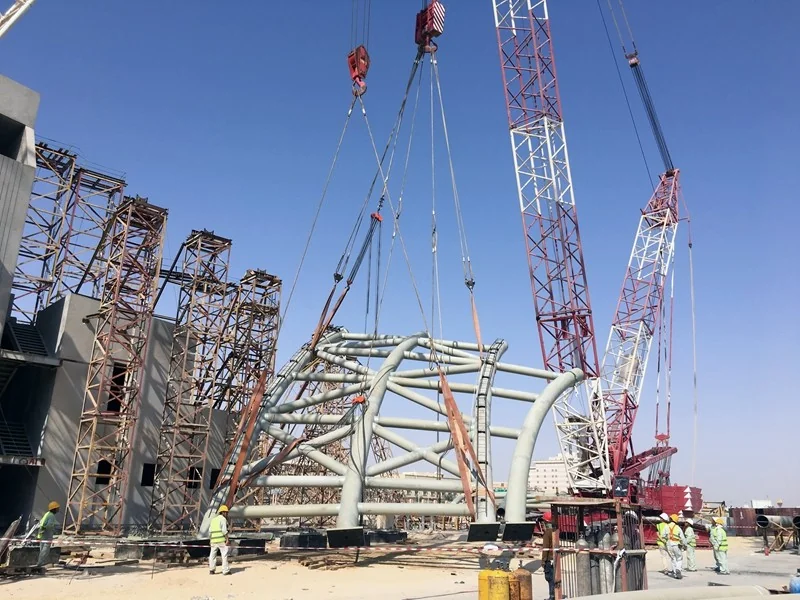
Roof uplift was addressed through a combination of aerodynamic shaping (reducing the suction coefficient on the roof surface) and structural tie-down capacity (ensuring that the roof-to-wall connections could resist the worst-case uplift force). The roof structure was designed as a spatial grid structure — a system whose inherent redundancy means that the failure of any single member does not lead to progressive collapse, because load paths redistribute through the three-dimensional grid.
Corrosion Protection System
The corrosion protection strategy was a three-barrier system:
- Substrate: Steel with controlled surface preparation to Sa 2.5 (near-white metal blast cleaning) immediately before priming
- Primer: Zinc-rich epoxy primer providing galvanic protection at any location where the topcoat is damaged
- Intermediate and topcoat: Multiple coats of high-build epoxy and polyurethane topcoat, achieving a total dry film thickness (DFT) exceeding 350 µm — roughly three times the coating thickness of a standard industrial building
Special attention was given to coating edge profiles. Sharp edges are the first locations where coatings fail, because the coating pulls thin over a radius. All external edges were radiused, and stripe coats were applied to all edges, corners, and weld profiles before full-area coating application. This labor-intensive process is standard in offshore and marine engineering but rare in general steel structure fabrication — yet it is exactly the level of detail required for a structure that cannot be recoated for decades.
Thermal Isolation at Foundation Level
The foundation design incorporated thermal isolation between the heated building interior and the permafrost substrate. Steel foundation columns were specified with thermal break connections — insulating material inserted in the load path to interrupt conductive heat flow from the building into the ground. This prevents permafrost thaw, which would cause differential settlement and potentially destabilize the entire structure.
The elevated steel structure also provides a ventilated crawlspace beneath the building, allowing ambient air (cold as it is) to maintain the ground temperature at its natural state rather than allowing building heat to warm the permafrost. This is the same principle applied in Arctic and sub-Arctic construction, but extended to a much more extreme thermal gradient.
What This Project Means
The Antarctic Ross Sea station is more than a building. For Permanent Steel, it is the ultimate proof of our manufacturing capability. If our welds hold at −80°C under 100 m/s wind loading, they hold anywhere. Every welding procedure, every quality control protocol, every material specification developed and validated for this project has been incorporated into our standard practice for cold-region and extreme-environment projects.
For China's Antarctic program, the station provides a year-round scientific presence in the Pacific sector of Antarctica for the first time in history. The station's laboratories, living quarters, and observation platforms support research programs that contribute to global climate science, oceanography, and space weather monitoring — research that depends on the structural integrity of a building that 99.9% of steel fabricators could not build.
For the steel structure industry, this project demonstrates that Chinese manufacturers can deliver extreme-environment structural engineering at a level previously associated only with specialized Arctic engineering firms. The combination of ultra-low-temperature steel welding, modular prefabrication, marine-grade corrosion protection, and aerodynamic wind engineering in a single project represents a capability profile that very few fabricators worldwide can match.
Quality Assurance and Lessons Learned
The project reinforced several principles that are now embedded in our quality management system:
- Test at service temperature, not room temperature. Material and weld qualifications that pass at +20°C can fail catastrophically at service temperature. For any project with a design minimum temperature below −20°C, we now require Charpy testing at the actual service temperature.
- Modularize when field conditions are hostile. The ratio of factory welds to field welds on this project exceeded 10:1. Every weld moved from the field to the factory is a weld made under controlled conditions, inspected under proper lighting, and reworkable if non-conforming. This principle applies to any project where site access or environmental conditions are constrained — not only Antarctica.
- Coating quality is structural quality. In an environment where re-coating is impossible for years, the corrosion protection system is not a finish — it is a structural element. Edge preparation, stripe coating, and DFT verification must receive the same inspection rigor as structural welding.
Systems Used in This Project
 Building System
Modular Prefabricated Building System
Factory-complete modules with structural frame, envelope, and utilities pre-installed. The system that made Antarctic assembly possible in a 6-week window.
 Structure
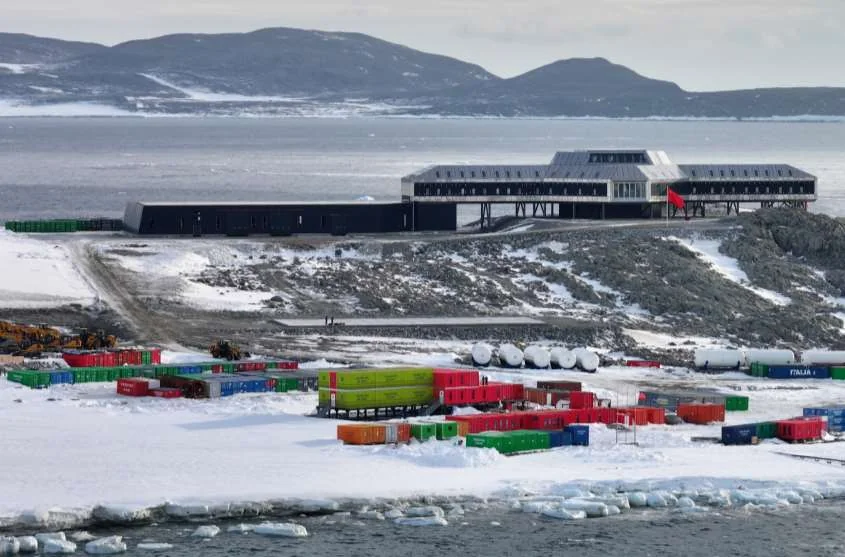
Spatial Grid Structure
Three-dimensional grid providing redundant load paths and wind resistance. Inherent redundancy means single-member failure does not cause progressive collapse.
 Components
Ultra-Low-Temperature Steel Welding
Core manufacturing technology No. 9. Welding procedures qualified at service temperatures down to −80°C with Charpy V-notch verification of HAZ toughness.
Have an Extreme-Environment Project?
If your project site involves temperatures below −20°C, sustained high winds, marine corrosion, or remote assembly logistics, we have proven experience delivering structures that perform. Contact our engineering team to discuss your requirements.
Request a Consultation WhatsApp Our Engineer