Buying Steel Structures from China for Brazil
Brazilian buyers comparing imported steel against local fabrication usually find the decision turns on one number: the landed-cost multiplier created by the import tax stack. This guide covers the design standards your fabricator must meet, the certification questions that actually apply, how to model the II + IPI + PIS/COFINS + ICMS burden, and how ex-tarifário can change the arithmetic for capital goods.
Which Brazilian Codes Your Fabricator Must Meet
Brazilian steel construction is governed by ABNT NBR standards, led by NBR 8800 for the design of steel structures. Unlike some markets, there is no blanket government certification for every imported steel article — the obligations that matter are design compliance, material certificates your Brazilian engineer accepts, and INMETRO certification only for the specific product lines that require it. Put the standard list below in writing before quoting.
| Document | Scope | Key Requirement for Imported Steel |
|---|---|---|
| ABNT NBR 8800 | Design of steel structures (LRFD basis) | Member, connection and stability checks per NBR 8800, with a Brazilian engineer of record reviewing the design and shop drawings. |
| ABNT NBR 6123 | Wind loads on buildings | Project wind cases must be calculated to NBR 6123 with the site's basic wind speed and terrain category. |
| ASTM A572 / A36 (material mapping) | Structural steel grades common in the Brazilian market | Mill certificates must show the equivalent grade with full chemistry and yield values so the Brazilian engineer can map them into NBR 8800 checks. |
| ABNT NBR 14762 | Cold-formed steel sections | Applies where the package uses cold-formed members; confirm the section basis before fabrication starts. |
| AWS D1.1 (welding acceptance) | Structural welding qualification and inspection | Most Brazilian projects accept AWS D1.1 welder qualification, WPS/PQR and inspection acceptance; confirm the contract clause. |
How We Execute Brazil-Code Projects
On Brazil-bound orders we design and check to NBR 8800 with wind cases per NBR 6123, map material to the ASTM grades Brazilian engineers work with, and qualify welding to AWS D1.1 with WPS documented at our Xuzhou shop. Shop drawings are issued for your Brazilian engineer of record; an independent agency can hold witness inspection before loading.
This is not theoretical for us. We have already fabricated and shipped structural steel into Brazil for a shipyard project in Vitória, and that delivery taught us exactly which certificate formats Brazilian customs and engineering reviewers accept without back-and-forth.
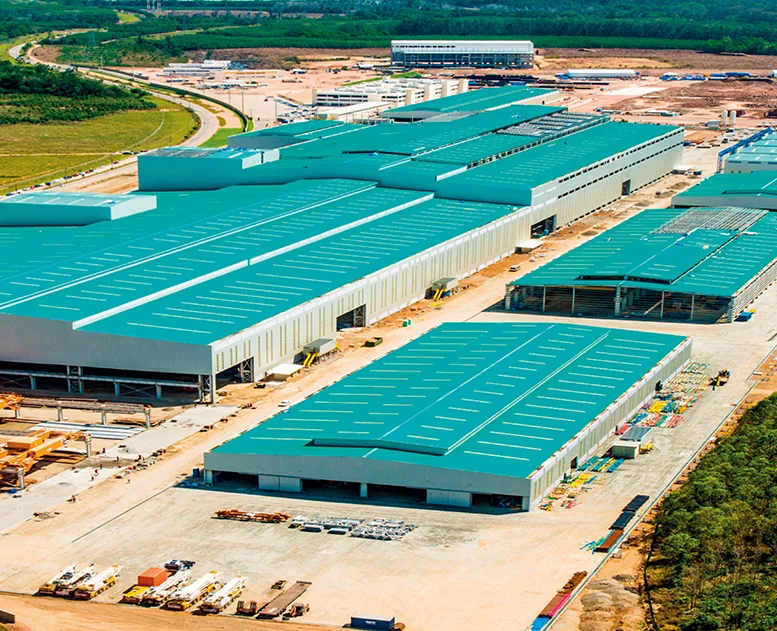
Delivered Into Brazil Already
Our Vitória shipyard steelwork is a live reference: Brazilian port handling, certificate acceptance and site erector coordination are solved problems for our team, not first-time unknowns.
INMETRO, ANVISA and What Really Applies
Importers sometimes over-worry about Brazilian certification. The administration that matters is INMETRO, the Brazilian conformity assessment body. INMETRO runs mandatory certification programmes for specific product lines — certain steel products used in construction are inside those programmes, while plain fabricated structural steelwork may fall outside depending on its final use. The opposite common worry, ANVISA health certification, does not apply to steel at all.
What We Check With You Before Quoting
For any steel article that carries a mandatory INMETRO certification requirement, the certificate must be issued by a body accredited in Brazil and the marking must appear on the product or its packaging before customs release. The decisive question is the final application of the goods, so we ask, in writing, how the structure will be used and which federal or state programme the client reports to. That single answer decides the certification route, the paperwork and whether the shipment is simple or complex.
For the rest of the package — structural connections, coating system, fabrication tolerances — the applicable evidence is the same everywhere: mill certificates, welding records, coating reports and inspection photographs, assembled into a file your customs broker and engineer can read in one pass.
ex-tarifário: The Lever For Capital Goods
Brazil's ex-tarifário mechanism is a customs procedure that temporarily reduces the II (import duty) rate for capital goods — machinery, equipment and structures that have no equivalent domestic production. For an industrial facility importing a specialised steel building system, a successful ex-tarifário application can materially reduce the largest single component of the tax stack.
Applications are filed by the importer before shipment and are evaluated case by case, so the planning sequence is: confirm eligibility with a customs advisor, file early, and only then fix the shipping schedule. We support the process by documenting that the goods have no equivalent local manufacture — something our export documentation package already evidences.
The Tax Stack: II, IPI, PIS/COFINS and ICMS
Brazilian import tax is not one line item — it is four federal and state charges stacked on the CIF value, and some are also levied on the tax itself. This is why a Brazil quotation must never be compared on FOB prices alone. The figures below are planning references: confirm every rate with a licensed customs advisor at time of import, because federal and state adjustments happen regularly.
| Cost Component | Indicative Magnitude | Notes |
|---|---|---|
| II — import duty | 10–20% depending on NCM classification (planning range) | Confirm the NCM code with your broker; ex-tarifário may reduce this for eligible capital goods. |
| IPI — industrial products tax | Varies by product line (planning range 5–15%) | Levied on CIF + II; rate depends on the NCM position. |
| PIS / COFINS on imports | ≈9.25% combined (1.65% + 7.60%) | Social contributions on landed value; confirm the current combined rate. |
| ICMS — state tax | 17–20% depending on destination state | Collected at customs on imports; rate is set by the destination state (e.g. São Paulo, Rio de Janeiro). |
| Ocean freight, Shanghai → Santos | USD 95–150 / t (2026 indicative) | Santos is the main container gateway; Itaguaí, Paranaguá and Rio Grande are alternates depending on final site and cargo type. |
The bottom line: stacked II + IPI + PIS/COFINS + ICMS can take the landed cost 35–55% above the FOB value for a typical fabricated steel shipment, before freight. That is a serious number, and it is exactly why we ask Brazilian clients to model the full stack instead of comparing unit prices. The comparison only closes in favour of import when the structure is engineered for weight efficiency and assembly speed — a spatial grid or long-span truss that saves foundation and erection cost can still win on total installed cost.
Two practical moves change the arithmetic: apply for ex-tarifário where the goods qualify as capital goods, and import as a registered company so ICMS and PIS/COFINS can flow through your normal credit and recovery structure. We work with your customs advisor on both.
Timeline to a Brazilian Site, Step by Step
Plan 22–26 weeks from approved shop drawings to delivery in Brazil. The ocean leg is the longest of any of our major export routes, so documentation quality and berth choice matter more than quayside speed.
Shop Drawing & Approval — Wk 0-4
Tekla shop drawings issued to NBR 8800 for your Brazilian engineer of record. Budget 2–4 weeks; complex grids or trusses run 4–6. Revisions are version-controlled with a transmittal record.
Material Procurement & Mill Certs — Wk 2-5
Mill certificates collected per heat in the ASTM-equivalent format Brazilian engineers expect, including chemistry and yield values. No substitution without written client approval.
Fabrication & QC — Wk 5-13
A 1,000 t frame runs 6–9 weeks in our shop: AWS D1.1 welding qualification, 100% weld inspection by certified QC, coating to your specification for the site environment.
Pre-Shipment Inspection & Loading — Wk 12-14
Optional third-party witness (SGS/BV/Cotecna). Fumigated, ISPM-15-compliant packing for timber; steel bundles strapped and edge-protected for the long tropical crossing.
Ocean Transit — Wk 14-21
Shanghai to Santos typically 42–49 days sailing, the 6–7 week leg our clients plan for. Itaguaí (Rio de Janeiro) and Paranaguá are common alternates for bulkier cargo.
Customs Clearance & Delivery — Wk 21-26
Licensing and the full tax stack settled via your customs broker, ICMS collected at the destination state rate. DDP to site is available on select shipments through our logistics partners.
Projects of Similar Scale and Complexity
Brazilian buyers should evaluate three things: local delivery evidence, long-span capability and airport-grade quality discipline. The projects below cover exactly that pattern.
Shipped Into Brazil
Vitória shipyard steelwork — our live Brazilian reference for port handling, certificate acceptance and coordination with local erectors on a demanding industrial structure.
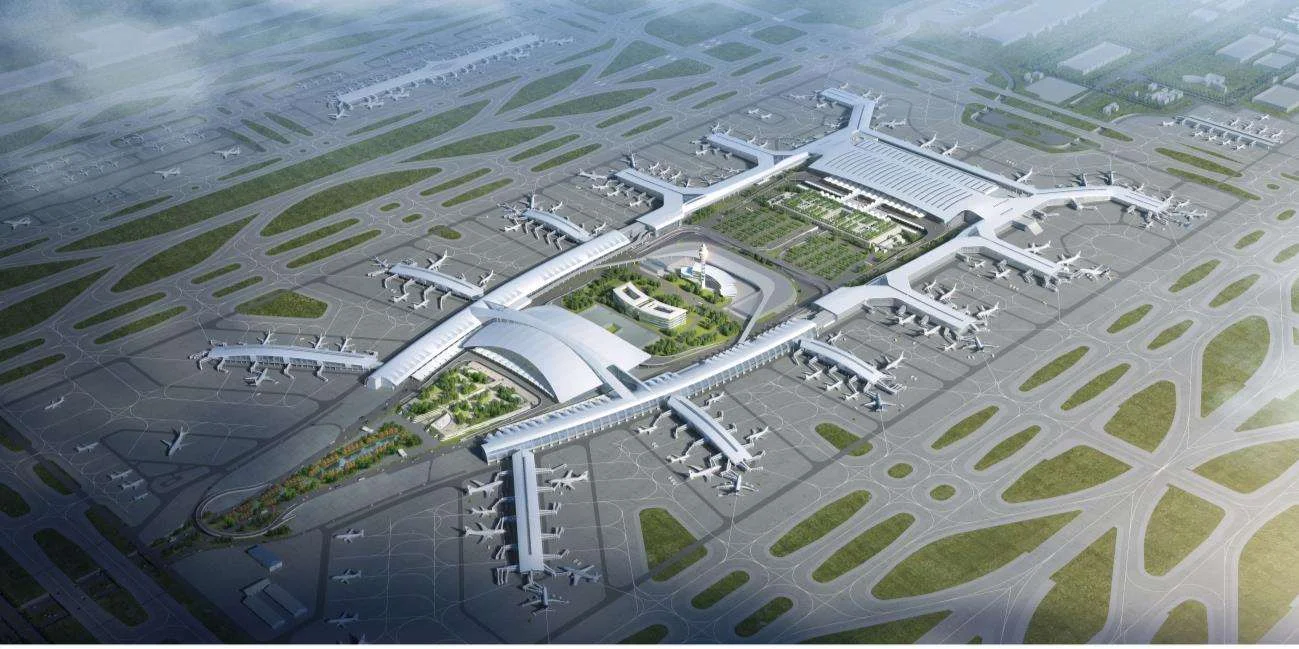
450,000 m² Airport Roof
Guangzhou Baiyun Phase III: 42,000 t of steel in one terminal programme — the scale and quality discipline airports demand, transferable to large Brazilian public buildings and terminals.

Weight-Efficient Grids
Bolted-sphere space grids deliver the material efficiency that makes imported steel competitive in Brazil — less steel per square metre means a smaller tax base and lighter foundations.
Brazilian Buyer Questions, Answered
Do you design and fabricate to NBR 8800?
Yes. We issue shop drawings checked to NBR 8800 with wind cases per NBR 6123, map material to the ASTM grades used in Brazil, and qualify welding to AWS D1.1. Your Brazilian engineer of record reviews and approves before fabrication.
Does every steel import need INMETRO certification?
No — only product lines covered by a mandatory INMETRO programme. Whether yours is inside the requirement depends on the article and its final use, so we confirm that with you and your advisor in writing before quoting. ANVISA health certification does not apply to steel.
What is the realistic total landed cost versus manufacturers' price?
Plan for II + IPI + PIS/COFINS + ICMS to add roughly 35–55% over FOB value before freight, depending on NCM classification and destination state. Model the stack with your broker; on weight-efficient structures the installed-cost comparison can still favour import.
Can you support an ex-tarifário application?
Yes. We document that the structure has no equivalent domestic production — the core evidence in an application — and schedule production around your approval timeline. File with a customs advisor early: it is an importer-side procedure.
What is the realistic total lead time?
Plan 22–26 weeks from approved drawings to delivery in Brazil: about 14 weeks of engineering and fabrication, 6–7 weeks of ocean transit, and 2–5 weeks for clearance once the vessel arrives.
Get a Brazil-Specific Quotation
Send your drawings and site location and we will return: NBR 8800 design notes, FOB/CIF/DDP pricing, a modelled II+IPI+PIS/COFINS+ICMS estimate, ex-tarifário guidance and a binding fabrication schedule.
Request a Quotation Talk to an Engineer