Buying Steel Structures from China for Nigeria
Nigerian buyers importing fabricated steel face four practical questions: which design code the fabricator actually uses, whether the shipment will pass SONCAP verification, how much duty and VAT land on top of the invoice, and how to schedule around port congestion in Lagos. This guide covers each one with the same numbers we share with clients before quoting.
Which Standards Apply to Steel Structures in Nigeria
Structural design in Nigeria follows British and European practice. Most new projects are designed to EN 1993 (Eurocode 3), while older sites and contractor-built frames may still reference BS 5950. Material, welding and execution requirements follow European BS EN standards. Import itself is regulated separately by SONCAP, covered in the next section — but the design basis must be written into your contract before quoting starts, because it changes both engineering hours and inspection scope.
| Document | Scope | Key Requirement for Imported Steel |
|---|---|---|
| EN 1993 (Eurocode 3) | Design of steel structures | Dominant code for new Nigerian projects. Member, connection and stability checks with project-specific wind loads must follow EN 1993 sections and national annex guidance. |
| BS 5950 (legacy) | Former UK steel design code | Existing drawings and refurbishment packages may still reference it. We re-verify legacy designs to EN 1993 where clients need a modern calculation basis. |
| BS EN 10025 / BS EN 10210 | Structural steel material grades and hollow sections | Mill certificates must list BS EN 10025 grades (e.g. S355JR) with chemistry and yield values; hollow sections per EN 10210 for lattice trusses and grids. |
| EN 1090-2 | Execution of steel structures | Fabrication tolerances, welding qualification and inspection acceptance for European-code work — the shop QC basis on our Nigeria-bound orders. |
| NIS / SON reference standards | Nigerian Industrial Standards for building materials | SON applies its own standards to regulated building materials; confirming applicability before shipment avoids rejection at the port. |
How We Execute Nigeria-Code Projects
On Nigeria-bound orders we fabricate to a double standard: material to BS EN 10025 grades with complete mill certificates per heat, welding and execution to EN 1090-2, and shop drawings issued to EN 1993 for your consulting engineer's review. Independent inspection by an agency such as SGS or Bureau Veritas can witness the production before loading — the same witness can run the SONCAP verification visit, saving you a second mobilisation.
Our 200,000-tonne annual capacity and 6 special-grade qualifications mean a typical warehouse or factory frame of 400–1,500 t is a standard production slot, not a schedule risk. We have shipped and erected European-code steelwork across more than 40 countries, including African projects in environments similar to Lagos.

Long-Span Roofs for Warehouses and Terminals
Bolted-sphere space grids and pipe trusses give Nigerian clients the column-free spans they need for warehouses, logistics centres and public terminals, with node and member checks to EN 1993.
SONCAP: What Must Happen Before Your Cargo Sails
The Standards Organisation of Nigeria (SON) administers SONCAP, the SON Conformity Assessment Programme. For regulated products — fabricated steel building structures fall within the programme — a Certificate of Conformity (CoC) issued against pre-shipment verification is required to clear customs at Apapa, Tin Can Island or Lekki. This is an import requirement, not a design requirement, and it is the step most first-time buyers underestimate.
The Practical Sequence
In practice the verification happens while the goods are still in our Xuzhou shop: an authorised SONCAP inspection agency checks the packed items against the commercial invoice, the mill certificates and the agreed standard, then issues the CoC before the vessel loads. Cargo that sails without a CoC lands at the port and sits — at demurrage rates that quickly exceed the inspection fee. The certificate must be matched to the shipping documents when the clearing agent files the entry.
We prepare the full document set alongside it: commercial invoice, packing list, mill certificates per heat, welding qualification records, coating thickness reports and loading photos. That package is what lets a Lagos clearing agent move the entry through quickly instead of chasing the factory by email for three weeks.
Planning Notes
SONCAP applies per shipment and per regulated product line, so state your HS classification clearly during quotation — changing it after fabrication can change both the certification route and the duty rate. Exceptions and exemptions exist for some categories, but we advise clients never to plan around an exemption; verify it in writing with the inspection agency before production starts.
For government-financed and bank-backed projects, ask us to include the CoC as a document required under the LC — it is the cleanest way to prove regulatory compliance in one step at negotiation time.
Duty, VAT and the Real Landed Cost in Lagos
Nigerian import cost is driven by import duty, VAT and port handling — and they are all calculated on top of the CIF value, so the multiplier matters more than the headline freight rate. The figures below are planning references only: confirm rates with your clearing agent and the Federal Inland Revenue Service at time of import, because the annual Finance Act and exchange-rate policy move them.
| Cost Component | Indicative Magnitude | Notes |
|---|---|---|
| Import duty | 5–20% depending on HS chapter (planning range) | Fabricated steel structures (HS 7308) typically sit mid-range; confirm your exact HS code before ordering. |
| VAT | 7.5% (2026 prevailing standard rate) | Applied on CIF plus duty for imports; confirm the rate in force at clearance. |
| SONCAP verification & CoC | Fixed fee per shipment | Arranged by us pre-shipment or through your agent; small relative to demurrage risk. |
| Ocean freight, Shanghai → Lagos | USD 90–140 / t (2026 indicative) | Break-bulk or container to Apapa/Tin Can; congestion surcharges apply in peak seasons. Lekki Deep Sea Port offers an alternative berth as capacity ramps. |
| Terminal handling & clearing in Lagos | Quoted by your clearing agent | Demurrage becomes material when documentation or SONCAP is incomplete on arrival. |
The bottom line: work from landed cost, not FOB. For a typical 500–1,000 t project the gap between FOB and total landed cost in Lagos can reach 35–45% once duty, VAT, terminal handling and clearing fees are stacked. CIF quotations are the norm for Nigerian buyers because they fix the freight element; DDP (Delivered Duty Paid) to Lagos is available on select shipments through our logistics partners, giving one invoice and one fixed landed figure.
For government or bank-financed projects, an LC at sight with the SONCAP CoC and the standard shipping document set is a common and workable structure — we regularly assemble the file package for exactly that presentation.
Timeline to a Nigerian Site, Step by Step
A realistic schedule protects both sides. Budget 20–24 weeks from approved shop drawings to delivery in Lagos. The port step is the least predictable part of the chain, and good documentation is the cheapest insurance against it.
Shop Drawing & Approval — Wk 0-4
Tekla shop drawings and erection plans issued to EN 1993 for your consulting engineer. Budget 2–4 weeks; complex grids or trusses run 4–6. Revisions are version-controlled with a transmittal record.
Material Procurement & Mill Certs — Wk 2-5
BS EN 10025 mill certificates collected per heat, including the chemistry values your engineer's check requires. No substitution without written client approval.
Fabrication & QC — Wk 5-13
A 1,000 t warehouse frame runs 6–9 weeks in our shop: EN 1090-2 execution controls, weld inspection by certified QC, coating to your spec (typically 2–3 coats, 240 µm DFT for a C3 coastal environment).
Pre-Shipment Inspection & SONCAP — Wk 12-15
Third-party witness and the SONCAP verification visit run while goods are still in the shop, so the CoC is issued before the vessel loads. Fumigated, ISPM-15-compliant packing for timber; steel bundled and edge-protected.
Ocean Transit — Wk 15-20
Shanghai to Apapa typically 28–35 days sailing. Add 5–10 days for Lagos berth congestion; routing via Lekki Deep Sea Port is increasingly available as its container capacity scales up.
Customs Clearance & Delivery — Wk 20-24
CoC plus the complete invoice and certificate package filed by your Lagos clearing agent. DDP delivery to site available on select shipments — one invoice, no surprises at the gate.
Similar Climates, Grids and Sites — Already Delivered
The projects below are the evidence pattern we ask Nigerian buyers to evaluate: African airport and housing programmes executed under remote-site logistics, plus a long-span record relevant to large column-free buildings.
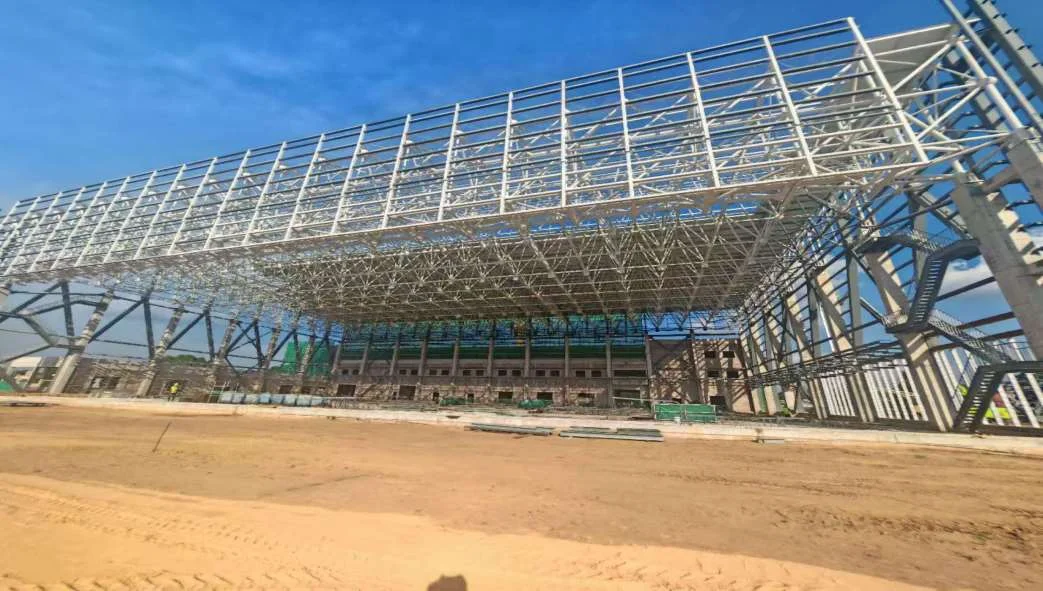
African Airport Terminal
Airport of the Republic of the Congo — terminal steelwork delivered to a tropical climate with remote-site logistics, the same discipline a Nigerian airport or large public building demands.
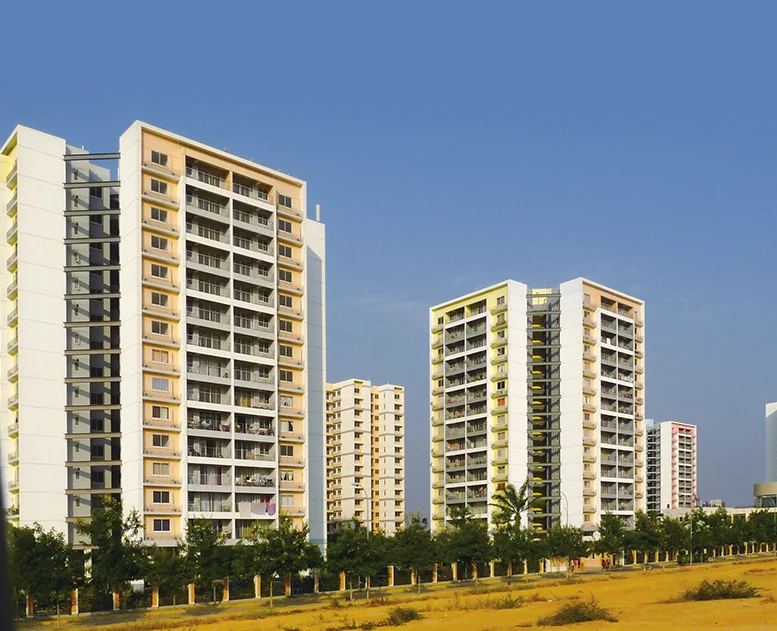
African Housing Programme
Angola affordable housing — mass-produced portal frames and prefabricated steelwork shipped break-bulk to Africa, proving repeatable volume delivery under programme deadlines.
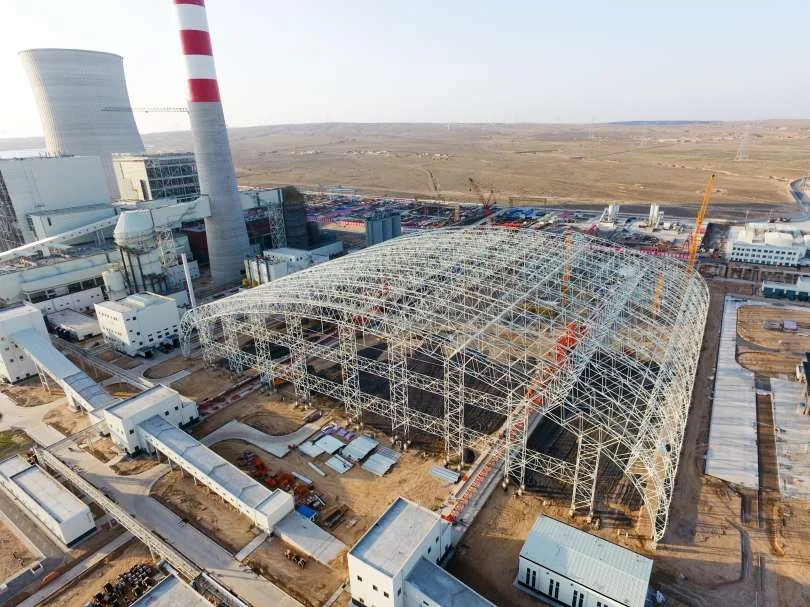
229 m Long-Span Enclosure
Guodian Ningxia enclosed coal shed — a 229-metre prestressed beam-string roof; the capability base for Nigerian clients planning large column-free warehouses or terminal buildings.
Nigerian Buyer Questions, Answered
Do you handle SONCAP certification for us?
Yes. The SONCAP verification visit is arranged while the goods are still in our shop, and the Certificate of Conformity is issued before loading. We assemble the full document set — invoice, packing list, mill certificates, welding records, coating reports — for your clearing agent.
EN 1993 or BS 5950 — which do you design to?
New projects are designed to EN 1993 with project-specific wind loads. Where an existing design references BS 5950, we re-verify the calculation and issue the shop drawings on that basis so the engineer of record can approve without rework.
What is a realistic total lead time?
Plan 20–24 weeks from approved shop drawings to delivery in Lagos on a standard 1,000 t programme: about 15 weeks of engineering and fabrication, 4–5 weeks of ocean transit, and 2–4 weeks of port and customs handling depending on berth availability.
Can you quote CIF Lagos or DDP?
Both. CIF Apapa or Tin Can is our standard export term for Nigerian buyers; DDP with the duty and VAT included is available on select shipments through our logistics partners, giving one fixed landed price.
Get a Nigeria-Specific Quotation
Send your drawings and site location and we will return: EN 1993 design notes, FOB/CIF/DDP pricing, a SONCAP documentation plan with indicative duty and VAT, and a binding fabrication schedule.
Request a Quotation Talk to an Engineer