
Buying Steel Structures from China for the UK
British buyers importing fabricated steel now work with two conformity regimes — UKCA for Great Britain and CE for Northern Ireland — plus EN 1090-2 execution classes, HMRC duty and 20% VAT. This guide covers the documents to request, the indicative cost components and a realistic timeline from a Chinese shop floor to a UK site.
The Code Framework British Engineers Expect
UK projects are enforced through the Building Regulations, the Building Safety Act 2022 and the standards your engineer of record writes into the specification — not by a single national steel code. In practice that means design to BS EN 1993 (Eurocode 3) with the UK National Annex, fabrication to EN 1090-2 with an assigned execution class, and welder and NDT evidence that can be handed over as part of the golden thread of information. If these are not fixed in writing before quoting, a Chinese fabricator will default to Chinese codes, so specify the documents below in your enquiry.
| Document | Scope | Key Requirement for Imported Steel |
|---|---|---|
| EN 1090-1 / EN 1090-2 | Conformity assessment and execution of steel structures | Factory production control and a DoP per EN 1090-1; the execution class (EXC2 or EXC3) assigned by the project engineer, with matching welder certificates and NDT records. |
| BS EN 1993 (Eurocode 3) + UK NA | Design of steel structures | Member and connection checks to Eurocode 3 with UK National Annex parameters (BS EN 1993-1-1 NA) and UK load combinations. |
| BS 9999 / Approved Document B | Fire safety design of buildings | Where fire engineering applies, structural fire design and compartmentation follow BS 9999 principles and ADB; protected steel details are confirmed at drawing stage. |
| EN 10025-2 (S275 / S355) | Structural steel material grades | Mill certificates to EN 10204 3.1 per heat stating chemistry, yield and Charpy values; S355 is the common frame and truss grade. |
| BS EN ISO 1461 / EN ISO 12944 | Protective treatment of steel | Hot-dip galvanizing to BS EN ISO 1461 or coating systems to EN ISO 12944 where C3–C5 environments or a maintenance schedule are specified. |
How We Execute UK-Code Projects
On UK-bound orders we fabricate to EN 1090-2 and document the full conformity file: EN 10204 3.1 material certificates, WPS and welder qualifications to EN ISO 9606-1, NDT reports, coating logs and an inspection record for every batch. Shop drawings are issued for your engineer’s check before steel is cut, and each revision is version-controlled and transmitted with a record.
If your consultant or building control body requires witness inspection, an independent agency (SGS or Bureau Veritas) can attend our Xuzhou shop before loading. Our 200,000-tonne annual capacity and 6 special-grade qualifications mean a typical 400–1,500 t warehouse or factory frame is a standard production slot rather than a scheduling risk — over 500 projects delivered to more than 40 countries sit behind that claim.

Long-Span Roofs Without Internal Columns
Pipe trusses and bolted-sphere grids give UK architects the clear spans they design for warehouses, logistics centres and retail — with node and member checks to BS EN 1993.
UKCA, CE and What Applies in Britain vs Northern Ireland
UKCA (UK Conformity Assessed) is the marking regime for products placed on the Great Britain market after the UK left the EU, and it replaces CE for most regulated products; under the Windsor Framework, Northern Ireland continues to accept CE marking. For structural steel the operative standards remain EN 1090-1 (conformity) and EN 1090-2 (execution), so the practical difference is in the conformity documents rather than the engineering.
GB-facing projects generally follow the UKCA route with a Declaration of Performance recognised in the UK, while Northern Ireland projects keep the CE route. In practice the UK government has repeatedly extended the acceptance of valid CE marking for construction products while industry moves to UKCA, so many GB projects today accept either — provided the EN 1090 conformity file (DoP, FPC records, execution class, welder and NDT certificates) is complete and traceable. What a UK buyer should not accept is a fabricator that offers neither route. Ask for the conformity file by name in your request for quotation and let your building control body or approved inspector confirm which marking the project needs.
Since 2023 the Building Safety Act 2022 has placed duties on designers and contractors to keep accurate, up-to-date information about a building — the “golden thread”. For imported steelwork this mainly means paper discipline: every certificate, drawing revision and inspection result handed over with the structure, labelled with the correct positions and heat numbers. That is one reason we build the document set during production rather than reconstructing it after shipment.
HMRC Duty, UK VAT and What It Costs to Land Steelwork
UK import duties are set by the UK Global Tariff and collected by HMRC at the border; 20% VAT is payable on arrival and is reclaimable for VAT-registered businesses. Work with a licensed customs broker — the figures below are planning guidance, not a binding quote, and should be confirmed at the time of import.
| Cost Component | Indicative Magnitude | Notes |
|---|---|---|
| UK import duty, fabricated steel (HS 7308) | 2.7% (indicative) | Confirm the classification and rate for your structure at import; some sub-headings differ. |
| VAT at import | 20% standard rate | Payable at clearance; reclaimable in your next VAT return if you are registered. |
| Customs clearance via CDS | Broker fee + handling | Declarations run through HMRC’s Customs Declaration Service; appoint a broker before the vessel sails. |
| Ocean freight, Shanghai → Felixstowe / London Gateway | USD 60–90 per t (2026 indicative) | Southampton is also served; rates move with container and break-bulk markets. |
| Port handling & UK haulage | Per tonne / per load | Felixstowe and London Gateway have direct rail connections into the Midlands and the North. |
The bottom line: land everything through one door and add it up left to right — FOB price, freight per tonne, duty, clearance charges and haulage; VAT is a cash-flow item you reclaim. A typical 1,000 t portal-frame warehouse lands at roughly FOB plus USD 80–120 per tonne all-in before VAT at current freight and duty levels. Compare that number with UK fabrication plus installation risk — the gap that made China fabrication attractive has not disappeared for standard frames.
We quote FOB, CIF or DDP London-inclusive. Under DDP we carry the duty, VAT and clearance risk and you receive one invoice — useful for contractors who want a fixed landed price with no border surprises.
Timeline to a UK Site, Step by Step
A realistic worst-case schedule protects both sides. Build the milestones below into your contract so that approvals and payments cannot silently slip the shipment window.
Shop Drawing & Approval — Wk 0-4
We issue Tekla shop drawings and erection plans for your engineer’s check to BS EN 1993. Budget 2–4 weeks; complex grids or trusses run 4–6. Every revision is version-controlled and emailed with a transmittal record.
Material Procurement & Mill Certs — Wk 2-5
EN 10025-2 S275/S355 mill certificates to EN 10204 3.1 are collected per heat. We stop production if any heat fails chemistry — no substitution without written client approval.
Fabrication & QC — Wk 5-13
A 1,000 t warehouse frame runs 6–9 weeks in our shop under EN 1090-2 FPC: welder qualifications to EN ISO 9606-1, 100% weld inspection by certified QC, NDT per the execution class and coating to your specification.
Pre-Shipment Inspection & Loading — Wk 12-14
Optional third-party witness (SGS/BV/Cotecna). Timber is fumigated and ISPM-15-compliant; steel bundles are strapped and edge-protected for break-bulk or containers.
Ocean Transit — Wk 14-19
Shanghai or Qingdao to Felixstowe, London Gateway or Southampton typically 30–35 days sailing; transhipment via Rotterdam adds 1–2 days. Add 3–7 days port dwell.
Customs Clearance & Delivery — Wk 19-21
CDS declaration with duty and VAT handled by your broker or our DDP partner; haulage by truck or rail to site on a delivery schedule agreed before loading.
Projects at UK Scale and Complexity
The pattern below — European-code transit work, airport-scale roofs and long-span bridges — is what we ask a UK buyer to evaluate before the first call.
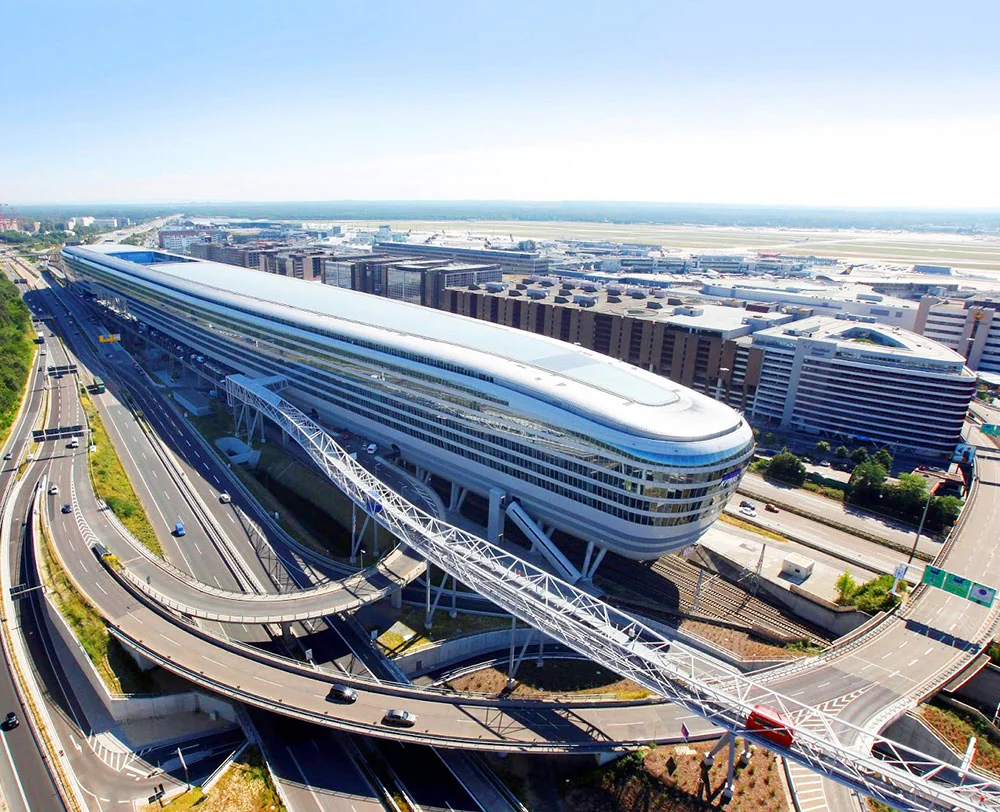
European Transit Hub
Frankfurt AirRail center steelwork — executed to European codes with airport-grade logistics and tight-tolerance erection, the same discipline UK rail and airport projects demand.

450,000 m² Airport Roof
Guangzhou Baiyun Phase III: 42,000 t of steel in one terminal programme — proof that UK-scale aviation projects are within one supply chain.

748 m Covered Bridge
The Xianyang covered bridge — 748 m of structural steelwork with long-span deck framing — demonstrates the span engineering UK footbridge and atrium projects need.
UK Buyer Questions, Answered
Do you fabricate to EN 1090-2 for UK projects?
Yes. We work to EN 1090-2 with the execution class your engineer assigns (typically EXC2 for portal frames, EXC3 where the design requires it), maintain factory production control and hand over the full conformity file — DoP, 3.1 material certificates, welder qualifications, NDT reports and coating logs.
UKCA or CE — which will my project need?
It depends on the destination: Great Britain uses the UKCA route for regulated products, while Northern Ireland continues to accept CE. Many GB projects still accept CE under the government’s extended transition, but ask your building control body to confirm — and make sure your fabricator can supply either document set.
Who handles UK customs and VAT?
Your importer of record (you or your broker) declares through the Customs Declaration Service and pays duty and VAT. We quote FOB or CIF by default; DDP is available on UK routes through our logistics partners — one fixed landed price including duty and clearance.
What is the realistic total lead time?
Plan 19–21 weeks from approved drawings to a UK port, and roughly 21–23 weeks to site, on a standard 1,000 t programme — including fabrication, 30–35 days of sea transit and clearance.
Get a UK-Specific Quotation
Send your drawings and site location and we will return: EN 1090-2 conformity notes, FOB/CIF/DDP pricing, a UK duty and VAT estimate and a binding fabrication schedule.
Request a Quotation Talk to an Engineer