Buying Steel Structures from China for the USA
American buyers face a specific combination of challenges: AISC 360 design compliance, AWS D1.1 welding acceptance, Section 232 tariff exposure and long supply chains. This guide walks through exactly what to specify, what it will cost and how to de-risk the process.
Which US Codes Your Fabricator Must Meet
Unlike EN 1090 with mandatory CE marking, US steel construction is enforced through project specifications referencing industry standards. If your contract does not require them, many Chinese fabricators will quietly fabricate to GB 50017. Specify the documents below, in writing, before quoting.
| Document | Scope | Key Requirement for Imported Steel |
|---|---|---|
| AISC 360-22 | Design of steel structures by LRFD or ASD | Member design, connection design and stability must follow AISC 360. A licensed US engineer of record reviews the connection design. |
| AWS D1.1/D1.1M | Structural welding code — steel | Welder qualification, WPS/PQR and inspection acceptance criteria. Welders must be qualified to AWS D1.1 with readable certificates. |
| ASTM A992 / A572 | Structural steel material grades | W-shapes per ASTM A992 (Fy=50 ksi); plates per A572 Gr.50. Mill certificates must list US-equivalent chemistry and tensile values. |
| ASCE 7-22 | Minimum design loads (wind, snow, seismic) | Load cases should be calculated to ASCE 7-22 with project-specific wind exposure and seismic risk category. |
| AISC 303 (Code of Standard Practice) | Trade practices, tolerances, shop drawings | Defines shop drawing approval cycles, fabrication tolerances and erection sequence responsibilities. |
How We Execute US-Code Projects
On US-bound orders we fabricate to a double standard: material to ASTM equivalents (Q355B mapped to A572 Gr.50 with documented chemistry), welding to AWS D1.1 with WPS qualified at our Xuzhou shop, and dimensional acceptance to AISC 303 tolerances. Shop drawings are issued for the client's licensed engineer of record to stamp. If your design firm requires witness inspection, an independent agency (e.g. SGS or Bureau Veritas) can hold shipments in the shop before loading.
Our 200,000-tonne annual capacity and 6 special-grade qualifications mean a typical warehouse or factory frame of 400–1,500 t is not a scheduling risk; it is a standard production slot.

Column-Free Roofs, US Building Code Compliant
Bolted-sphere space grids and pipe trusses give US architects the long clear spans they design for retail, sports and aviation projects — with node and member checks to AISC 360.
Section 232, Tariffs and What Duty You Will Actually Pay
Importing fabricated steel into the United States triggers both Section 232 (national security) tariffs and standard MFN duties, plus antidumping / countervailing duty checks on specific Chinese steel products. Work with a licensed customs broker — the numbers below are planning guidance, not a binding quote.
| Cost Component | Indicative Magnitude | Notes |
|---|---|---|
| Section 232 steel tariff | 25% ad valorem (2025-2026 rate) | Applies to most steel articles; exemptions exist via product exclusion requests. Confirm status at time of shipment. |
| MFN base duty, structural steel | 0–3.3% | HTS chapters 7301-7306; fabricated girders and structures carry low base rates. |
| ISF (Importer Security Filing) | Filing fee; must be submitted 24 h before vessel lading | 10+2 data set; late or missing ISF risks US$5,000 penalties per violation. |
| Ocean freight, China→US West Coast | USD 75–100 / t (2026 indicative) | US East Coast / Gulf typically USD 15–25 more per tonne. |
| U.S. Customs bond & handling | Continuous bond or single-entry bond | Arrange through your customs broker before the vessel departs. |
The bottom line: with Section 232 at 25%, a China-fabricated structure must still beat domestic US fabrication on total landed cost. It usually does when the design is relatively standard (warehouses, logistics centers) and the tonnage is 500 t or more — because Chinese fabrication labour and plate costs remain structurally lower. But the gap is narrower than in 2019, so buyers should compare CIF+DPU numbers, not FOB prices.
Your other option is to keep value outside the tariff lines: ship steel components (HTS 7308) rather than "structures", or buy engineering + fabrication where the US engineer stamps shop drawings locally. Ask us for a duty-optimised quotation structure — we ship structures into the US market and can work with your broker on classification.
Timeline to Your US Site, Step by Step
A realistic worst-case schedule protects both sides. Build the milestones below into your contract so that approvals and payments cannot silently slip the shipment window.
Shop Drawing & Approval — Wk 0-4
We issue Tekla shop drawings and erection plans for your engineer of record. Budget 2–4 weeks; complex grids or trusses run 4–6. Every revision is version-controlled and emailed with a transmittal record.
Material Procurement & Mill Certs — Wk 2-5
ASTM A992 / A572 mill certificates are collected per heat. We stop production if any heat fails chemistry — no substitution without written client approval.
Fabrication & QC — Wk 5-13
A 1,000 t warehouse frame runs 6–9 weeks in our shop. Fit-up tolerances to AISC 303, 100% weld inspection by certified QC, coating to your spec (typically 2–3 coats, 240 µm DFT for C3).
Pre-Shipment Inspection & Loading — Wk 12-14
Optional third-party witness (SGS/BV/Cotecna). Fumigated, ISPM-15-compliant packing for any timber; steel bundles strapped and edge-protected for break-bulk or containers.
Ocean Transit — Wk 14-18
Shanghai/Qingdao to Los Angeles or Long Beach typically 13–18 days sailing; to New York/New Jersey 30–35 days via Panama. Add 3–7 days port dwell.
US Customs Clearance & Delivery — Wk 18-20
ISF + entry filing + Section 232 payment via bond. DDP (Delivered Duty Paid) available on many US routes — one invoice, no surprises at the gate.
Projects of Similar Scale and Complexity
While no US project is currently public on our site, the evidence pattern below — airports, power sheds, grids and bridges — is what we ask a US buyer to evaluate before the first call.
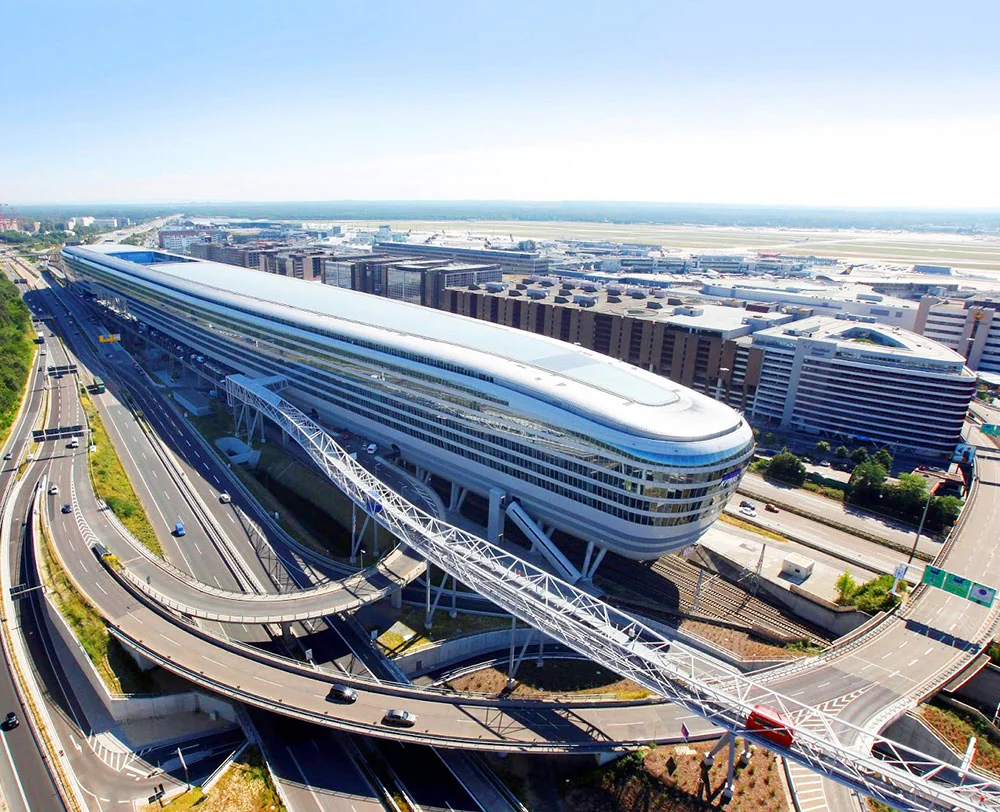
European Transit Hub
Frankfurt AirRail center steelwork — demonstrates European code compliance, tight-tolerance erection and airport-grade logistics, the same discipline US transit projects require.
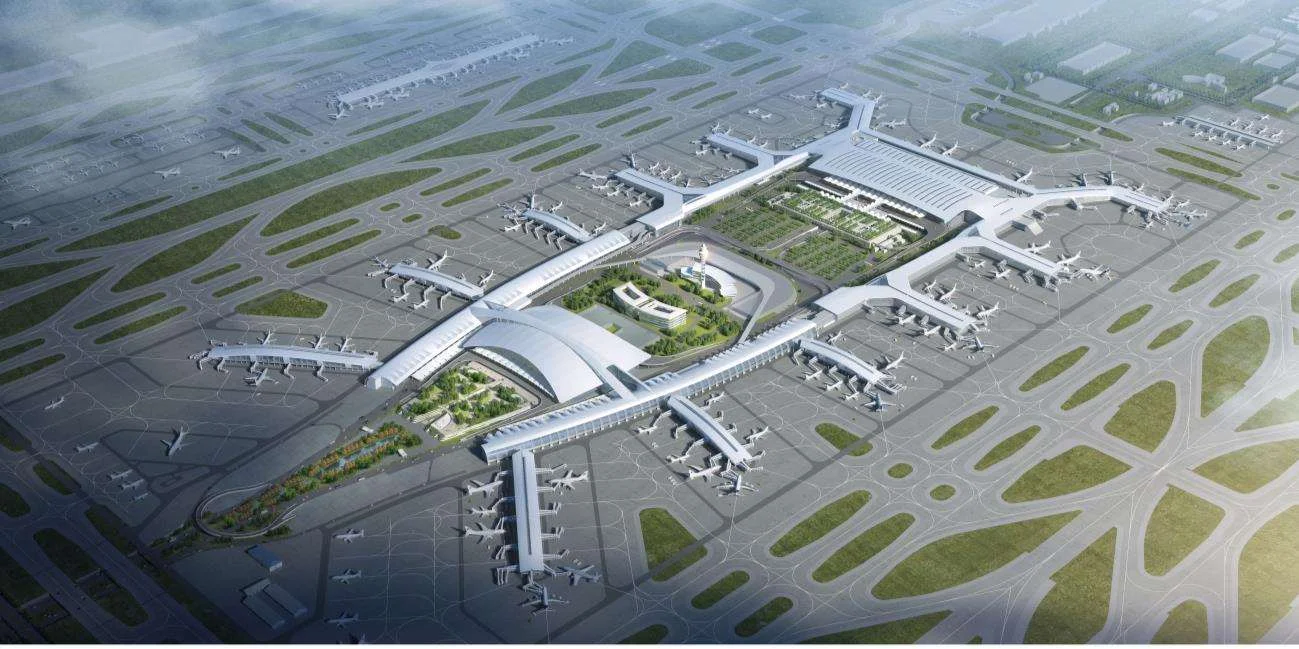
450,000 m² Airport Roof
Guangzhou Baiyun Phase III: 42,000 t of steel in one terminal programme — proof that US-scale aviation projects are within one supply chain.
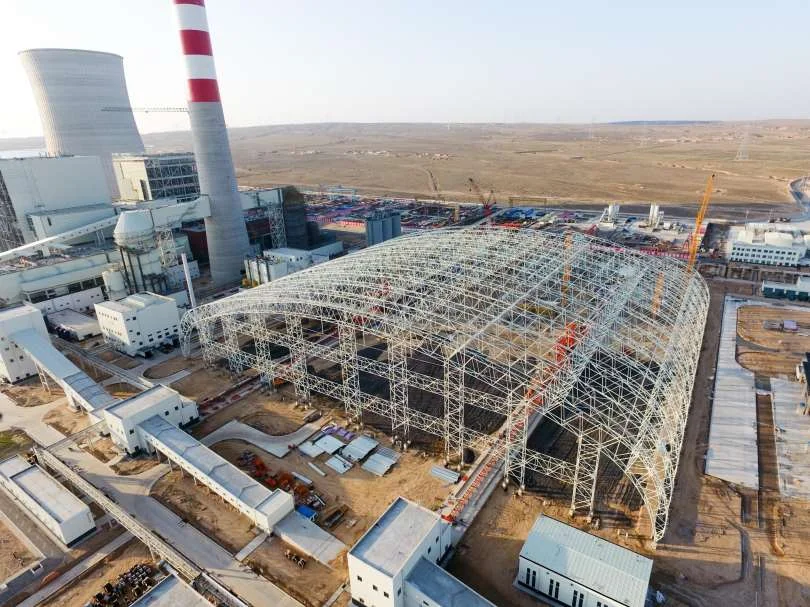
229 m World-Record Shed
The longest prestressed beam-string coal shed in the world by span — extreme wind and deflection controls, analogous to demanding US industrial envelopes.
US Buyer Questions, Answered
Do you fabricate to AISC 360 and AWS D1.1 for US projects?
Yes. We map material to ASTM equivalents, qualify WPS to AWS D1.1, and issue shop drawings for your licensed engineer of record. Independent witness inspection is available before loading.
Who handles US customs and the Section 232 tariff?
Your importer of record (you or your broker) files ISF and pays duties. We quote FOB or CIF by default, and DDP is available on select US routes through our logistics partners — one fixed landed price.
What is the realistic total lead time?
Plan 18–22 weeks from approved drawings to US West Coast, 20–26 weeks to the East Coast, including fabrication, transit and clearance on a standard 1,000 t programme.
Can your engineer stamp shop drawings for the US?
We design and check to AISC codes, but professional stamping requires a US-licensed engineer. We cooperate with clients' US engineers of record — provide the connection design for their review and seal.
Get a US-Specific Quotation
Send your drawings and site location and we will return: AISC-compliant design notes, FOB/CIF/DDP pricing, Section 232 duty estimate and a binding fabrication schedule.
Request a Quotation Talk to an Engineer