Steel Structure Projects in Antarctica — The Chinese Antarctic Ross Sea Station
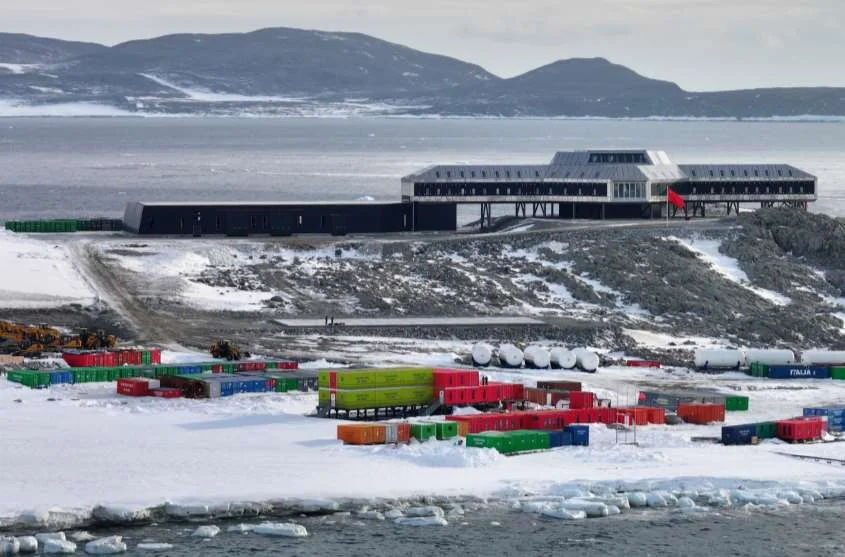
In February 2024, China's fifth Antarctic research station began operation on the Inexpressible Island coast of the Ross Sea — the world's southernmost research station, and the only one built primarily by a commercial steel company. Jiangsu Permanent Steel Structure was the main contractor for its structures and modules, delivering a fully modular, steel-framed scientific facility engineered for one of the harshest environments on Earth: design temperature −63 °C (daily average −28 °C in the coldest month), wind speeds up to 60 m/s in the polar katabatic regime, 24-hour polar nights, and a construction season measured in weeks.
Why Antarctica is the Ultimate Test of Steel Structure Engineering
1. The cold is a material problem, not a comfort problem. At −63 °C design temperature, structural steel enters the brittle-fracture regime. Charpy V-notch impact testing to EN 1993-1-10 / GB 50017 low-temperature provisions becomes a governing requirement — the steel grade, plate thickness and joint type must all be coordinated so every member's toughness matches the design temperature. Bolts, welds and coatings are selected for the same regime: low-temperature bolts, qualified welding procedures with controlled preheat against cold cracking, and coatings that do not embrittle at polar service temperatures. Snow creep and frost heave act on the foundations and on the module-to-ground interfaces continuously, so the structure is detailed to move as frozen ground moves.
2. Katabatic wind is a load case, a logistics constraint and a safety case. The Ross Sea coast funnels Antarctic katabatic winds and storm systems into sustained gusts up to 60 m/s — roughly Force 11-12 hurricane force sustained, with gust factors beyond. Wind governs the lateral system: bracing is distributed through the module grid, cladding and skylights are detailed for extreme suction and local pressure, and roof gravel or parapet detailing prevents ice and snow adhesion loads from exceeding the design envelope. The same wind regime dictated the construction strategy — modules were fully prefabricated inland and erected in open-water season windows, with each lift planned around the weather forecast.
3. Antarctica has no site factory and no margin for error. Every member, panel, fitting and fastener had to be fabricated in China, packed, shipped across the Pacific and erected in a working season measured in months. This enforced the modular paradigm at an industrial scale: close to all of the facility's fabrication and pre-assembly happened in our workshops where quality control, welding, coating and testing could be fully controlled; the site scope was reduced to foundation works, module placement, connections and commissioning. A design-for-transportation review covered containerisation, sea-fastening, vehicle transport across ice and the sequence of erection — the members arrived in a deliberate order, match-marked and ready.
4. Polar science buildings are machines for research, not just shelters. The station houses laboratories, living quarters, energy systems and observation facilities whose service demands are as rigorous as the climate: airtight envelopes against heat loss and drift, structural stiffness for instrument stability, and vibration and snow-management design that protects both personnel and experiments. The steel frame had to satisfy not only the structural code cases of wind, snow and seismic, but the functional tolerance of a research facility that runs year-round through polar night.
5. Sustainability is inherent when logistics is the largest cost. Every truckload of extra steel costs weeks and fuel in the most remote logistics chain on Earth. The project optimises steel weight per function — the structural solution shrinks the carbon and cost of shipping as directly as it shrinks steel tonnage. This is the same logic we bring to every project: engineered efficiency is the greenest design decision.
The Ross Sea Station is proof of what a Chinese steel company can do at the very limit of the possible: full modular prefabrication, polar-grade engineering, and delivery to a site where rework is not an option.
Antarctic Projects & Deliveries
 Polar Research
Chinese Antarctic Ross Sea Station (Qinling)
Type: Modular research station | Design: −63 °C / 60 m/s wind
China's fifth Antarctic research station, fully steel-framed and overwhelmingly prefabricated in our workshops before polar shipment. The facility spans 5,244 m² across its modules, engineered for polar temperatures, hurricane-force wind and the low-temperature toughness regime that governs Antarctic structures. Delivered to a site where the construction window is measured in weeks — and rework is physically impossible.
Modular Delivery
Modular Prefabrication & Polar Logistics
Approach: Workshop prefabrication → polar shipment → sequenced erection
The delivery strategy that made the Antarctic programme possible: the great majority of fabrication and pre-assembly completed under controlled workshop conditions in China, then containerised, sea-fastened and shipped in erection sequence to the Ross Sea coast. Design-for-transport and match-marked kits turned site construction into precision placement.
What a Client in Extreme Environments Receives From Us
The Antarctic programme validates a delivery model applicable to any extreme or remote site — polar bases, off-grid mines, island airports, high-altitude facilities:
- Low-temperature engineering: Charpy impact-tested steel, low-temperature connections and coatings verified for the actual design temperature — not assumed from catalogues.
- Wind-ruled lateral design: bracing, cladding and roof systems engineered for the site's sustained wind and gust regime, with local pressure factors checked.
- Modular prefabrication: maximum fabrication under workshop control, minimum work on site — the only strategy that works where logistics is measured in months.
- Design-for-transport: containerisation, sea-fastening, ice and off-road transport cases reviewed at design stage, with erection sequenced to the arrival.
- Full documentation: the complete engineering, fabrication, testing and coating record travelled with the modules — audit-ready at the edge of the world.
If a steel structure must be delivered somewhere the weather is a risk, the logistics is the schedule and rework is impossible — this is the team that has done it.
Planning Steel Structures in Extreme or Remote Environments?
Tell us the site conditions, design temperature and wind regime, and the logistics reality. We return a design-for-transport and modular prefabrication plan, engineered for the edge of the possible.
Email: market@permanentsteelstructure.com | WhatsApp: +86 18621689980 | Phone: +86 516-83269982