
Steel Structure Projects in South America — Heavy Industry, Ports and Export Infrastructure
South America's industrial steel story is written in shipyards, ports, mines, refineries and energy plants — facilities where the steel frame carries not just a roof but the industrial logic of the operation. These are heavy structures with crane duty, process loads and corrosion regimes that coastal and tropical conditions push to their limit. Our delivery to the Brazil Vitoria Jurong shipyard demonstrates what the region's industry demands and what we deliver: heavy fabrication, marine-grade protection, and export logistics that land the steel where the schedule needs it.
Five Engineering Realities of Heavy Industry South of the Equator
1. The structure works, it does not just stand. A shipyard fabrication hall, a port terminal or a mineral-processing building hosts cranes, monorails, process equipment and heavy live loads that turn the frame into a machine support. Our design for such facilities starts with the duty schedule — crane class (A5-D), wheel loads, impact factors and braking forces — and sizes the frame, runway girders and columns for the fatigue and distortion checks that crane duty imposes. In a shipyard, the 30-100 t gantry and overhead cranes alone can dominate the framing; the structure must also accept the dynamic loads of steel plates, blocks and machinery moving across the shop floor.
2. Marine atmosphere is the baseline, not the exception. Most South American industrial hubs are coastal — Vitoria, Santos, Rio, Buenos Aires, Callao, Cartagena and the Gulf of Venezuela all sit in ISO 9223 C5 corrosivity zones where airborne chlorides attack bare steel within months. Hot-dip galvanizing (85-140 µm) or a marine-grade coating system (epoxy + polyurethane, 240+ µm DFT) is therefore our baseline for external members near the coast, with A4 stainless fasteners and galvanic isolation where dissimilar metals meet. The corrosion budget is a design parameter, declared to the client with its expected maintenance interval — not a discovery.
3. Seismic codes carry the Andean and Caribbean demand. The Pacific coast from Colombia to Chile and the Caribbean rim sit in active seismic zones with design accelerations of 0.2-0.5 g; even interior Brazil now applies a national seismic code with zones up to 0.1-0.2 g. Every heavy industrial structure we export is analysed to the local code (NSR-10 in Colombia, NCh 433 in Chile, NBR 15421 in Brazil, ASCE 7 or EN 1998 where consultants govern), with the mass of cranes and live load included per code. Industrial facilities in seismic zones must also remain operable after the design event — which drives both the ductility detailing and the bracing distribution.
4. Local manufacture and import compete on cost — and the frame must win on engineering. Brazil has a strong domestic steel industry, and the region's clients compare Chinese imports against local fabrication on landed cost, delivery reliability and quality records. We hold the comparison by delivering EN 1090-2 EXC3 fabrication with full traceability, ISO 3834-2 welding, mill certificates, and by documenting every coating batch — the documentation set that lets an importer's or contractor's QA pass inspection without re-testing.
5. Logistics run through ports that reward planning. Shipping heavy steel to Santos, Vitoria, Callao or Cartagena is straightforward; moving it inland is where schedules die. Our logistics planning for the region boxes heavy members to the crane capacity of the destination port, plans sea-fastening and lashing for the voyage, and sequences deliveries to the erection programme. For shipyard and port work, tie-in with the client's existing cranage and laydown is engineered before the first container sails.
South America buys steel structure for the same reason the rest of the world does — speed, span and certainty. The difference is that the region's climate, seismicity and industrial duty are unforgiving, and the steel must be right the first time.
South American Projects & Deliveries
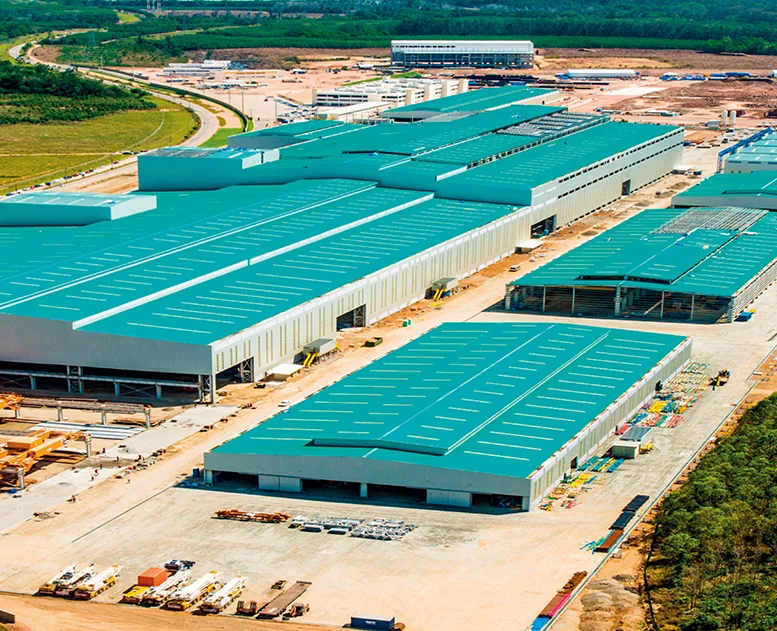 Shipbuilding
Brazil Vitoria Jurong Shipyard
Type: Shipyard fabrication and support buildings | Condition: C5 coastal, crane duty
Heavy shipyard facilities on Brazil's Atlantic coast: fabrication halls and support structures engineered for crane duty, process loads and the C5 marine atmosphere of the Vitoria coast. The delivery combined heavy steel fabrication, marine-grade corrosion protection and export logistics sequenced to the yard's commissioning programme. The structures stand today as working machine systems, not just buildings.
Heavy Steel
Heavy Fabrication & Crane-Runway Frames
Scope: Heavy plate girder frames, crane runways | Standard: EN 1090-2 EXC3
The shipyard scope demonstrates our heavy fabrication capability: plate girder runway girders, portal frames sized for overhead and gantry crane duty, and connection details engineered for fatigue under repeated crane cycles. Heavy welding to ISO 3834-2 with UT per ISO 17640 Level B on all full-penetration splices.
What a South American Client Receives From Us
Heavy industrial buyers compare on engineering and documentation, not brochure claims. Our package for South America includes:
- Duty-based design: crane class and duty schedule documented, runway girders fatigue-checked, live loads per the process definition — the frame sized to work, not to stand.
- Code compliance: design to the local seismic and building code or the consultant's reference standard, with the soil amplification and wind zone of the actual site.
- Marine corrosion strategy: ISO 1461 galvanizing or marine coating systems per the site's corrosivity zone, A4 stainless fixings, and a declared maintenance interval.
- Full traceability: EN 1090-2 EXC3 records, ISO 3834-2 weld qualifications, mill certificates, UT and coating thickness reports — ready for the importer's QA.
- Port-aware logistics: members sized to the destination port's crane capacity, marine lashing engineered, deliveries sequenced to the erection plan.
Send us the process definition (crane duty, equipment loads, building function), the site and its code regime — we return a duty-based design basis, corrosion schedule and budget that an industrial client can take to board level.
Planning Heavy Steel Structures in South America?
Tell us the facility type, crane duty and process loads, the site location (seismic zone and coastal exposure), and the reference standard. We return a duty-based design basis, corrosion strategy and budget.
Email: market@permanentsteelstructure.com | WhatsApp: +86 18621689980 | Phone: +86 516-83269982