Steel Structure Projects in Africa — Proven Delivery Under Tropical Conditions
Africa's infrastructure build-out is one of the largest structural steel opportunities of this decade. But delivering steel to Africa is not a domestic project with a longer freight leg. Tropical atmospheric corrosion, port handling, site logistics, local skilled labour availability, and code environments all reshape how the structure must be engineered, protected and shipped. Every African project we deliver is engineered around these conditions from the first drawing.
Six Conditions That Reshape Steel Delivery in Africa
1. The corrosion environment is the design brief. From the Gulf of Guinea to the Indian Ocean coast, most African development corridors sit in ISO 9223 corrosivity categories C3 to C5. Coastal humidity above 80%, airborne chlorides from 10 km of ocean influence, and 6-8 months of wet seasons mean a hot-dip galvanized coating of 65-85 µm per ISO 1461 is the floor, not the premium, for external members. For C5 zones within 1 km of the coastline we specify 85-140 µm coatings or duplex systems (galvanizing plus powder coat), and all fasteners move to A4 stainless or hot-dip galvanized equivalents. A domestic Chinese project can use the same steel with 40 µm of paint; an African coastal project cannot survive its first decade without the coating strategy designed up front.
2. Temperature range drives connection design. The diurnal and seasonal temperature swing across much of Africa (15-25 °C daily, up to 40 °C across the year) creates thermal expansion in a 100 m building of roughly 45-70 mm. Long buildings are therefore articulated with expansion joints at 60-90 m spacing, and secondary members are detailed with slotted holes so the cladding can move with the frame. Bearing designs must accommodate the same movement, especially at portal frame bases, or the structure will crack its envelope within two years.
3. Port and inland logistics define the module size. African ports receive break-bulk and containerised cargo with cranes of 30-45 t capacity, and inland transport often runs 1,000-2,500 km on roads with 7 m bridges and 40-50 t weight limits. Our fabrication planning therefore caps steel pieces at transportable module sizes — single members below 12 m where possible, packages holed and match-marked at the works for field bolting, and no site welding except where the design mandates it. A portal frame designed as three field-bolted segments ships and erects more reliably than a one-piece frame that cannot navigate the port approach.
4. Tropical solar loads affect both structure and envelope. With design shade temperatures of 35-40 °C and intense solar gain, roof steel can reach surface temperatures of 60-70 °C. The frame's design thermal movements compound with the daily cycle, and the envelope's expansion must be absorbed in the sheeting fixings, not the frame. Roof insulation of 50-100 mm foil-faced PU is standard in our African warehouse and airport envelopes to cut both the operational cooling load and the thermal movement input to the structure.
5. Site labour and equipment reality changes the erection method. Cranage of 50-100 t is available in most capital cities, but mobilisation is slow and costly; remote sites may have only 20-30 t mobile cranes. Our method statements for African projects assume smaller cranes, more staged erection, and pre-assembly on the ground. Columns arrive in one piece, rafters in two or three bolted segments, and the erection sequence builds each bay as a self-stabilising unit before the next bay starts. We also deliver rigging plans that a local crew with four men and one crane can execute safely — not a method that silently assumes an 8-erector specialist crew.
6. Local code acceptance is often a hybrid. Many African markets adopt a national building code modelled on British Standards or the French DTU system, while clients' insurers and consultants default to Eurocodes, AISC or ASTM. Our documentation set is therefore delivered bimodally: design calculations in the client's reference code, fabrication and quality records to EN 1090-2 EXC3 and ISO 3834-2, and galvanizing certificates to ISO 1461. This is what lets a Chinese-fabricated structure pass a British-, French- or US-based consultant's review on the first submission.
We have learned these six conditions the hard way — on live African projects, not in a marketing deck. The engineering we bring to the continent is the same that we bring to a 229 m coal shed or an Antarctic station; the difference is that every member, coating and package is re-checked against the African conditions that will try to destroy it.
African Projects & Deliveries
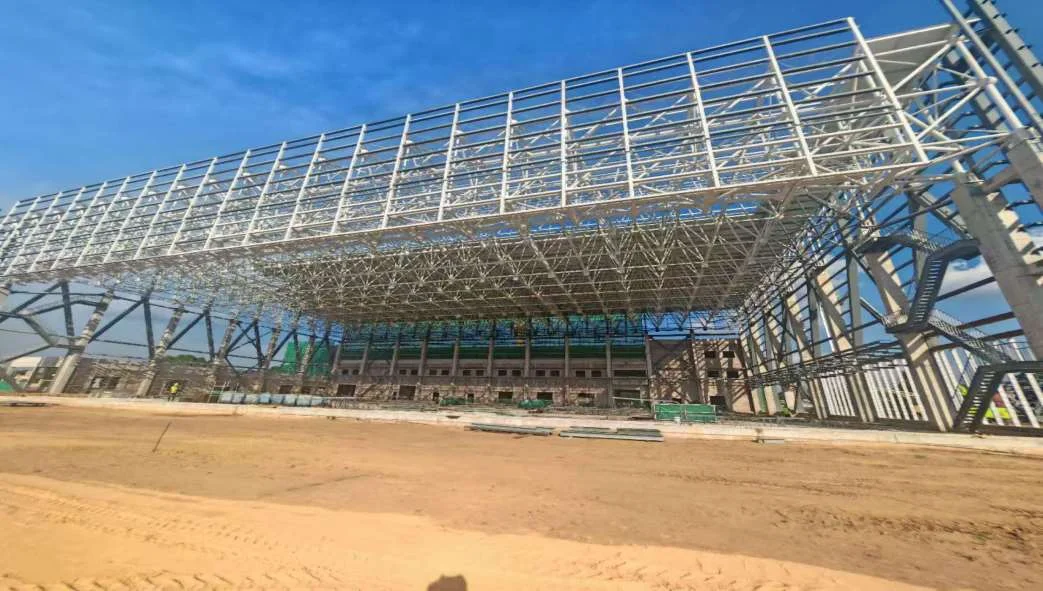 Aviation
Republic of Congo International Airport
Scope: Steel structure fabrication and enclosure | Steel: 1,200 t
A four-span continuous structure of 172.75 m total length with a maximum clear span of 43 m — beyond the range of simple hot-rolled beams, and engineered with splices sized for field bolting under tropical conditions. The complete delivery package covered structural steel, envelope and fixing systems, containerised and shipped from Xuzhou to Africa. The 5,200 m² facility demonstrates our turnkey export scope and the logistics discipline described above: each member package match-marked, bolted on site, and protected by a coastal-grade coating system.
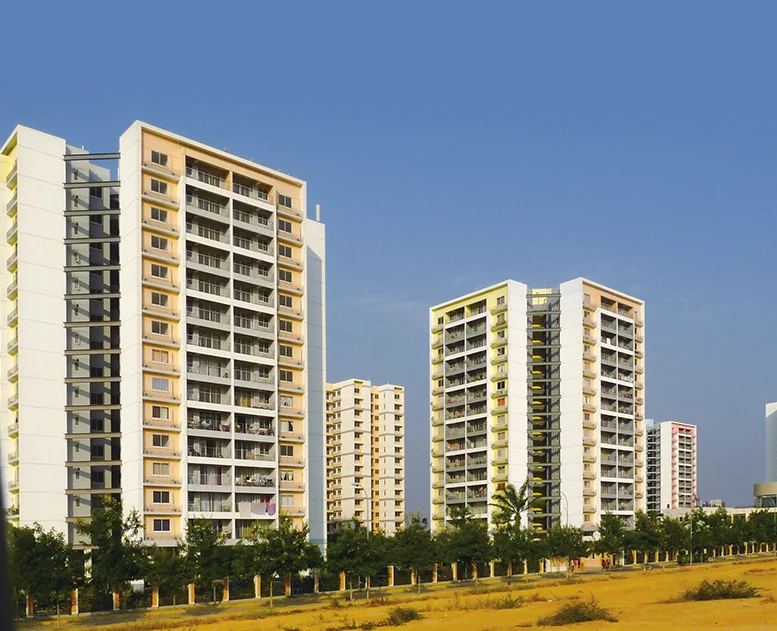 Housing
Angola Affordable Housing Programme
Scope: Residential steel structure buildings | Condition: C4 coastal environment
Part of Angola's national housing drive, this programme uses our prefabricated steel building system to deliver homes at industrial speed and cost. The design decisions mirror the six conditions above: hot-dip galvanized frames with duplex finish near the coast, 6 m module spans that ship two-up in a 40 ft container, and bolted erection that a local crew completes bay by bay. The programme demonstrates how steel can answer not only airports but the core shelter demand of the continent.
Export Engineering for African Clients: What You Actually Receive
For an African client, buying steel structure from China spans four questions that a domestic client never asks: What standard are you building to? How do you protect it for my climate? What exactly arrives at my port? And how does my crew erect it safely? Our export package is engineered to answer all four in writing:
- Design and documentation: structural calculations, shop drawings and connection details in your reference code (Eurocode / British / US / local), BIM or 2D as agreed, with a design report your consultant can issue against.
- Corrosion strategy: ISO 1461 hot-dip galvanizing (65-85 µm, C5-plus duplex option), A4 stainless fasteners, and a coating schedule mapped to your site's ISO 9223 corrosivity zone.
- Shipping package: containerised or break-bulk per project, with packing lists, lashing drawings, fumigation certificates and marine-grade wrapping for coastal voyages.
- Erection support: site-assembly method statements, rigging plans sized to the available cranage, and (on request) our own supervisor or full erection crew for the first project.
- Quality records: EN 1090-2 EXC3 mill certificates, welding qualification records per ISO 3834-2, UT reports per ISO 17640 Level B, and galvanizing thickness reports.
We keep a dedicated export engineering desk for the African market, and we quote against your actual port, site elevation and climate — not a generic “international” price list. Send us the building dimensions, the site location, and the reference code your consultants expect, and you will receive a budget, a coating schedule and a shipping plan, not a brochure.
Planning a Steel Structure Project in Africa?
Tell us the country, site location and corrosivity zone, building type and dimensions, and the reference code your consultants require. We return a corrosion strategy, budget and containerised delivery plan engineered for your conditions.
Email: market@permanentsteelstructure.com | WhatsApp: +86 18621689980 | Phone: +86 516-83269982