Steel Structure Projects in Southeast Asia — A City of Steel in the Tropics
Southeast Asia is the fastest-moving steel structure market in the world — Indonesian industrial estates, Vietnamese factory corridors, Malaysian data-centre belts and Philippine logistics hubs are all being built at a pace that domestic fabricators cannot absorb. But the region punishes steel delivered as a “domestic project with a longer boat ride”. Seismic zones, tropical cyclones, salt-laden air and high-humidity construction sites each demand engineering that is decided before fabrication, not discovered during erection. Our largest overseas delivery to date — a 250,000 m² industrial city in Indonesia — is the proof of that discipline.
Five Engineering Realities of the Region
1. Seismic design is not optional at any scale. Indonesia sits across the Pacific Ring of Fire: design seismic accelerations of 0.3-0.9 g on parts of Java, Sumatra and Sulawesi, with soil amplification doubling or tripling the effective demand. Every steel building we ship to the region is analysed for the local seismic map — portal frames with moment connections at the knees and apex, braced bays distributed to control torsional response, and base plates anchored for the overturning case. The bolted-sphere grid systems used for our Indonesian coal sheds are particularly well suited: the joint ductility and redundancy of a space frame absorb seismic energy through controlled joint deformation, exactly the mechanism that prevents collapse in a large earthquake.
2. Tropical cyclones make cladding a structural element. The South China Sea and Western Pacific typhoon tracks brush Vietnam, the Philippines and coastal Indonesia with design wind speeds of 45-60 m/s for 50-year return periods, rising above 70 m/s on exposed island sites. Wind loads govern the secondary members — purlins and girts step up two sections, side rails in windward walls go to stronger channels, and the cladding-to-frame fixings are designed for the pressure coefficients directly, not “by rule of thumb”. The structure's vulnerability in a typhoon is almost never the main frame; it is the 100 mm purlin and its fixing to the rafter. Ours are engineered for the zone.
3. Salt and humidity corrode fast and invisibly. Coastal sites from the Strait of Malacca to the Java Sea sit in ISO 9223 C4-C5 corrosivity zones. Two realities follow: hot-dip galvanizing of 65-85 µm per ISO 1461 on every member (85-140 µm within the coastal band), and a corrosion budget in the client's maintenance plan that acknowledges the climate. We also control an invisible failure — condensation inside cold-formed purlins — by requiring ventilated or sealed purlin systems per the envelope design, because a coastal warehouse that sweats from the inside corrodes at the fixings first.
4. The wet season decides the construction programme. With 2-4 months of monsoon delivering up to 300-400 mm of rain per month, erection cannot follow a domestic schedule. Our sequence plans for Southeast Asia front-load foundation and lower-column works into the dry season, pre-assemble and muscle-up whenever a five-day dry window appears, and detail the steel so that partially erected frames are self-draining — no ponding on top flanges of rafter segments, no water traps in connections. The 90+ buildings of the Indonesia complex were erected to this logic across a full monsoon cycle.
5. Scale is delivered module by module, not job by job. A 90-structure industrial estate is not a project with a big shop drawing set; it is a supply-chain exercise. Our fabrication plan for the Indonesia complex standardised member families across all buildings, cut the steel in repeated modules, pre-drilled every connection, and match-marked complete building kits so that site crews assembled 90 structures from a common system rather than 90 bespoke detail sets. This is how 9,000 tonnes leave a single Chinese works and erect cleanly on an Indonesian site — the modularity is engineered, not improvised.
Southeast Asia does not need a steel supplier. It needs an engineering partner that has already solved a 250,000 m² tropical, seismic, cyclone-exposed complex — and documented what worked. That is the experience we bring to every enquiry from the region.
Southeast Asian Projects & Deliveries
 Industrial
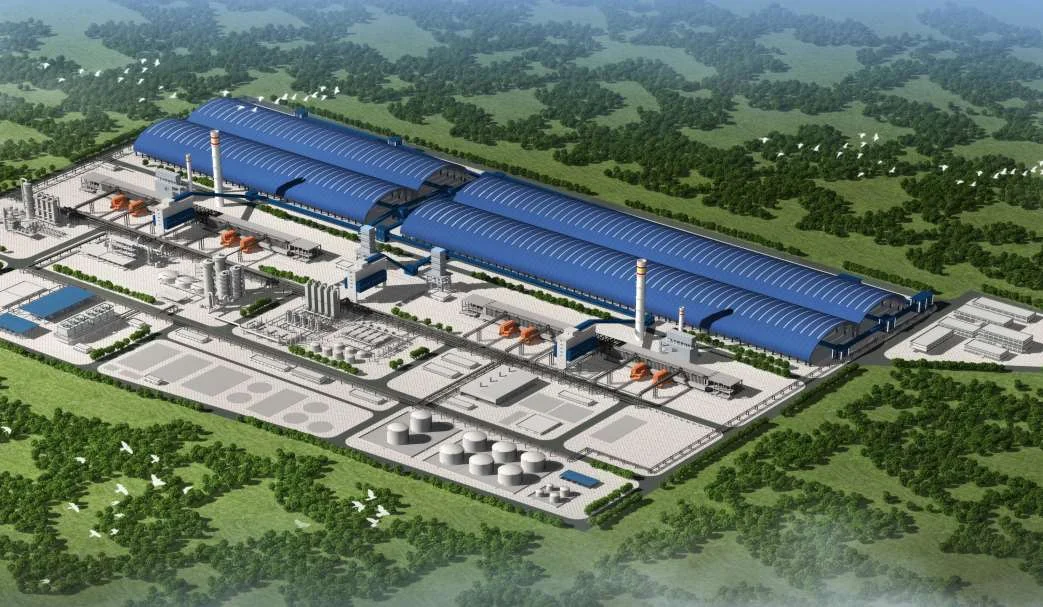
Indonesia Jinrui New Energy Industrial Complex
Scope: 90+ steel structures | Steel: 9,000 t | System: SBG + industrial building
A city of steel in the tropics: more than 90 individual structures including two enclosed coal sheds on bolted-sphere grid systems totalling 98,000 m², delivered across one of Southeast Asia's most challenging climates. The complex combined process buildings, material handling enclosures, and supporting facilities — all engineered for Indonesian seismic demand, tropical cyclone wind, and C4 coastal corrosivity, and all erected from match-marked kits by local crews.
Energy
Indonesia Jinrui Enclosed Coal Sheds (98,000 m²)
System: Bolted-sphere grid (SBG) | Coverage: 98,000 m²
Two of the region's largest enclosed coal stores, built on our bolted-sphere grid system. The SBG solution delivers the long clear spans a coal stockpile needs while the joint ductility carries the Indonesian seismic demand — the same structural family proven at our domestic 229 m world-record coal shed, scaled and seismic-engineered for this market.
What a Southeast Asian Client Receives From Us
Delivering 9,000 tonnes to Indonesia taught us exactly what the region's clients and consultants need to see before they approve a Chinese fabricator. Our export package for Southeast Asia therefore includes:
- Seismic documentation: design response spectra analysis to the local seismic code (or SNI 1726 in Indonesia, or the region's equivalent), with storey drift checks and ductility classification if required by the local checker.
- Typhoon-grade secondarys: purlin and girt schedules calculated for the site's design wind speed and pressure coefficients, with tested cladding fixings — supplied as a full envelope package, not left to the roofing contractor.
- Corrosion strategy: ISO 1461 galvanizing matched to the site's corrosivity zone, A4 stainless fasteners at the coast, and a maintenance-interval schedule the client's facility team can budget against.
- Kit-based delivery: match-marked building kits that a local crew erects from our method statements, with site supervision available for the first building of any typology.
- Full quality records: EN 1090-2 EXC3 fabrication, ISO 3834-2 welding qualifications, ISO 17640 Level B UT on splices, and coating thickness certificates per batch.
From a single warehouse to a 250,000 m² complex, the discipline is the same: design for the region's real demands before fabrication, ship in kit form, and hand over a structure that erects cleanly and stands for decades in the climate it serves. Send us your site location, building programme and reference code — we will return the seismic and wind basis, the corrosion schedule and a budget that reflects the region, not a template.
Building Steel Structures in Southeast Asia?
Tell us the country and site location (seismic zone and cyclone exposure), the building types and dimensions, and the programme. We respond with the seismic and wind design basis, corrosion strategy, delivery plan and budget.
Email: market@permanentsteelstructure.com | WhatsApp: +86 18621689980 | Phone: +86 516-83269982