The 229m Engineering Frontier: Why Coal Sheds Need Ever-Larger Spans
Environmental compliance is driving coal storage from open stockpiles to fully enclosed sheds. The larger the enclosed span, the more efficient the stockpile volume and the more freely stacker-reclaimers can traverse. We hold the world record: a 229m clear-span beam-string coal shed — the longest of its kind ever built.
Why Coal Sheds Are Not Just Large Warehouses — and Why 229m Changes the Structural Type
A coal storage shed is, superficially, a large industrial building: a steel frame, a roof, walls, and a door large enough for dump trucks. This surface similarity masks a set of engineering demands that make coal sheds one of the most structurally demanding building types in the steel construction industry.
The environmental compliance driver. Open coal stockpiles are increasingly regulated out of existence. Wind-blown coal dust contaminates surrounding communities, and rainfall leaches sulfur compounds into groundwater. Environmental regulations in China and across Asia now require coal storage at power plants, ports, and mines to be fully enclosed. The shed must cover the entire stockpile footprint — which is dictated by the stockpile volume required to maintain the plant's operational buffer, not by the structural engineer's span preference.
Why larger spans matter. A coal stockpile's usable volume is a function of its base area and the angle of repose of the coal (approximately 35-40 degrees). The stockpile forms a cone or prism shape, with the peak height limited by the shed's clearance. Interior columns reduce the base area available for stockpiling: a column grid of 30m × 30m in a 120m-wide shed removes approximately 15-20% of the usable storage volume. Eliminating interior columns entirely, through a single clear span, maximizes storage efficiency.
Why stacker-reclaimers dictate the span. A stacker-reclaimer is a rotating boom machine that traverses the length of the coal shed on rails, stacking coal in one direction and reclaiming it in the other. The machine's slewing radius — typically 50-100m for large units — determines the minimum shed width for the machine to access the full stockpile. A 100m slewing radius requires a minimum 110-120m clear span (adding clearance for the machine's counterweight and the shed wall). Eliminating interior columns is not optional — the machine cannot operate around them.
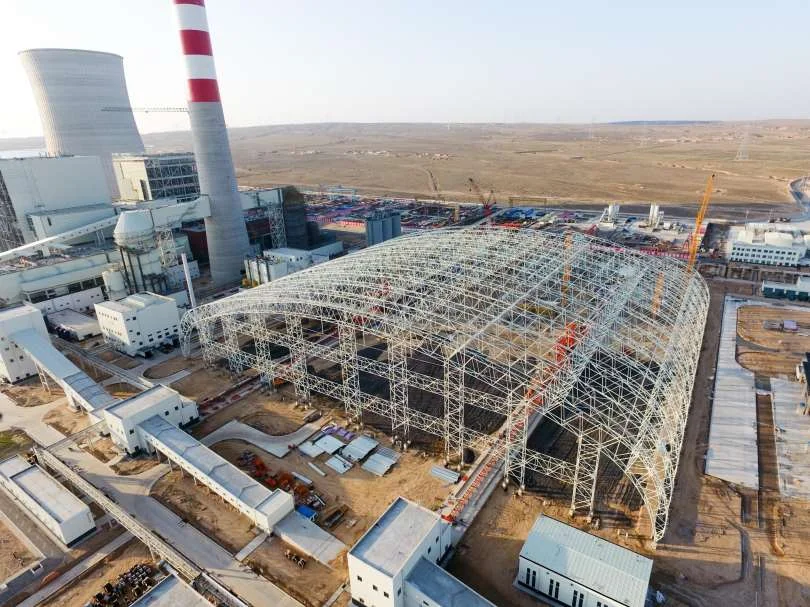
Why 229m is the frontier, not the limit. As power plant capacities grow and environmental regulations tighten, clients request ever-larger spans. Our 229m beam-string coal shed for Guodian Ningxia was the world's longest at completion. It was not an arbitrary target — it was the span required to enclose the stockpile volume that the plant's operational buffer demanded, with a stacker-reclaimer that needed that clearance to operate. The structural challenge was not "can we build it" but "what structural type makes 229m efficient and buildable."
Why Beam-String, Not Grid, for Spans Over 200m
The structural logic that makes beam-string systems the only efficient choice for ultra-long coal shed spans.
The Structural Efficiency Threshold
A bolted sphere spatial grid structure is the workhorse for coal shed spans up to approximately 150m. At these spans, a double-layer or triple-layer grid with a depth of 8-12m achieves the clear span with a steel consumption of 30-50 kg/m². The grid's self-weight is a manageable fraction of the total load, and the member forces are within the range of standard steel sections.
Above 150m, the grid's self-weight begins to dominate the structural demand. The top chord — carrying compression from the grid's bending under gravity — must resist forces that increase with the square of the span. At 200m, the top chord compression may be 2.5-3 times that of a 120m span grid, requiring significantly heavier sections. The bottom chord, carrying tension, faces a similar proportional increase. The grid's depth must increase to 12-15m to maintain the depth-to-span ratio, further increasing self-weight. The result is a structure where 60-70% of the steel is carrying the grid's own weight, not the applied loads — a diminishing return that makes pure grids structurally and economically inefficient at 200m+.
The Beam-String Solution
A beam-string structure solves this problem by replacing the grid's bottom chord with prestressed high-strength steel cables. The cables, tensioned to a predetermined force, put the upper grid into compression and themselves into pure tension — the ideal stress state for each material. Steel excels in compression when braced against buckling (which the grid's web members provide). Cable excels in tension, with no buckling concern and a strength-to-weight ratio 3-5 times that of structural steel.
The result: at 229m, the beam-string system consumes approximately 30% less steel than a conventional grid of equivalent span. The cables replace hundreds of tonnes of bottom-chord steel with a few tonnes of high-strength wire. The upper grid, now in compression, is braced by the web members and the cable's tension, preventing buckling. The structural depth is maintained at 12-15m, but the mass within that depth is dramatically reduced.
The Pre-Tensioning Sequence
The beam-string system's structural integrity depends on the cable pre-tensioning. The cables must be tensioned to a force that achieves the design compression in the upper grid under permanent dead load. Too little tension, and the upper grid goes into tension under live load — a state it was not designed for. Too much tension, and the grid is over-compressed, risking buckling.
The pre-tensioning sequence for our 229m coal shed was engineered in stages:
- Stage 1 — Grid assembly: The upper grid and web are assembled on the ground or on temporary shoring, with the cables installed but slack. The grid geometry matches the design pre-tension shape — not the final dead-load shape.
- Stage 2 — Initial tensioning: Cables are tensioned to approximately 30% of design force. This lifts the grid off the shoring and puts the web members into a stable stress state. The grid geometry is surveyed and compared to the model — deviations indicate fabrication errors or cable length discrepancies that must be corrected before further tensioning.
- Stage 3 — Intermediate tensioning: Cables are tensioned to 60-70% of design force in a synchronized sequence — all cables at a given cross-section are tensioned simultaneously to avoid generating unbalanced lateral forces on the grid. The synchronization is controlled by computer-monitored hydraulic jacks that measure both force and elongation at each cable anchor.
- Stage 4 — Final tensioning: Cables are tensioned to 100% of design force. The grid deflects to its final position under the cable tension. The total deflection is compared to the predicted value from the structural model — agreement within 5% confirms that the as-built structure matches the as-designed model.
- Stage 5 — Cladding and dead load application: Roof cladding, wall panels, and permanent dead loads are applied. These loads increase the grid's compression and the cables' tension — both within the design envelope. Final cable tension is verified by vibration-based force measurement, which infers cable force from the cable's natural frequency.
Throughout the sequence, cable tension is monitored by load cells at the anchor points and by vibration-based force measurement. Any deviation from the predicted tension-elongation relationship triggers a halt and engineering review. The pre-tensioning sequence is not a construction operation — it is a structural engineering process that determines whether the finished structure will perform as designed.
Protecting Steel in a Coal Dust Environment
Coal dust is one of the most aggressive atmospheric corrosion environments in the construction industry. Coal contains sulfur compounds, chlorides, and moisture that, when combined with air, form acidic solutions on steel surfaces. The interior of a coal shed is classified as corrosion environment category C4 (high) to C5 (very high) under ISO 12944 — the same category as marine splash zones and chemical plants.
Bare steel in a coal shed environment can corrode at 0.1-0.3 mm per year. For a structural tube with a 4mm wall thickness, this means 25-50% section loss over a 30-year design life — enough to compromise structural capacity. Anti-corrosion protection is not a maintenance issue; it is a structural design issue that must be addressed at the engineering stage.
Our Anti-Corrosion System for Coal Sheds
- Surface preparation: Abrasive blasting to Sa 2.5 (near-white metal) per ISO 8501-1, removing all mill scale, rust, and contaminants. No coating is applied to improperly prepared steel — the surface preparation determines 70% of coating system performance.
- Primer coat: Zinc-rich epoxy primer (2 × 75 μm), providing galvanic protection at scratches and coating defects. The zinc sacrifices itself to protect the steel substrate.
- Intermediate coat: Epoxy intermediate (2 × 100 μm), providing barrier protection and film build. The epoxy layer is impermeable to water, oxygen, and ions.
- Topcoat: Polyurethane topcoat (1 × 60 μm), providing UV resistance for exposed areas and color stability. For interior-only surfaces, the epoxy intermediate serves as the final coat.
- Total dry film thickness: 400-500 μm, providing a design life of 15-25 years to first maintenance in a C5 environment.
The bolted sphere connection system is particularly well-suited to coal shed applications because the conical sealing plates at each tube end seal the tube interior against moisture and dust ingress. Unlike welded connections, where the weld itself is a corrosion initiation point, bolted connections are protected by the coating system on each component — applied in the factory under controlled conditions, not on site where coal dust contamination compromises coating adhesion.
Wind Load on a 229m Coal Shed — Not Your Typical Building
A 229m clear-span coal shed is, from a wind engineering perspective, a very large enclosed shell with one or more large openings for truck and train access. The wind does not treat it like a typical building — the long span, the large interior volume, and the partially open end walls create pressure distributions that building codes do not accurately capture.
For the 229m shed, we conducted wind tunnel testing at a scale of 1:200. The testing revealed two critical findings that code calculations missed:
First, internal pressure amplification. When wind blows against the open end of the shed (the end with the truck/train access door), the building acts as a pressure vessel: wind enters through the opening and pressurizes the interior. The internal pressure acts outward on the roof and walls, combining with external suction to create a total uplift force significantly higher than the code-predicted value. The design uplift at the roof's leading edge was 1.8 times the code value — enough to change the structural sizing of the leading-edge members.
Second, vortex shedding on the long roof. A 229m-long roof with a curved or gabled cross-section sheds vortices at a frequency determined by the wind speed and the roof's crosswind dimension. These vortices generate alternating pressure zones on the roof surface, creating a dynamic load that can excite the roof's lateral vibration modes. The wind tunnel data identified the critical vortex shedding wind speed and the resulting dynamic amplification factor, which was incorporated into the structural analysis as a dynamic load case.
The wind load design also addressed the partially built state. During construction, the shed may have cladding on one end and the other end open — a configuration that generates internal pressure forces very different from the completed building. The construction-period wind load case was checked separately, and temporary bracing was specified for the open-end condition to prevent damage during the cladding installation sequence.
Coal Storage Projects We Have Delivered
World Record
Guodian Ningxia 229m Coal Shed
The world's longest clear-span beam-string coal shed. Eliminated all interior columns for stacker-reclaimer operation. 30% steel savings versus conventional grid. Pre-tensioned cable system with real-time force monitoring.
 Coal Yard
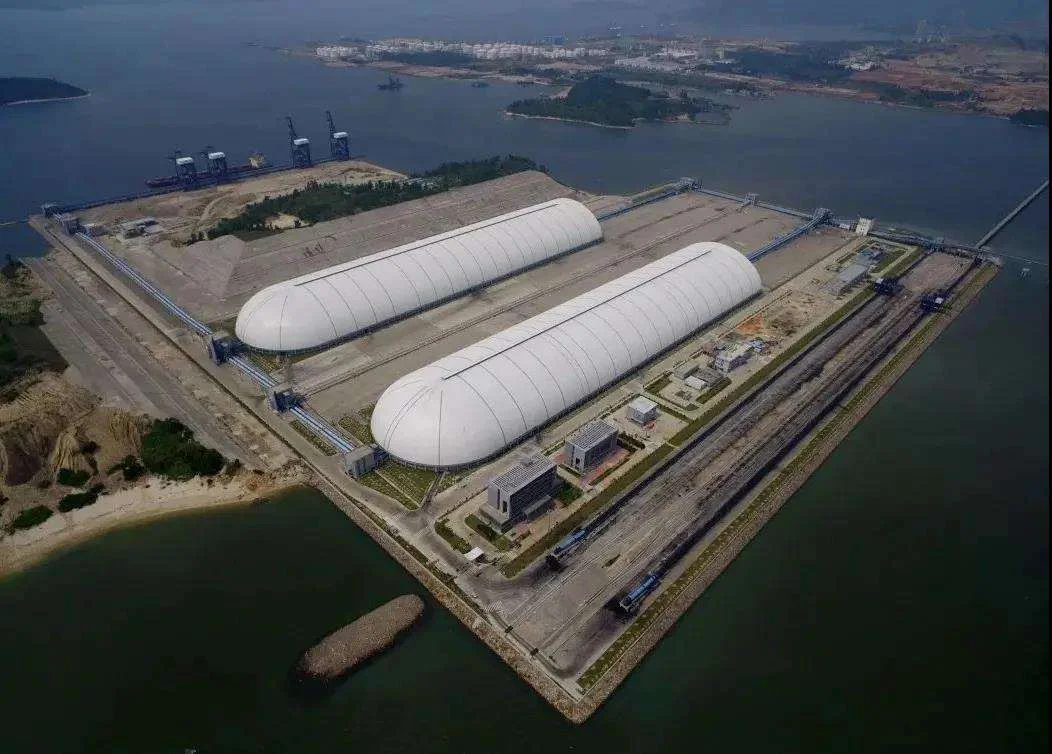
Huizhou Coal Yard
Enclosed coal storage facility with large-span grid structure, C5-rated anti-corrosion coating system, and wind-tunnel-verified design for coastal environment wind loads.
Planning a Coal Storage Shed?
Send us your stockpile volume requirement, stacker-reclaimer slewing radius, site wind and corrosion data, and required clear span. Our engineering team will respond within 24 hours with a structural system recommendation (grid vs beam-string), anti-corrosion specification, and budget quotation — backed by world-record 229m span experience.
Email: market@permanentsteelstructure.com | WhatsApp: +86 18621689980 | Phone: +86 516-83269982