Steel H Beam — Fabricated on a Line, Not by Hand and Hope
Every steel fabricator cuts and welds H-beams. Permanent Steel operates a self-developed intelligent H-beam production line with CNC assembly, twin-wire submerged arc welding, and automatic flange straightening — producing beams to tighter tolerances than manual fabrication, at roughly three times the throughput.
The Difference Between Welding an H-Beam and Producing One
In a conventional fabrication shop, an H-beam is a manual assembly task. A fitter positions two flange plates against a web plate, tack-welds them by hand, and a welder runs single-wire fillet welds along both sides — twice, once per flange. Beam length is cut to a steel tape measurement. Flange squareness is whatever the fitter's eye and the tack welds produce. Straightness is checked with a string line, and only if somebody thinks to check. It is slow, it is inconsistent, and the process quality lives entirely inside one welder's skill.
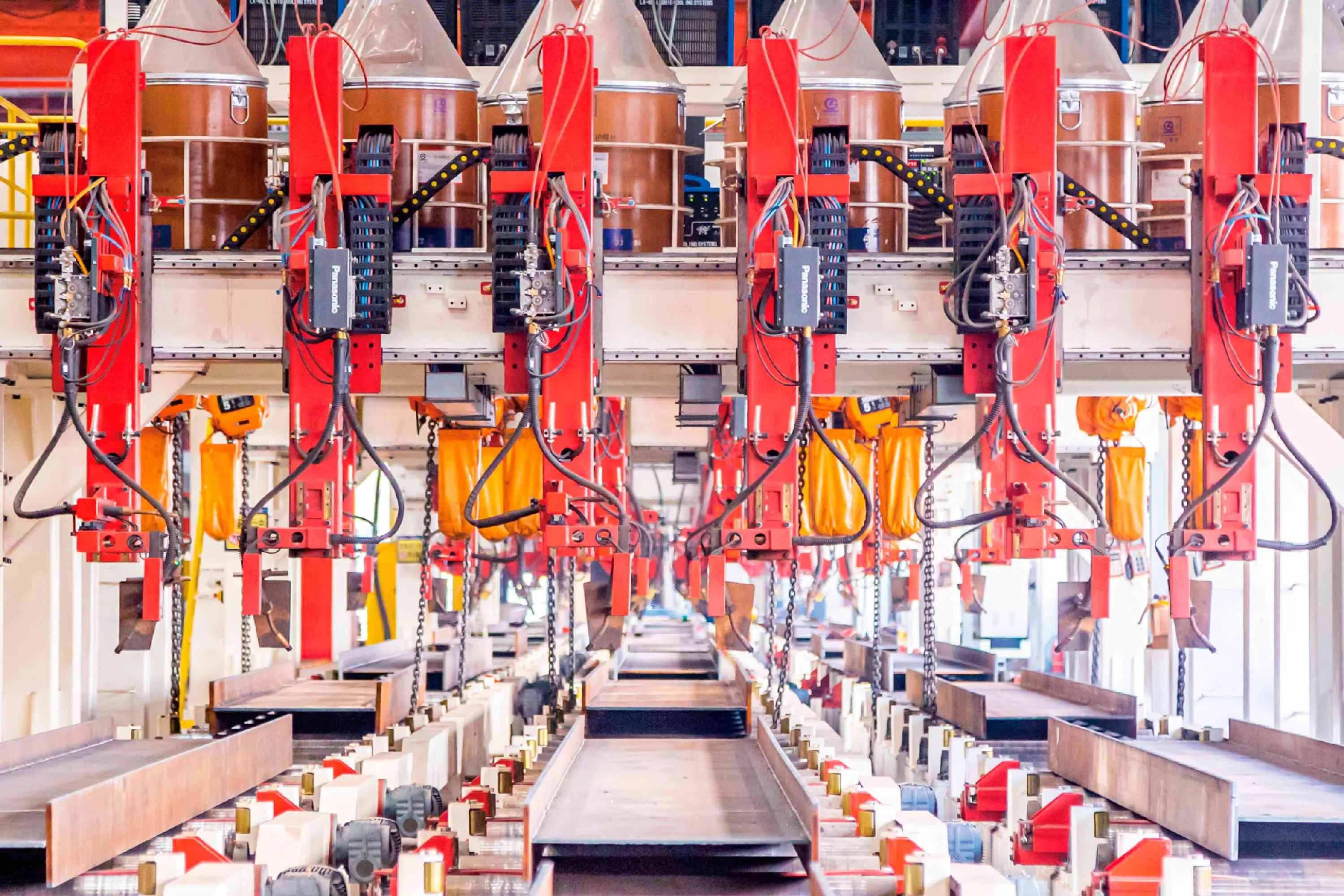
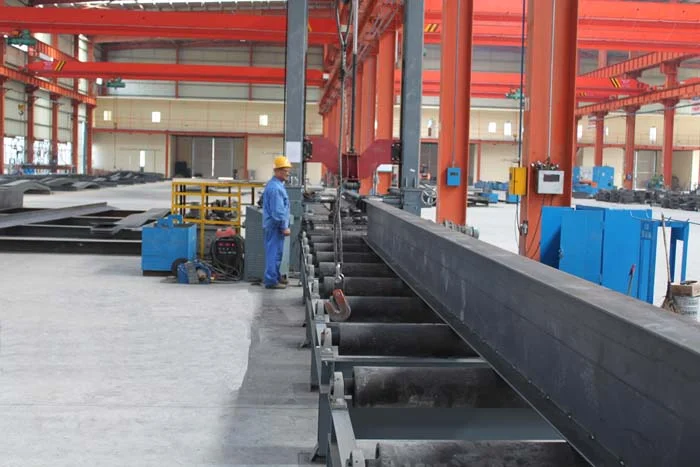
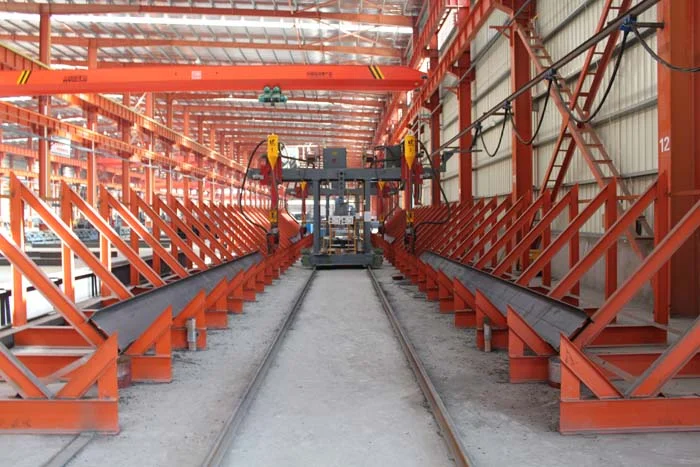
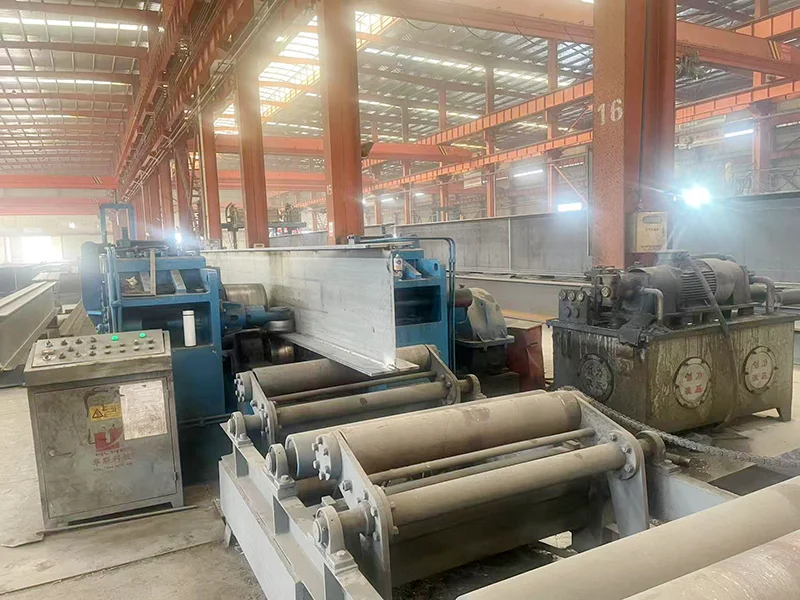
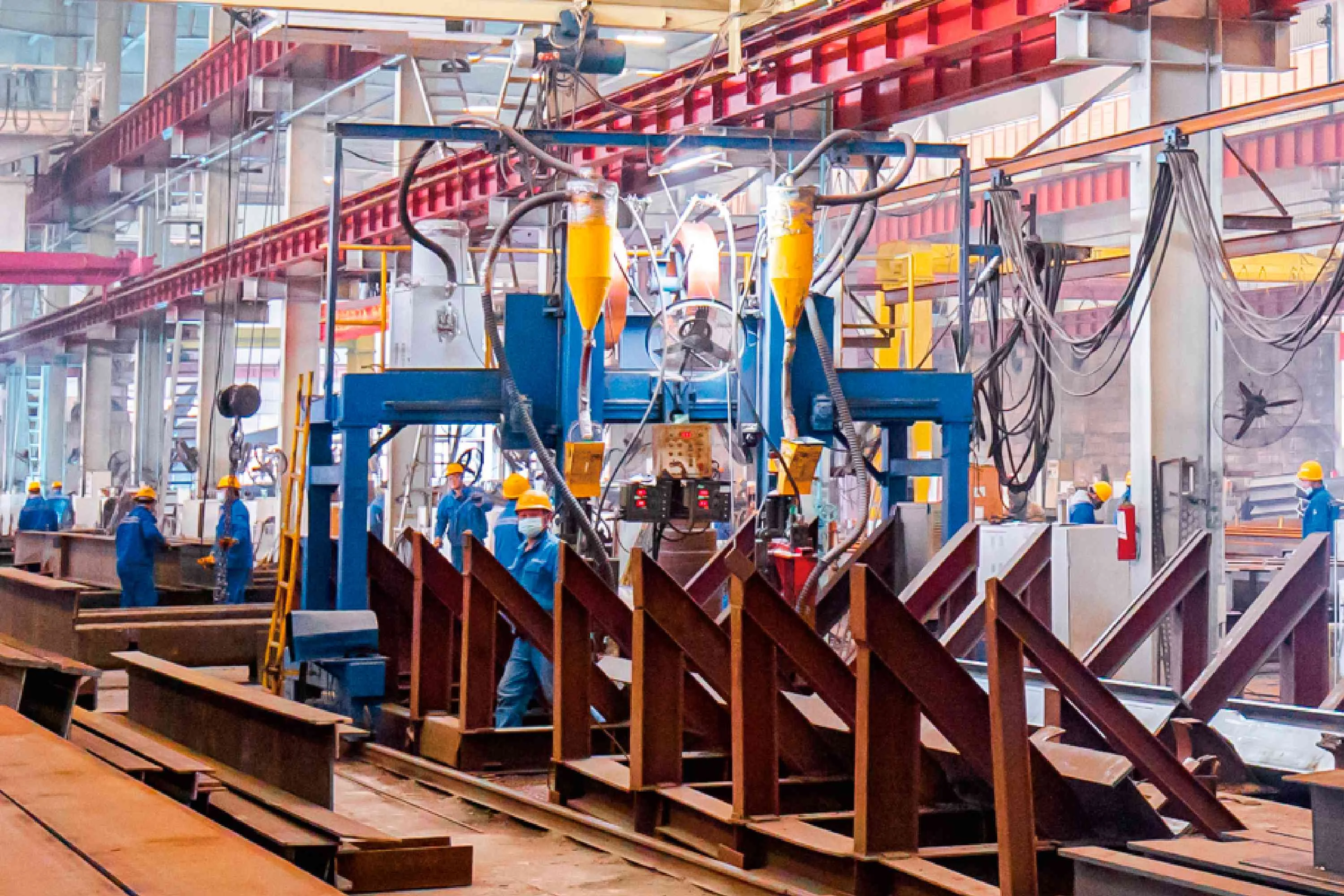
Permanent Steel operates a fundamentally different system: a self-developed intelligent H-beam production line. Cutting, assembly, welding, and straightening are machine-controlled against the beam's shop drawing. The assembler holds web and flanges in CNC-positioned clamps before a single weld is struck — so section geometry is set by machine, not by tack-weld shrinkage. Twin-wire submerged arc welding deposits both flange welds continuously and uniformly. A hydraulic straightening press then corrects residual distortion, and shot blasting prepares the surface for coating in the same pass.
The result is a beam fabricated to dimensional tolerances that manual shops quote but rarely hold: flange squareness controlled, camber and sweep corrected, weld quality consistent from the first metre to the last. And because the line runs on machine time rather than welder fatigue, it produces at roughly three times the throughput of a manual bay — which is why we can commit to delivery programmes measured in weeks, not seasons.
H-Beam Types: Rolled Sections and Welded Built-Up Beams
Structural H-beams come in two families with different metallurgy, tolerances, and supply economics. We supply both, and we will advise which one your frame actually needs.
Hot-Rolled H-Sections (HW / HM / HN)
Hot-rolled H-beams are produced at the steel mill by rolling a single billet into the I/H profile. The section is uniform along its length, the corners are radiused, and the material is homogeneous. They are the economical answer for standard column and beam sizes where the catalogue section fits the design load — the majority of conventional building frames.
- HW series — wide flange, square profile; column duty, high axial capacity
- HM series — medium flange; general framing, columns and girders
- HN series — narrow flange, tall profile; beam duty, high bending efficiency
Rolled sections up to 1,000 mm in depth and 64 mm in flange are supplied from certified mills, or from our own stock for the common grades and sizes.
Welded Built-Up H-Sections
Where the design requires a section that no rolling mill produces — a depth deeper than a mill's pass, a flange wider than its maximum, a hybrid grade (e.g., Q355B web with Q420B flanges), or a tapered member — the beam must be built up by welding plates. This is the class where fabrication quality decides structural performance, and it is the class where our intelligent line earns its keep.
- Depth range: 200–2,000 mm
- Flange width: 150–1,000 mm
- Plate thickness: 6–40 mm and beyond
- Length: up to 20,000 mm in one piece, splicing by design
If your project needs built-up sections, you are not buying a catalogue product — you are commissioning a bespoke structural member, and the fabrication process below is exactly how we deliver the tolerance you design to.
Inside the Intelligent H-Beam Line: Six Controlled Steps
Every beam on the intelligent line passes through the same controlled sequence. Each station is a quality gate, and the process is designed so that faults are caught in the shop — not on the erector's hoist.
Step 1 — CNC Plate Cutting
Web and flange plates are cut on CNC multi-torch straight-line cutting machines, with dimensions programmed directly from the shop drawing. Cut edge quality, squareness, and length tolerance are machine-set, not tape-measured. Plate thickness up to 40 mm is handled routinely; thicker plate is produced on the heavy cutting stations.
Step 2 — CNC Assembly
The H-beam assembler clamps the web and both flanges into CNC-positioned alignment. Contact surfaces are automatically cleaned before assembly, and the sections are tack-welded while held in true geometry. This is where the profile is born correct: web centring and flange squareness are set by machine, before weld shrinkage can distort them.
Step 3 — Twin-Wire Submerged Arc Welding
Flange-to-web welds are deposited with twin-wire submerged arc welding (SAW) — two wire electrodes feeding one molten pool under a granular flux. The process delivers high deposition rates, deep penetration, and a smooth, slag-covered weld that is protected from atmospheric contamination. Both sides of the web are welded in sequence to balance distortion, with weld size per the design (typically 0.5–0.7 times the web thickness for fillet, or full-penetration where specified).
Step 4 — Hydraulic Straightening
Welding inevitably introduces residual distortion. The H-beam hydraulic straightening machine presses the flanges and web back to spec — flange squareness, beam sweep, and camber are corrected mechanically and verified against the tolerance table, rather than accepted as "normal welding distortion."
Step 5 — Drilling, Notching & Machining
Connections (end plates, stiffeners, bolt holes, coping) are machined or CNC-drilled after straightening, so the beam arrives at site as a ready-to-connect member with accurate geometry. Field re-drilling — the most common source of site-borne corrosion — is eliminated by design.
Step 6 — Shot Blasting & Coating
Every beam passes through the shot blasting machine, which cleans the surface to Sa2.5 and gives the coating system the profile it needs to bond. Primer is applied under controlled conditions, and finished beams are marked, bundled, and documented for despatch.
Steel Grades and Material Traceability
Beam performance starts with the plate. We purchase certified structural steel and verify it twice: once against the mill certificate at intake, once against the test report we retain per project.
| Grade (GB/T) | Yield ≥ MPa | Tensile MPa | Typical Use | Usual Approx. Equivalents |
|---|---|---|---|---|
| Q235B | 235 | 370–500 | Secondary members, bracing, low-rise framing | S235JR, A36, SS400 |
| Q355B | 355 | 470–630 | Primary beams and columns — the workhorse grade | S355JR, A572 Gr.50, SM490 |
| Q390B | 390 | 490–650 | Heavy framing, long-span members, snow-heavy regions | S390, A572 Gr.60 class |
| Q420B | 420 | 520–680 | High-load columns, heavily loaded hybrid sections | S420, A572 Gr.65 class |
Material is the one variable a fabrication line cannot fix later; if the chemistry is wrong, the weld procedure is void and the beam's capacity does not exist. Every coil and plate is therefore documented with its certificate number, heat number, and test result, and those records accompany the beam through fabrication and into the project file — traceable from the erection drawing back to the mill, at any point in the building's life.
For earthquake regions and temperature-sensitive applications we also supply the sub-grade variants (C, D, E) with additional Charpy impact testing per the governing code, and we will advise the correct grade with the impact requirement for your project climate and seismic zone.
Tolerances and Testing: What "Fabricated to Spec" Actually Means
The questions that separate a competent fabricator from a superior one are tolerances and testing — not weld appearances. We fabricate welded beams to the dimensional tolerances of GB/T 11263 (hot-rolled) and the fabrication tolerances of the project design code (typically GB 50205), holding:
- Section height: ±3 mm for depths to 1,000 mm
- Flange width: ±4 mm, web centring within half the web thickness
- Flange squareness: typically within 2 mm across the flange width
- Overall length: ±2 mm on shop-cut lengths, ends squared
- Straightness: sweep and camber corrected and checked after straightening
Welds are verified by a documented control plan: visual inspection and dimensional checks on every member, ultrasonic testing (UT) on full-penetration welds and on heavy sections where the code requires it, and weld mapping per beam marked on the shop record. Welders are qualified to the applicable standard, and WPS/PQR documentation is maintained for every joint type we produce — without it, the welding above is only decoration.
Intelligent Line vs. Manual Fabrication
| Parameter | Intelligent Line | Typical Manual Shop |
|---|---|---|
| Assembly positioning | CNC clamps set geometry | Fitter's eye and tacks |
| Flange welding | Twin-wire SAW, continuous | Manual single-wire welding |
| Distortion control | Hydraulic straightening press | Hammer and flame correction |
| Throughput per bay | ≈3× manual | Baseline |
| Consistency | Member to member, shift to shift | Dependent on welder |
Welding Process Control: The Science Behind the Seam
A welded H-beam succeeds or fails at the weld — and the weld succeeds or fails according to three controlled variables: heat input, joint preparation, and the sequence in which the passes are laid. On the intelligent line, each of those variables is set, not improvised. The flange-to-web fillet welds are laid by twin-wire submerged arc welding (SAW) heads running at controlled travel speeds, with the wire feed and voltage logged per beam; a manual shop depends on the welder's eye and mood. The result is a weld of uniform leg length, consistent penetration, and predictable distortion — which is precisely what the straightening press is then able to control.
Joint preparation matters just as much as the deposit itself. Flange edges are bevelled on the CNC plate cutting line to the documented joint geometry, the fit-up gap between web and flange is held by the CNC assembly clamps, and the assembly is tacked in a sequence that prevents the parts from pulling apart during production welding. For heavy sections — flanges beyond 40 mm, or where the design demands full-penetration welds — the procedure includes preheat requirements, interpass temperature control, and designated electrode/flux combinations qualified by the project's WPS/PQR. These are not abstract values: they are written into the shop traveller for the beam, executed by qualified welders, and verified by the inspection plan before the member leaves the bay.
The quality logic behind the process control is simple to state: uniform, documented heat input produces uniform residual stress; uniform residual stress produces beams that stay straight after despatch and behave predictably under live load. A beam welded by a skilled welder on a good day and by an apprentice on a bad one is not a "quality product with variation" — it is two different products. The intelligent line exists to make every day a good day, which is why the dimensional stability of our beams is the property that erectors notice first and owners benefit from for the life of the building.
Where the design calls for it, we also run the manufacturing sequence in the direction of the finish: full member assembly and welding, corrective straightening, and then shot blasting to Sa 2½ before priming at a controlled dry-film thickness. The protective coating is applied to a clean, graded surface — not over mill scale and weld spatter — so the paint system's warranty period is measured against the surface it was qualified on.
H-Beams Across the Structural Spectrum
Industrial Buildings
Primary frame columns, crane girders, and roof beams for workshops and plants, including built-up sections to the deep, stiff profiles that heavy crane loads demand.
Portal Frame Structures
Tapered rafters and columns for warehouses and logistics buildings — often fabricated from built-up H-sections and then tapered in the web to follow the bending moment envelope (see our tapered steel beam).
Bridges & Infrastructure
Beam girders for highway and pedestrian steel bridges, with full-penetration welds, improved steels, and strict straightness and flatness requirements for deck installation.
High-Rise Framing
Columns and transfer girders in multi-storey buildings, coordinated with the cross-to-box column system where the column section must transition from cross-shaped to box-shaped through the height of the frame.
One Campus, the Whole Supply Chain
The intelligent H-beam line operates inside a 100,000 m² workshop complex on a 300+ mu base in Xuzhou, Jiangsu — the same campus as our box-column thick-plate facility, tube-bundle and rebar-truss lines, envelope production line, and heavy assembly bays. Plates arrive certified, beams ship as complete members with finish, and the design engineering, detailing, fabrication, and (where contracted) erection supervision are all performed in-house.
That vertical integration changes the framing of a procurement decision. A building owner buying fabricated H-beams from us is buying the engineering that sizes them (our 50+ R&D engineers and structural designers), the line that builds them to tolerance, the qualification that lets us erect them (six top-level qualifications), and the single-contract accountability that makes a failure someone's problem — ours, not a chain of subcontractors each blaming the other.
For project managers comparing fabricators, the practical test is simple: ask for the section dimensional tolerance you designed to, ask for the WPS and the welder qualifications, ask for the UT report on full-penetration joints — and ask how many beams a month the shop actually produces. The answers you get will tell you whether you are buying from a line or from a bay.
The campus also carries the finishing and logistics chain that keeps programme promises: shot blasting and priming bays, surface-preparation control for paint adhesion, storage and marshalling areas for finished members, and transport coordination for each delivery batch. Beams leave the plant cleaned, primed to the specified dry-film thickness, marked with member identification for the erection sequence, and accompanied by the inspection documentation for the batch. For export projects the packaging specification — dunnage, moisture protection, and bundling for container or break-bulk shipment — is engineered with the same formality as the welding, because a beam that arrives scored, wet, or bent is a beam that was never really delivered. When the erector unloads a batch and finds every member straight, marked, and dry, that is the supply chain working as designed — and it is precisely the reliability a construction programme is built on.
Steel H Beam Questions from Engineers and Buyers
What is the maximum plate thickness you weld into an H-beam?
Our standard line handles plate up to 40 mm thickness as routine; heavier plate is welded on the heavy fabrication stations, and we confirm capability and welding procedure against your section size before quoting. Thickness beyond 40 mm involves preheat control and additional NDT levels, which we spec per code.
Can you fabricate tapered H-beams for portal frames?
Yes — tapered webs and flanges are cut by CNC and assembled on the line. For the design economics and tolerances of tapered members, see the tapered steel beam page.
Do you supply hot-rolled sections from stock?
Common grades and sizes (Q235B and Q355B, HW/HM/HN series) are stocked; special grades and sizes are mill-ordered with the project's certificates. Either way, all material is traceable to its heat and certificate.
What certification do you hold for fabrication?
We hold top-level national qualifications including steel structure manufacturing and erection grades, plus ISO system certifications, and our welders and NDT personnel are qualified under the applicable codes. Specific certificates are listed on our qualifications page.
Do you provide fabrication drawings and connection design?
Yes. Detailing, connection design, and shop drawing production are performed in-house by our engineering team, including 3D modelling integration with the frame design — beams are fabricated to the exact geometry the erector connects, not to a drawing that lives in a different format than the site uses.
Get H-Beams Fabricated to Your Section Schedule
Send your member list, steel grades, and delivery programme. Our engineers will confirm the fabrication route — rolled or built-up — and return a quotation with tolerances and NDT scope within 48 hours.
Request H-Beam Quotation