
Steel Structure Anti-Corrosion Systems: ISO 12944 Guide
Corrosion is the silent enemy of steel structures. Unlike a structural failure, which is sudden and dramatic, corrosion is gradual — a progressive loss of section thickness that reduces load capacity over years or decades. A steel structure designed for 50 years of service can fail in 15 years if the anti-corrosion system is inadequate for the environment. The cost of remediation after corrosion has begun is typically 5-10 times the cost of a proper protective coating system applied during fabrication.
ISO 12944 is the international standard for protective coating systems on steel structures. It provides a systematic framework for selecting coating systems based on the corrosivity of the environment, the desired service life, and the surface preparation method. This guide explains the ISO 12944 framework and applies it to real project scenarios from our portfolio, including the Antarctic Ross Sea Station (C5-M environment) and the Ningxia coal shed (C4 environment).
1. ISO 12944 Environment Classification: C1 through C5
ISO 12944-2 classifies atmospheric corrosivity into six categories based on the mass loss of unprotected steel reference specimens exposed for one year. The categories represent the first-order filter for coating system selection:
| Category | Corrosivity | Steel Mass Loss (μm/yr) | Typical Environment |
|---|---|---|---|
| C1 | Very Low | ≤ 1.3 | Heated buildings, clean atmospheres (offices, schools) |
| C2 | Low | 1.3 - 25 | Unheated buildings, rural atmospheres with low pollution |
| C3 | Medium | 25 - 50 | Urban/industrial atmospheres, moderate SO2, coastal areas with low salinity |
| C4 | High | 50 - 80 | Industrial areas, coastal areas with moderate salinity, chemical plants |
| C5-I | Very High (Industrial) | 80 - 200 | Heavy industrial areas, high humidity, aggressive atmospheres |
| C5-M | Very High (Marine) | 80 - 200 | Coastal/offshore, high salinity, Antarctic/coastal structures |
Additional Environmental Factors
Beyond the atmospheric category, ISO 12944 also considers environmental factors that can accelerate corrosion beyond the base category:
- Humidity and condensation: Structures in environments with sustained relative humidity above 80% (tropical, coastal, or enclosed humid spaces) experience corrosion rates 2-3 times higher than the base category suggests.
- Chemical exposure: Acid gases (SO2, H2S, NOx) from industrial emissions, alkalis from concrete contact, and chlorides from marine environments all accelerate corrosion. A structure in a C3 atmosphere with significant SO2 exposure may require C4 or C5 coatings.
- Immersion and splash zones: Structures in or near water (bridge piers, waterfront facilities, cooling towers) require special immersion-grade coatings, typically vinyl ester or glass-flake reinforced systems, regardless of the atmospheric category.
- Temperature extremes: High temperatures (>60°C) degrade organic coatings faster, while extreme cold (−40°C) embrittles standard coatings and accelerates cracking from thermal cycling.
2. Coating Systems per Environment Category
ISO 12944-5 specifies coating systems (combinations of primer, intermediate coat, and topcoat) for each environment category and service life range. The standard defines four service life ranges: Low (7-15 years), Medium (15-25 years), High (25-50 years), and Very High (>50 years). The following are the coating systems we use most frequently:
C2 (Low Corrosivity) — Medium Service Life
For rural or lightly polluted urban environments:
- System: Zinc-rich primer + alkyd topcoat
- Primer: Zinc-rich epoxy, 40 μm DFT
- Topcoat: Alkyd enamel, 40 μm DFT
- Total DFT: 80 μm
C3 (Medium Corrosivity) — High Service Life
For standard urban and industrial environments, which is the most common category for our projects in Xuzhou and surrounding areas:
- System: Zinc-rich primer + epoxy midcoat + polyurethane topcoat
- Primer: Zinc-rich epoxy, 60 μm DFT
- Midcoat: Epoxy micaceous iron oxide (MIO), 80 μm DFT
- Topcoat: Aliphatic polyurethane, 50 μm DFT
- Total DFT: 190 μm
C4 (High Corrosivity) — High Service Life
For industrial environments including coal yards, power plants, and chemical processing facilities. This was the system used on the Ningxia coal shed:
- System: Zinc-rich primer + two epoxy midcoats + polyurethane topcoat
- Primer: Inorganic zinc-rich, 75 μm DFT
- Midcoat 1: Epoxy MIO barrier, 100 μm DFT
- Midcoat 2: Epoxy MIO barrier, 100 μm DFT
- Topcoat: Aliphatic polyurethane, 60 μm DFT
- Total DFT: 335 μm
The double epoxy midcoat provides a thicker barrier to water and chemical ingress. The inorganic zinc-rich primer provides cathodic protection (the zinc acts as a sacrificial anode, protecting the steel substrate even if the coating is locally damaged). This system, properly applied, provides a maintenance-free service life of 25+ years in a C4 environment.
C5-M (Marine, Very High) — Very High Service Life
For marine environments, coastal structures, and polar installations. This is the system used on the Antarctic Ross Sea Station:
- System: Zinc-rich primer + three epoxy midcoats + polyurethane topcoat
- Primer: Inorganic zinc-rich, 75 μm DFT
- Midcoat 1-3: Epoxy MIO barrier, 3 × 100 μm DFT
- Topcoat: Aliphatic polyurethane (low-temperature flexible grade), 60 μm DFT
- Total DFT: 435 μm
The thicker barrier (300 μm of epoxy) provides the resistance to chloride and moisture penetration needed for a 50+ year service life in a marine environment. The low-temperature flexible polyurethane topcoat retains elongation at −40°C, accommodating thermal movement without cracking — a critical requirement for the Antarctic environment.
3. Surface Preparation: Sa 2.5 Blast Cleaning
The performance of any coating system depends on the quality of the surface it is applied to. ISO 8501-1 defines surface preparation grades for blast-cleaned steel:
- Sa 1: Light blast cleaning. Removes loose mill scale, rust, and coatings. Not suitable for protective coating systems.
- Sa 2: Thorough blast cleaning. Removes nearly all mill scale, rust, and coatings. Acceptable for C2-C3, Low-Medium service life.
- Sa 2.5: Very thorough blast cleaning. Removes all mill scale, rust, and coatings, with only faint traces remaining. The standard for C3-C5, High-Very High service life. This is our default for all structural steel.
- Sa 3: Blast cleaning to visually clean steel. All mill scale, rust, and coatings removed, with a uniform metallic surface. Required only for special applications (thermal spray, nuclear).
Surface Profile (Roughness)
Beyond cleanliness, the surface must have an appropriate roughness profile for the coating to adhere. The profile is characterized by the maximum peak-to-valley height (Rz), measured with replica tape or a surface profile gauge. ISO 12944 recommends a surface profile of:
- 50-85 μm Rz for coatings with DFT ≤ 100 μm
- 60-100 μm Rz for coatings with DFT 100-300 μm
- 80-120 μm Rz for coatings with DFT > 300 μm
The rule of thumb is that the surface profile should not exceed 1/3 of the primer DFT. If the profile peaks exceed the primer thickness, the peaks will be exposed above the coating, creating a pathway for corrosion to initiate. For our C5-M system with 75 μm zinc primer, we specify a profile of 50-70 μm Rz, which is well within the 1/3 rule (75 μm / 3 = 25 μm minimum profile height needed for adhesion).
Abrasive Media Selection
The surface profile depends on the abrasive media. We use:
- Steel grit G24 (0.6-1.0 mm) for structural steel: produces a sharp, angular profile of 60-90 μm Rz, ideal for epoxy systems.
- Steel shot S230 (0.6-0.8 mm) for surfaces requiring a smoother profile (architectural steel, surfaces visible to occupants): produces a rounded profile of 40-60 μm Rz.
- Garnet (0.5-1.0 mm) for stainless steel and aluminium: does not embed iron particles (which would cause galvanic corrosion on non-ferrous substrates).
4. Dry Film Thickness (DFT) Specifications and Verification
The total DFT is the primary specification for a coating system. Each coat has a specified DFT range, and the total must fall within the system specification. DFT is measured with a magnetic gauge (for steel substrates) at specified locations:
- Flat surfaces: 5 readings per 10 m2, evenly distributed.
- Complex geometries (nodes, intersections, edges): 3 readings per surface, focusing on areas where coating thinning is likely (edges, corners, weld profiles).
- Acceptance criteria: 80% of readings must be within the specified range. No individual reading may be below 80% of the specified minimum or above 120% of the specified maximum.
Areas prone to coating thinning require special attention:
- Edges and corners: Surface tension causes liquid coating to pull away from sharp edges, reducing DFT by 30-50%. We specify stripe coating (a thick, manually applied coat) on all edges before the full coat.
- Weld profiles: Irregular weld beads create valleys where air pockets can trap moisture. We grind welds smooth to a radius of 2-3 mm before coating, and apply a stripe coat to the weld zone.
- Bolt heads and nuts: The hexagonal geometry creates edges that thin the coating. Stripe coating is required, and the DFT on bolt heads is measured separately.
- Interior surfaces of hollow sections: Cannot be blast-cleaned or coated after fabrication. We seal the ends with welded end caps or use sealant to prevent moisture and air exchange that would cause internal condensation.
5. Service Life Prediction and Maintenance Planning
ISO 12944-5 provides a framework for predicting the time to first major maintenance based on the environment category, coating system, and DFT. The "service life" in ISO 12944 does not mean the coating fails at the end of this period — it means the coating reaches the point where over 15% of the surface area requires repair (Ri 3 on the ISO 4628 rust grade scale).
For our standard C4 system (zinc primer + double epoxy + polyurethane, 335 μm total DFT), the predicted service life is:
- First maintenance inspection: Year 10 (visual inspection, adhesion test, DFT verification)
- Minor repair (localized coating breakdown, <5% area): Year 15-20
- Major maintenance (15%+ area requires repair): Year 25-30
- Full recoating: Year 35-40 (if the structure is still in service)
For the C5-M Antarctic system (435 μm total DFT), the predicted service life is:
- First maintenance inspection: Year 15
- Minor repair: Year 25
- Major maintenance: Year 40-50
These predictions assume proper surface preparation, correct application, and no mechanical damage during service. They are based on ISO 12944-5 tables and are consistent with our field experience on similar projects.
6. Project Examples: ISO 12944 in Practice
Coal Storage Shed (C4 Environment)
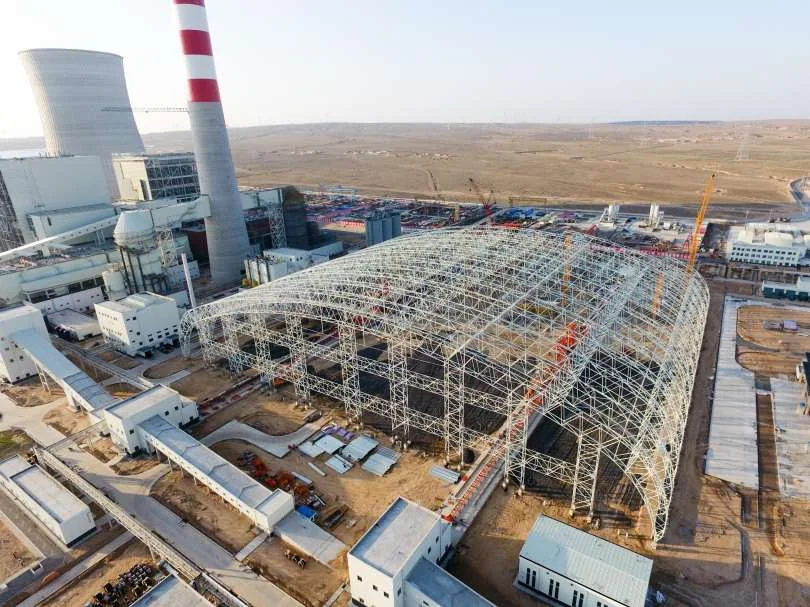
Our 229-metre coal shed at the Guodian Ningxia Power Plant is a C4 environment: high dust loading, moderate humidity, occasional acid rain from nearby coal combustion, and no marine salt influence. The coating system is the C4 High system described above (zinc + double epoxy + polyurethane, 335 μm total DFT). After 8 years in service, the coating shows no significant degradation — the first maintenance inspection at year 10 is expected to confirm the system is performing as designed.
The coal shed environment presents a special challenge: coal dust is hygroscopic (absorbs moisture from the air), creating a damp layer on the steel surface that can accelerate corrosion in areas where the coating is thin or damaged. The double epoxy midcoat provides the moisture barrier needed for this environment, and the polyurethane topcoat's smooth surface resists dust accumulation.
Antarctic Ross Sea Station (C5-M Environment)
The Antarctic Ross Sea Station is a C5-M environment: salt-laden air from sea spray, high UV radiation, extreme cold, and no possibility of maintenance for years at a time. The coating system is the C5-M Very High system (zinc + triple epoxy + low-temperature polyurethane, 435 μm total DFT). This system was selected because:
- The triple epoxy barrier (300 μm) provides the maximum resistance to chloride and moisture penetration available from organic coatings.
- The inorganic zinc primer provides cathodic protection, which is critical in an environment where coating damage cannot be immediately repaired.
- The low-temperature flexible polyurethane topcoat resists UV degradation and accommodates thermal movement without cracking, even at −40°C.
- The 435 μm total DFT provides a 50+ year predicted service life, matching the structure's design life without requiring maintenance that the environment makes impractical.
For more on the Antarctic project's engineering challenges, see our project case study and our cold-climate engineering guide.
7. Application Quality Control
A correctly specified coating system is only as good as its application. Our quality control during coating application includes:
- Climate monitoring: Air temperature, steel temperature, relative humidity, and dew point are monitored continuously during application. Coating is not applied when the steel surface temperature is less than 3°C above the dew point (the ISO 12944 minimum margin), or when relative humidity exceeds 85%.
- Abrasive cleanliness verification: The abrasive media is tested for chloride contamination (maximum 50 mg/m2) before use, because chloride embedded in the surface by contaminated abrasive will cause under-film corrosion even with a perfect coating system.
- Wet film thickness (WFT) monitoring: WFT is checked during application with a comb gauge to ensure the target DFT will be achieved after drying. This allows correction during application, before the coating has cured.
- Adhesion testing: After full cure (7-14 days depending on temperature), cross-cut adhesion testing (ISO 2409) or pull-off testing (ISO 4624) is performed on 0.1% of the coated surface. Minimum acceptable pull-off adhesion is 5 MPa for epoxy systems and 3 MPa for polyurethane.
- Holiday testing: For immersion and splash zone coatings, a high-voltage holiday detector (1.5-3 kV depending on DFT) is used to detect pinholes and coating discontinuities that are invisible to the naked eye.
8. Alternatives to Coating: Weathering Steel and Thermal Spray
While organic coating systems are the standard for most steel structures, two alternatives are worth noting:
Weathering Steel (Corten)
Weathering steel (grade Q355NH or Q460NH per GB/T 4171) forms a stable, self-renewing rust patina that provides corrosion protection without coating. The patina reduces the corrosion rate to approximately 5-10 μm/year (comparable to a C2 coating system). However, weathering steel is suitable only for environments where the patina can form and remain stable — it is not suitable for marine environments (chlorides prevent patina formation), high-humidity environments (continuous moisture prevents patina drying), or environments with high SO2 (acid rain dissolves the patina). We use weathering steel selectively for bridge components in rural, low-pollution environments.
Thermal Spray (Metallizing)
Thermal spray (typically zinc or aluminium, applied by wire-arc or flame spray) provides a metallic coating that offers both barrier protection and cathodic protection. Thermal spray zinc at 250 μm provides a service life of 30-50 years in C5 environments — longer than any organic coating system. The disadvantage is cost: thermal spray is 3-5 times more expensive than organic coating. We use thermal spray for immersion-zone components (bridge piers, waterfront structures) where organic coatings cannot achieve the required service life.
Conclusion
ISO 12944 provides a systematic framework for selecting anti-corrosion coating systems based on environment, service life, and surface preparation. The key to a successful system is matching the coating to the environment: a C2 system in a C5 environment will fail in 5 years, while a C5 system in a C2 environment is a waste of 50% of the coating cost. The engineering decision requires accurately classifying the environment, selecting the appropriate coating system, preparing the surface correctly, and applying the coating under controlled conditions.
Our manufacturing facility applies these systems daily, with full quality control documentation for every project. If you need a coating system recommendation for your steel structure, contact our engineering team with your site location, environment description, and desired service life, and we will provide an ISO 12944-compliant specification.
Need Expert Engineering for Your Steel Structure Project?
Our engineers bring 25+ years of experience specifying and applying ISO 12944-compliant coating systems for environments from rural China to the Antarctic coast. With Special-Class manufacturing qualifications and full quality control documentation, we deliver coating systems that last. Send us your project requirements today.
Request a Consultation