Karot Hydropower Plant — Curved Steel at High Precision
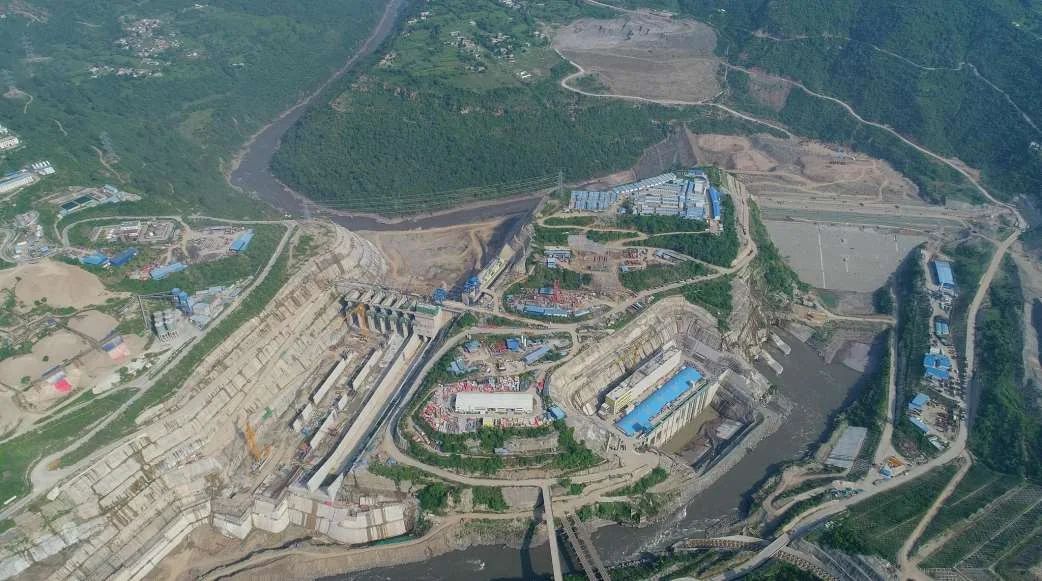
A curved H-shaped steel structure for the Karot Hydropower project on the Jhelum River in Pakistan — complex fabrication, demanding precision, and anti-corrosion protection specified far beyond Chinese domestic levels. Jiangsu Permanent Steel Structure Co., Ltd. fabricated steelwork for one of the flagship renewable-energy projects of the Pakistan-China economic corridor.
The Project at a Glance
Location: Karot, Punjab, Pakistan — on the Jhelum River | Facility: Karot Hydropower Project, a 720MW run-of-river hydroelectric plant developed under the China-Pakistan Economic Corridor (CPEC) | Structure delivered by Permanent Steel: curved H-shaped steel structure; complex fabrication with high precision requirements | Corrosion protection: anti-corrosion standards far exceeding China’s domestic levels.
Hydropower infrastructure sits where rivers and mountains meet — which means its steelwork must curve, twist and fit in spaces dictated by concrete, rock and water, while facing an environment built for destruction: humidity, splash, condensation and temperature swings. The Karot project’s curved H-shaped steel structure concentrated every one of those challenges into a single fabrication scope: geometry that had to be bent precisely, assembled to tight tolerances, and protected against corrosion to a standard that ordinary domestic steelwork never meets.
This case study examines each of those three engineering fronts — curved fabrication, precision control and international-grade anti-corrosion — and what they reveal about delivering to the standard of a hydroelectric scheme built for the national grid.
Fabricating Curved H-Shaped Steel
Curved H-shaped steel is the hinge of the whole project’s difficulty. Straight H-beams are factory products with predictable geometry; curved ones are fabrication challenges with a geometry that must be created, verified and preserved.
Producing the Curve
Curved members are produced by controlled bending — either incremental cold bending or heat-assisted forming — applied so that the section’s material properties, flange squareness and web flatness survive the process. The radius, the arc length and the location of the tangent points must match the design model, because a member that is straight where it should be curved, or curved by the wrong radius, will not fit its connections at either end. On this project, bend data were generated directly from the detailing model and verified member-by-member before any cutting of connections began.
Why Curved Members at a Power Station
Curved steel in hydropower buildings is rarely architectural decoration — it follows geometry dictated by function: roofs sweeping over turbine halls and gantry crane envelopes, members following the curved profiles of concrete structures, truss chords tracing the arch shapes that give the most efficient load path over irregular openings. The curve is not ornament; it is the structure adapting to the space the machinery and the river leave available.
Distortion Control During Assembly
Welding a curved member is more demanding than welding a straight one. Weld shrinkage acts on geometry that is already directional, and a curved chord can spring, twist or pull out of plane if sequencing and restraint are not controlled. Assembly was carried out in jigs that locked the design geometry, with balanced welding sequences and intermediate dimensional checks at each stage, so the finished member carried its curve — not its tolerances’ memory of being made.
High Precision on an International Project
Precision requirements on an international hydropower project are not a style choice — they are a compatibility requirement. The steelwork must fit against reinforced-concrete structures built to their own tolerances, against mechanical plant installed to manufacturer’s tolerances, and within a site crew working far from the factory that made the members.
Tolerance Stack-Up
Every fabrication tolerance accumulates. A column leaning by its allowance, a beam shortened by its allowance, a connection hole pattern drilled to its allowance — individually invisible, together fatal. Precision fabrication manages the stack-up: critical dimensions held to the tightest end of the code envelope, connection holes drilled from the model once geometry was verified, and splice joints trial-assembled in the workshop so that the fit the site will experience was proven in Xuzhou first.
Bolted Fit-Up at Distance
Field connections on export work are overwhelmingly bolted — they install faster, tolerate the modest misalignment that real sites produce, and avoid site welding that depends on local skill availability. But bolting transfers the precision burden to the holes: a hole pattern drilled 5 mm out is a connection that stops the erection crane. Our hole drilling and inspection regime treated every field connection as a fit-up test waiting to happen, with check fixtures and hole-pattern verification before release.
Measurement and Verification
High precision requires measurement discipline. Members were dimensionally verified in stages — after cutting, after assembly, after welding, after blast and paint — with the final survey matching the shipped geometry to the 3D model. On an export project the verification records travel with the steel, so the client’s inspectors can confirm at their own hold points that what arrived is what was designed.
Protection Far Beyond Domestic Standards
Perhaps the defining engineering requirement of the Karot scope was corrosion protection — specified at a level far exceeding Chinese domestic practice, and for good reason. The structure lives in and around a river valley: relative humidity that often sits above 80 %, airborne moisture from the reservoir, condensation cycles across every day, and splash and wetted exposure near water-associated plant. Under those conditions, ordinary shop paint fails within years and structural steel quietly loses section.
A Coating System Designed for the Exposure
The protective system was engineered against the project’s exposure category — a specification regime aligned with internationally recognized coating durability classifications, which for wet and humid industrial environments demands substantially more than a standard domestic spec. The system combined zinc-rich priming for cathodic protection at the steel surface, intermediate barrier coats and a durable finish, applied over blasted surfaces at verified cleanliness and profile, with each coat’s dry-film thickness logged to meet the specification rather than hope.
Edge, Weld and Damage Protection
Corrosion starts at edges, welds, drilled holes and handling damage — the places the general surface spec never reaches. Every flame-cut edge was ground to the profile the coating system requires; welds were dressed where necessary; and after fabrication, defined procedures restored the full protective build at every damage point. The last layer of protection is the discipline that treated the final touch-up as part of the specification, not as an afterthought.
Protection Through Transport
Between the shop in Xuzhou and the site at Karot lies an ocean voyage, port handling and inland road transport through a dusty, humid climate. Transit protection — sacrificial handling coatings, vapour barrier packing for critical surfaces, and documented damage-inspection procedures at each handover — ensured the coating arrived at site to do its job, rather than arriving as a repair legend.
The Karot Project Under CPEC
Karot is a run-of-river hydropower project on the Jhelum River, developed under the China-Pakistan Economic Corridor — a scheme of infrastructure, energy and transport projects connecting China and Pakistan. With its generating capacity feeding Pakistan’s national grid, Karot is part of the answer to a persistent challenge: bringing reliable, low-carbon electricity to a country whose demand has outrun its supply for decades.
For a steel fabricator, a CPEC project is a double examination. Technically, it demands international standards applied with Chinese manufacturing precision — the curved geometry, precision control and anti-corrosion specification described in this case study. Commercially and logistically, it demands delivery discipline across borders: documentation that satisfies two countries’ customs and inspection regimes, packing engineered for long transport, and scheduling that respects a site programme driven by river works and concrete, not by the convenience of a factory.
Projects like Karot are why export experience matters. They prove that a manufacturer can hold dimensional, coating and documentation standards at the level the most demanding clients specify — and they build the delivery muscle that only repeat international work creates.
Export Quality Control, Step by Step
The quality control system behind the Karot supply ran on defined stages, each with a gate that had to be passed by records, not by memory:
- Material control: heat-numbered material with certified chemistry and mechanical properties, traceable through every member shipped.
- Procedure qualification: welding procedures and welder qualifications qualified before production and available for client audit.
- Geometry verification: curved-member coordinates and connection geometry checked against the model at defined fabrication stages.
- Inspection hold points: welds examined by non-destructive testing; surfaces and coating verified by independent inspectors before dispatch.
- Full documentation: mill certificates, weld maps, NDT reports, coating logs, dimension reports and packing lists assembled into the delivery dossier.
This is the system that lets a client trust steel built 5,000 km from the site — and lets the steel arrive, fit, erect and protect as designed.
Complex Steel, World Standard
Karot was not a volume job. It was a complexity job: curved members, tight precision, corrosion protection beyond the familiar — the three fronts where commodity fabricators decline and competent ones are measured. That is exactly why we take on such scopes.
Curved fabrication exercises our heavy-shop bending and assembly engineering. Precision control exercises our measurement and QA systems. International anti-corrosion exercises our coating discipline to the standard of environments where protection is not a preference but a survival requirement. And the whole delivery — from drawing to dossier — is evidence that when a client anywhere in the world specifies the hardest version of a steel structure problem, there is a manufacturer in Xuzhou that has built the answer before.
Curvature Without Compromise: Forming and Dimensional Control
Curved members begin as straight ones; the question is what happens between the straight section and the delivered curvature, and what the curve costs in accuracy.
Cold and Thermal Forming, Judged Per Member
The forming route was selected for each member by its radius, section and steel grade. Gentle curves were formed cold, where controlled bending preserves the material’s properties and is by far the most economical route — but cold forming was only permitted within the limits that keep the steel’s ductility intact, with springback compensation worked into the bending calculations so the released curve met the design line rather than the loaded one. Tighter radii and heavier sections required thermal forming, where controlled, localised heating shapes the steel — a slower, more skilful process, executed under procedures that protect the material from overheating. The production plan did not guess which route each member needed; every curved piece was scheduled by its forming method with the geometry, gauges and inspection steps for that method defined in advance.
Measuring Curves, Not Assuming Them
A straight member is verified by a few dimensions; a curved member is verified by its whole shape. Formed pieces were checked against the 3D model using profile gauges and coordinate measurement, comparing the delivered surface to the design surface at defined stations — a curve that is accurate at its ends but wrong in its belly fails the same test and would misalign everything that bolts to it. The tolerance regime treated curvature as a dimension in its own right, and the shop’s jigs and templates were built from the same model data the detailers used, closing the loop between design intent and delivered geometry.
Joints on Curved Geometry
Connections on a curved member sit at an angle to everything else: brackets are orientated out of the plane of the web, splices land on sloped geometry, and bolt groups must still align when the two sides of a joint curve in different directions. Every connection on the curved steelwork was modelled and detailed three-dimensionally and trial-assembled before dispatch, because the tolerance that is invisible on a straight frame becomes a misalignment you cannot shim on a curved one.
The Anti-Corrosion System: Beyond Domestic Standard Practice
Anti-corrosion requirements on the Karot steelwork were specified well beyond typical Chinese domestic standard practice — a conscious response to a project located in a region and a contract environment where both parties expect the coating to be the building’s nervous system, not its paint.
The coating specification raised the demand on every link in the chain: surface preparation by blast cleaning to a higher roughness standard; zinc-rich or high-build systems applied to film thicknesses above routine practice; each coat inspected by dry-film-thickness gauges at a density designed to catch drift, not just sample it; and touch-up control so strict that the final film on welds, edges and bolt contact faces matched the specification of the main surfaces. Holiday testing sweeps verified continuity — the pinhole-free surface that a specification demands but only a full check confirms.
Edges received pre-treatment before coating — the sharp edge is where films thin and corrosion begins, so edges were rounded and sealed by specification rather than left to fail in ten years. The result is a corrosion system whose economics are deliberate: spend the marginal cost at fabrication, save the replacement cost of the next generation. When the specification exceeds domestic practice, the workshop’s job is not to argue with the specification — it is to execute it as a system, verify it as evidence and hand it over as a warranty the client can keep.
Precision as an Inspection Discipline
High precision is not a target the workshop aims at once; it is a discipline applied through every stage, because on curved geometry one stage’s tolerance error is the next stage’s impossibility.
Assembled Accuracy
The final proof of precision was trial assembly: framed members were assembled on the shop floor to their manufactured positions, with the connection distances, angular fits and overall envelope measured against the model before any member left the works. Trial assembly on complex export projects is not a rehearsal for the site — it is where the geometry is actually proven, and where the few millimetres of difference between drawing and reality are resolved while a crane, a ship and a site crew are not yet waiting.
Certified Evidentially
Every check produced a record — dimensional reports, inspection certificates, coating logs, weld examinations — that travelled with the shipment and satisfied the third-party supervision that export projects carry as routine. The high precision was not claimed in the brochure; it is on the record.
From Order to Shipment: Execution Under International Control
The Karot steelwork was executed as an international project from its first day: requirements agreed in writing, quality control documented against the specification, progress reported against a programme, and every deviation — fabricated, not hidden — agreed with the client’s engineers before it affected the works.
Packing and marking deserved as much engineering as the steel: members marked to the erection plan, arranged so the site receives what the lift sequence needs, protected against the sea voyage’s humidity, and documented so customs, transport and erection each read the same story. On projects where precision is measured in millimetres, the logistics are part of the precision — a member that arrives unmarked or damaged is a member that has failed its tolerance, no matter how well it was made.
The regularity the project demanded — of fabrication, of coating, of inspection, of paperwork — is what international engineering clients can actually hold. That regularity is the export capability itself.
Related Products and Technologies
Steel Components
Fabricated members with curved geometry, precision connections and verified material traceability.
Pipe Truss Structures
Curved and spatial truss systems fabricated to the same precision discipline.
Steel Structure Bridges
Export-grade bridge steelwork — another domain where precision and corrosion protection are non-negotiable.
Related Projects
Pakistan Tarbela Hydropower
H-shaped steel truss structure for the Tarbela complex — the other side of Pakistan’s hydropower build-out.
Indonesia Jinrui New Energy
250,000 m² of tropical-climate industrial steelwork across 90+ structures.
Tianjin R&F Guangdong Tower
Heavy-plate precision fabrication at home — the same discipline, a taller scale.
International-Grade Steelwork?
Curved fabrication, precision control and corrosion protection beyond domestic norms — ask us how we deliver complex steel to world standards.
Contact Our Export Team Our Capabilities