Tarbela Hydropower Station — Steel for Pakistan’s Power Grid
An H-shaped steel truss structure crowned with a concrete roof, fabricated by Jiangsu Permanent Steel Structure Co., Ltd. for the Tarbela Hydropower Station in Pakistan — steelwork built to international export standards for one of the world’s great hydropower complexes on the Indus River.
The Project at a Glance
Location: Tarbela, Khyber Pakhtunkhwa, Pakistan — on the Indus River | Facility: Tarbela Hydropower Station, among the world’s largest hydropower complexes | Structure delivered by Permanent Steel: H-shaped steel truss structure with concrete roof | Standard: international export fabrication and quality requirements.
Tarbela Dam holds back the Indus River in one of the largest water-storage schemes ever built. Its powerhouses convert that stored water into a significant share of Pakistan’s grid electricity — which means the buildings inside the complex are not ordinary utility structures. They house generating equipment that must run continuously for decades, in a hot valley climate, with vibration, humidity and the operational demands of a working power station. Those conditions governed the design and fabrication of the steel structure we supplied: an H-shaped steel truss framing system carrying a concrete roof.
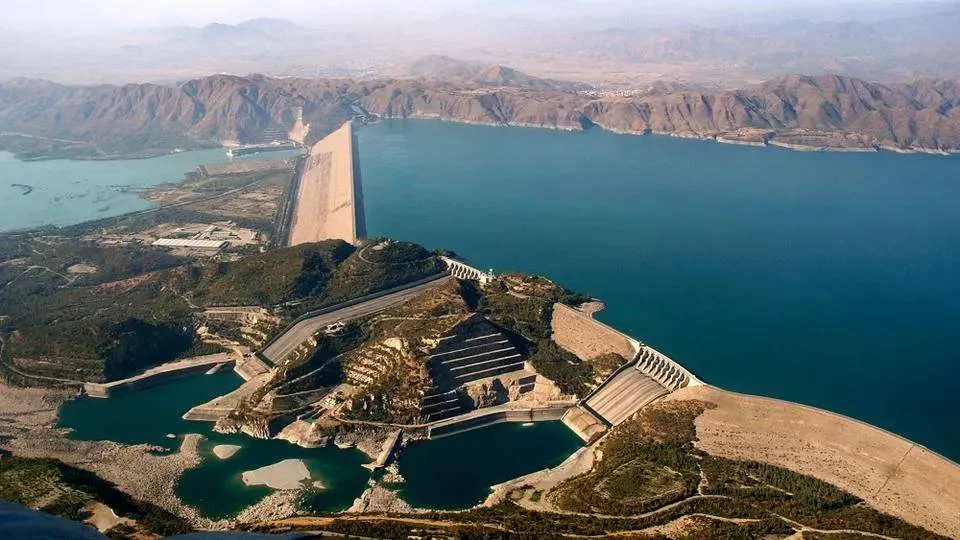
This case study covers the engineering logic of the H-shaped truss and concrete roof combination, the demands of hydropower buildings, and the export-quality systems that let steel fabricated in Xuzhou perform reliably on the Indus.
Why an H-Shaped Steel Truss
The H-shaped steel truss form is the workhorse of industrial building engineering — and on a hydropower station it earns its place against a specific set of requirements.
Span and Loads Above Generating Equipment
Hydropower buildings contain open volumes for turbine halls, gantry cranes and overhead equipment, with column grids arranged around the machines rather than around architectural convenience. The truss form spans those grids efficiently, using triangulation to convert roof weight and equipment loads into axial forces in its members — chords in tension and compression, diagonals distributing the shear. An H-shaped cross-section, fabricated from plates and standard sections, gives each member predictable stiffness in both directions and weldable, inspectable connections at every node.
The Concrete Roof Partnership
The structure’s roof is concrete — a deliberate pairing rather than a convenience. Concrete roof slabs over a steel truss provide a rigid horizontal diaphragm that distributes lateral loads back to the braced bays; they add mass to damp the vibration ranges that generating machinery and crane operation excite; and they deliver a durable, fire-tolerant cover over a facility where downtime for roof repair is a national-grid event, not a minor nuisance. The truss-to-slab interface was detailed so that composite behaviour and drainage both work: shear connection where the design required it, and engineered bearing details where the concrete sits on the steel.
Vibration and Machine-Induced Loads
Power station structures live with machines. Turbine-generator sets, transformers and travelling cranes impose dynamic loads that a normal building code never considers. The truss system was proportioned not merely for static strength but for the dynamic response the equipment introduces — with the roof mass and the structural stiffness tuned so that resonance with machine frequencies is avoided and serviceability stays comfortable for staff and plant alike.
What a Hydropower Building Requires
A power station building fails safe or fails often — there is no middle ground. The structure was engineered against the full set of facility demands:
- Continuous operation: generating stations run with minimal downtime. The structure had to be robust against decades of crane cycles, machine vibration and internal traffic without cumulative fatigue damage to connections.
- Humidity and condensation: the indoor climate around cooling water and machinery is humid. The steelwork’s corrosion protection was specified for an indoor industrial environment with condensation risk, plus the hot, dusty valley climate outside the envelope.
- Fire resistance: transformers, oil systems and electrical equipment concentrate fire risk. The concrete roof contributes inherent fire resistance, and the structure was detailed so that any fire protection required around critical plant remains effective over the facility’s life.
- Access and maintenance: catwalks, ladder access and clearance zones for crane maintenance were coordinated with the truss layout, so that operators can reach, inspect and maintain every corner of the building without ad hoc additions.
- Construction in an operating context: the steelwork had to erect safely within a congested plant environment, with members sized and spliced so they could be lifted and assembled around existing infrastructure.
Fabricating to International Export Standards
Fabricating steel in Xuzhou for a site on the Indus is a chain of verification from the first mill certificate to the final hold-point inspection before dispatch. Export work leaves no room for the informal shortcuts that a domestic project might absorb:
Material Certification Without Gaps
Every ton of structural steel in the Tarbela supply was backed by mill certificates traceable to its heat number — chemistry, mechanical properties and, where required, impact test data. The certification set was assembled and checked against the project specification before fabrication began, because steel already cut and welded cannot be un-cut when a document gap is found.
Standards Compliance and Equivalence
International projects are rarely specified in exactly the standard of the factory. The team reconciled the project’s requirements — referenced to British, American or European practice as specified — against our fabrication quality system, mapping weld procedures, testing frequencies and tolerance requirements to their equivalents so that compliance was demonstrated on paper and in practice, not assumed.
Third-Party Witnessing
Export steelwork is normally inspected by independent agencies representing the client and the contractor. On this project, defined hold points — material verification, welder qualification records, weld testing, dimensional release and final surface inspection — were witnessed and signed off, building the inspection dossier that accompanied the shipment to Pakistan.
International Logistics and Quality Control
Exporting steel structures is logistics engineering in its own right: the product must survive a sea voyage, port handling, inland transport and storage in a foreign climate — and arrive in the correct sequence, dimensionally intact and protected against corrosion.
Packing for Sea and Land
Members were packed in lifting-friendly bundles and containers with blocking, cushioning and edge protection calculated for ocean transport. Small parts — bolts, fittings and connection plates — were boxed and marked so that the site crew could match every bundle to its position in the erection sequence without guesswork.
Marine-Grade Transit Protection
The steel’s protective coating was specified knowing the cargo deck of an ocean vessel is a harsher environment than the building it is being shipped to build. Transit protection — vapour-corrosion protection, sealed packs for critical parts and touch-up procedures at port inspection — ensured the structure arrived as fabricated, not as a rusting approximation of it.
Documentation as Part of the Product
An international shipment travels with its documents, and on this project the documents were as engineered as the steel: marking plans that matched bundle numbers to drawings, packing lists reconciled against the bill of lading, and an inspection dossier that reached the client complete. For the engineer receiving the steelwork at Tarbela, the paperwork was the first quality inspection — and it passed.
Why Overseas Projects Matter
Pakistan-China economic corridor infrastructure has brought a wave of energy and transport projects to the region, and the Tarbela complex sits at the heart of Pakistan’s electricity system. Supplying its steel structure placed our work inside a critical national infrastructure story — electricity that powers homes, hospitals, industry and irrigation systems that feed millions.
For a steel manufacturer, overseas work is the strictest possible audit of capability. It demands standards equivalence, certification discipline, logistics competence and corrosion engineering beyond anything a domestic project forces. Every overseas delivery — and ours now span power, mining, transport and industry across Asia, Africa and beyond — is evidence that our fabrication does not merely meet Chinese industry practice; it meets the standards of clients who can choose any supplier in the world. That is the credential this project represents, and it is the standard we carry into every export enquiry we take.
Steel Grades and Material Security for a Power Facility
Export fabrication begins with material decisions, because the steel ordered is the steel built — there is no second sourcing cycle once fabrication is underway.
Grades Chosen for the Duty
Structural steel for the Tarbela structure was specified to the grades the design required, with guaranteed yield strength, verified chemistry and controlled weldability. The grade selection balanced strength against the welding economics of the truss members — the fabrication shop runs most efficiently when the steel and the procedures are developed together, and for a truss full of welded joints, weldability is a primary design property, not a secondary one.
Through-Thickness and Impact Properties
Wherever truss connections loaded plates through their thickness, through-thickness properties were specified to resist lamellar tearing under weld restraint — the classic hidden failure of heavily loaded plate connections. Impact toughness was verified for the temperature range the structure will actually see at Tarbela, so that the steel remains ductile under the facility’s operating conditions across decades of service.
Certification Without Gaps
Every plate and section carried its mill certificate: chemistry, mechanical properties and heat number, traceable through cutting, fabrication and shipment. For an export project the certification chain is inspected by third parties and the client’s engineers — a gap is not paperwork trouble, it is fabrication trouble. Material certification was closed out before any member entered production.
Fabrication and the Inspection Sequence
The fabrication of the truss structure ran through a defined inspection sequence, each stage gated by records:
- Material verification: heat numbers checked against mill certificates before cutting; test reports assembled into the project dossier.
- Welding control: procedures and welders qualified before production; consumables stored and controlled; welds executed with the specified preheat and inter-pass discipline.
- Non-destructive testing: welds examined to the required extent by qualified inspectors — ultrasonic, magnetic-particle and visual methods applied per the inspection plan, with every weld identity traceable.
- Dimensional verification: truss geometry — span, camber, node positions and connection alignment — measured and compared to the model at defined stages; trial assembly of representative bays proved field fit before dispatch.
- Surface and coating release: blast-cleaned surfaces verified, coating applied and dry-film thickness logged, holding points witnessed by independent inspection as required.
The sequence converted the confidence of the fabrication shop into documented evidence that travelled with the steel — the form of trust an international client can actually inspect.
Erecting Within a Working Power Station
One condition of the Tarbela site defines its erection engineering: the complex is a working power station. Construction shared space, access and attention with operating plant — and the steelwork had to be erected without causing a trip, a shutdown or an incident at a facility that cannot pause.
Designed Around Site Constraints
Members were detailed and spliced for the lifting equipment and access corridors available on site; the truss segments were sized so they could be delivered and placed within the spatial constraints of an operating plant, with rigging plans that avoided live equipment and kept clearances that the station’s safety regime demands.
Safe Integration with Operations
Erection proceeded under the station’s permit-to-work system, with temporary works — bracing, access platforms, scaffold — planned and cleared alongside the station’s own operations. The sequence was engineered so that each steel stage was stable and secure at the end of every working day, never left dependent on overnight holding — the standard that operating environments rightly insist on.
The lesson the site reinforced: steel structures are not just engineered for how they stand when finished, but for how they are placed in the environment where they are built. Both were engineered here, and both went as planned.
Standards Equivalence and the Dossier That Travelled
International steelwork is specified in the standards of the client’s engineers, fabricated in the standards of the workshop, and verified by inspectors fluent in both. The consensus between them is built the same way as the steel: piece by piece, documented.
Our fabrication quality system mapped the project’s requirements — material specifications, weld inspection frequencies, tolerance classes and coating performance — against the equivalents the workshop executes, so that compliance was demonstrated in both languages. The delivery travelled with a complete dossier: mill certificates, weld maps, NDT reports, dimensional records, coating logs, packing lists and the marking plans that tied every document to every member on the ship.
On export projects the documentation is not the by-product of fabrication — it is a deliverable as engineered as the steel. It is what lets a client, an inspector and a customs officer each verify that what arrived is what was designed, fabricated and paid for.
Related Products and Technologies
Pipe Truss Structures
Tubular truss systems for industrial and infrastructure buildings where span and strength combine.
Industrial Building System
Portal frames, truss systems and envelopes engineered for industrial facilities that cannot afford downtime.
Steel Components
Export-grade fabricated components with material traceability and full inspection dossiers.
What an International Hydropower Project Builds Into a Fabricator
Every export project leaves more behind than steel in the ground; it leaves capability in the factories that made it. The Tarbela work was engineered, fabricated and delivered under international supervision, and the disciplines it demanded became factory capability: weld procedures and NDT records accepted by third-party inspectors as routine; dimensional tolerances held in trial assembly rather than hoped for on site; coating systems verified for film thickness and holidays rather than assumed from a datasheet; and a documentation chain that turned every member into a fully traced, fully certified deliverable.
Those disciplines transfer directly to the next project, domestic or international. The lesson of working on a prestigious hydraulic facility is not that the steel was difficult — it is that the proof was the deliverable. The factory learned to build for verification: every process designed so its result can be inspected, recorded and handed over, which is the portrait of a fabricator an international client can commission with confidence. That is why Permanent Steel views overseas projects as investments in capability as much as contracts: each one raises the standard the next one starts from.
Related Projects
Pakistan Karot Hydropower
Curved H-shaped steel structure with anti-corrosion standards far beyond domestic requirements.
Indonesia Jinrui New Energy
250,000 m² industrial complex with 90+ steel structures and 9,000 tonnes of steelwork.
National Maritime Museum
Corrosion-resistant envelope engineering for a coastal national museum on the South China Sea.
Export-Grade Steel, Delivered Anywhere
From hydropower to heavy industry, we fabricate to international standards and ship to projects around the world. Talk to our export engineering team.
Request an Export Quote Why Choose Permanent Steel